Absolute continuity
Form of continuity for functions
In calculus and real analysis, absolute continuity is a regularity property of functions that is stronger than uniform continuity, and hence continuity. The notion of absolute continuity allows one to obtain generalizations of the relationship between the two central operations of calculus, differentiation and integration. This relationship is commonly characterized (by the fundamental theorem of calculus) in the framework of Riemann integration, but with absolute continuity it may be formulated in terms of Lebesgue integration. For real-valued functions on the real line, two interrelated notions appear: absolute continuity of functions and absolute continuity of measures. These two notions are generalized in different directions. The usual derivative of a function is related to the Radon-Nikodym derivative, or density, of a measure. We have the following chains of inclusions for functions over an interval:
- Lipschitz continuous ⊆ absolutely continuous ⊆ uniformly continuous ⊆ continuous
and, for a bounded interval,
- absolutely continuous ⊆ bounded variation ⊆ differentiable almost everywhere.
01Absolute continuity of functions
A continuous function fails to be absolutely continuous if it fails to be uniformly continuous, which can happen if the domain of the function is not compact, examples are tan(x) over [0, π/2), x2 over the entire real line, and sin(1/x) over (0, 1]. But a continuous function f can fail to be absolutely continuous even on a compact interval. It may not be "differentiable almost everywhere" (like the Weierstrass function, which is not differentiable anywhere). Or it may be differentiable almost everywhere and its derivative f ′ may be Lebesgue integrable, but the integral of f ′ differs from the increment of f (how much f changes over an interval). This happens for example with the Cantor function.
Definition
Let 


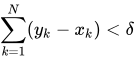
then
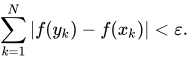
The collection of all absolutely continuous functions on 
Equivalent definitions
The following conditions on a real-valued function f on a compact interval [a,b] are equivalent:
- f is absolutely continuous;
- f has a derivative f′ almost everywhere, the derivative is Lebesgue integrable, and
for all x on [a,b];
- there exists a Lebesgue integrable function g on [a,b] such that
for all x in [a,b].
If these equivalent conditions are satisfied, then necessarily any function g as in condition 3. satisfies g = f′ almost everywhere.
Equivalence between (1) and (3) is known as the fundamental theorem of Lebesgue integral calculus, due to Lebesgue.
For an equivalent definition in terms of measures see the section Relation between the two notions of absolute continuity.
Properties
- The sum and difference of two absolutely continuous functions are also absolutely continuous. If the two functions are defined on a (bounded) closed interval, then their product is also absolutely continuous. On unbounded intervals this may fail: for example on
is absolutely continuous, but
is not even uniformly continuous.
- If an absolutely continuous function f is defined on a (bounded) closed interval and is nowhere zero then 1/f is absolutely continuous.
- Every absolutely continuous function (over an interval) is uniformly continuous and, therefore, continuous. Every (globally) Lipschitz-continuous function is absolutely continuous.
- If f: [a,b] → R is absolutely continuous, then it is weakly differentiable; conversely if f: [a,b] → R is weakly differentiable, then it coincides almost everywhere with an absolutely continuous function; this provides a characterization of Sobolev spaces on intervals of the real line.
- If f: [a,b] → R is absolutely continuous, then it is of bounded variation on [a,b].
- If f: [a,b] → R is absolutely continuous, then it can be written as the difference of two monotonic nondecreasing absolutely continuous functions on [a,b].
- If f: [a,b] → R is absolutely continuous, then it has the Luzin N property (that is, for any
such that
, it holds that
, where
stands for the Lebesgue measure on R).
- f: [a,b] → R is absolutely continuous if and only if it is continuous, is of bounded variation and has the Luzin N property. This statement is also known as the Banach-Zareckiǐ theorem.
- If f: I → R is absolutely continuous and g: R → R is globally Lipschitz-continuous, then the composition g
f is absolutely continuous. Conversely, for every function g that is not globally Lipschitz continuous there exists an absolutely continuous function f such that g
Examples
The following functions are uniformly continuous but not absolutely continuous:
- The Cantor function on [0, 1] (it is of bounded variation but not absolutely continuous);
- The function:
on a finite interval containing the origin.
The following functions are absolutely continuous but not α-Hölder continuous:
- The function f(x) = xβ on [0, c], for any 0 < β < α < 1
The following functions are absolutely continuous and α-Hölder continuous but not Lipschitz continuous:
- The function f(x) = √x on [0, c], for α ≤ 1/2.
Generalizations
Let (X, d) be a metric space and let I be an interval in the real line R. A function f: I → X is absolutely continuous on I if for every positive number
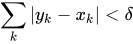
then:
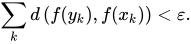
The collection of all absolutely continuous functions from I into X is denoted AC(I; X).
A further generalization is the space ACp(I; X) of curves f: I → X such that:
![d\left(f(s),f(t)\right)\leq \int _{s}^{t}m(\tau )\,d\tau {\text{ for all }}[s,t]\subseteq I](https://wikimedia.org/api/rest_v1/media/math/render/svg/87b73b94c7a308e4c1c4a8ef8303056556c7a0d7)
for some m in the Lp space Lp(I).
Properties of these generalizations
- Every absolutely continuous function (over a compact interval) is uniformly continuous and, therefore, continuous. Every Lipschitz-continuous function is absolutely continuous.
- If f: [a,b] → X is absolutely continuous, then it is of bounded variation on [a,b].
- For f ∈ ACp(I; X), the metric derivative of f exists for λ-almost all times in I, and the metric derivative is the smallest m ∈ Lp(I; R) such that:
![d\left(f(s),f(t)\right)\leq \int _{s}^{t}m(\tau )\,d\tau {\text{ for all }}[s,t]\subseteq I.](https://wikimedia.org/api/rest_v1/media/math/render/svg/c18f16867cf11735a9c9c10750aa0cb4594da971)
02Absolute continuity of measures
Definition
A measure 


In most applications, if a measure on the real line is simply said to be absolutely continuous, without specifying with respect to which other measure it is absolutely continuous, then absolute continuity with respect to the Lebesgue measure is meant.
The same principle holds for measures on Borel subsets of

Equivalent definitions
The following conditions on a finite measure
- For every positive number
such that
for all Borel sets
of Lebesgue measure less than
- There exists a Lebesgue integrable function
on the real line such that:
for all Borel subsets

For an equivalent definition in terms of functions see the section Relation between the two notions of absolute continuity.
Any other function satisfying (3) is equal to

Equivalence between (1), (2) and (3) holds also in 

Thus, the absolutely continuous measures on
Generalizations
If 



When 
Absolute continuity of measures is reflexive and transitive, but is not antisymmetric, so it is a preorder rather than a partial order. Instead, if 
If 


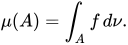
The Radon-Nikodym theorem states that if 


Singular measures
Via Lebesgue's decomposition theorem, every σ-finite measure can be decomposed into the sum of an absolutely continuous measure and a singular measure with respect to another σ-finite measure. See singular measure for examples of measures that are not absolutely continuous.
03Relation between the two notions of absolute continuity
A finite measure μ on Borel subsets of the real line is absolutely continuous with respect to Lebesgue measure if and only if the point function:
![F(x)=\mu ((-\infty ,x])](https://wikimedia.org/api/rest_v1/media/math/render/svg/8fd27e1270c259cdf84af8f91574eb33bc1d3f75)
is an absolutely continuous real function. More generally, a function has a locally (meaning on every bounded interval) absolutely continuous representative almost everywhere if and only if its distributional derivative is a measure that is absolutely continuous with respect to the Lebesgue measure.
If absolute continuity holds then the Radon-Nikodym derivative of μ is equal almost everywhere to the derivative of F.
More generally, the measure μ is assumed to be locally finite (rather than finite) and F(x) is defined as μ((0,x]) for x > 0, 0 for x = 0, and −μ((x,0]) for x < 0. In this case μ is the Lebesgue-Stieltjes measure generated by F. The relation between the two notions of absolute continuity still holds.
Sources and credits
This article is adapted from the Wikipedia article “Absolute continuity”, written by its contributors and licensed under CC BY-SA 4.0. Fathomly has changed the layout, removed citation markers, navigation and maintenance notices, and adjusted punctuation. This adapted version is shared under the same license. For references, see the original article.
Fathomly is not affiliated with or endorsed by the Wikimedia Foundation. Spotted a problem? Tell us.