5-simplex
Regular 5-polytope
| 5-simplex Hexateron (hix) | ||
|---|---|---|
| Type | uniform 5-polytope | |
| Schläfli symbol | {34} | |
| Coxeter diagram | ||
| 4-faces | 6 | 6 {3,3,3} |
| Cells | 15 | 15 {3,3} |
| Faces | 20 | 20 {3} |
| Edges | 15 | |
| Vertices | 6 | |
| Vertex figure | 5-cell | |
| Coxeter group | A5, [34], order 720 | |
| Dual | self-dual | |
| Base point | (0,0,0,0,0,1) | |
| Circumradius | 0.645497 | |
| Properties | convex, isogonal regular, self-dual | |
In five-dimensional geometry, a 5-simplex is a self-dual regular 5-polytope. It has six vertices, 15 edges, 20 triangle faces, 15 tetrahedral cells, and 6 5-cell facets. It has a dihedral angle of cos−1(1/5), or approximately 78.46°.
The 5-simplex is a solution to the problem: Make 20 equilateral triangles using 15 matchsticks, where each side of every triangle is exactly one matchstick.
01Alternate names
It can also be called a hexateron, or hexa-5-tope, as a 6-facetted polytope in 5-dimensions. The name hexateron is derived from hexa- for having six facets and teron (with ter- being a corruption of tetra-) for having four-dimensional facets.
By Jonathan Bowers, a hexateron is given the acronym hix.
02As a configuration
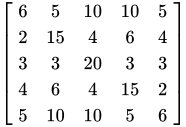
This configuration matrix represents the 5-simplex. The rows and columns correspond to vertices, edges, faces, cells and 4-faces. The diagonal numbers say how many of each element occur in the whole 5-simplex. The nondiagonal numbers say how many of the column's element occur in or at the row's element. This self-dual simplex's matrix is identical to its 180 degree rotation.
03Regular hexateron cartesian coordinates
The hexateron can be constructed from a 5-cell by adding a 6th vertex such that it is equidistant from all the other vertices of the 5-cell.
The Cartesian coordinates for the vertices of an origin-centered regular hexateron having edge length 2 are:
![{\begin{aligned}&\left({\tfrac {1}{\sqrt {15}}},\ {\tfrac {1}{\sqrt {10}}},\ {\tfrac {1}{\sqrt {6}}},\ {\tfrac {1}{\sqrt {3}}},\ \pm 1\right)\\[5pt]&\left({\tfrac {1}{\sqrt {15}}},\ {\tfrac {1}{\sqrt {10}}},\ {\tfrac {1}{\sqrt {6}}},\ -{\tfrac {2}{\sqrt {3}}},\ 0\right)\\[5pt]&\left({\tfrac {1}{\sqrt {15}}},\ {\tfrac {1}{\sqrt {10}}},\ -{\tfrac {\sqrt {3}}{\sqrt {2}}},\ 0,\ 0\right)\\[5pt]&\left({\tfrac {1}{\sqrt {15}}},\ -{\tfrac {2{\sqrt {2}}}{\sqrt {5}}},\ 0,\ 0,\ 0\right)\\[5pt]&\left(-{\tfrac {\sqrt {5}}{\sqrt {3}}},\ 0,\ 0,\ 0,\ 0\right)\end{aligned}}](https://wikimedia.org/api/rest_v1/media/math/render/svg/b79141ce810582c49e87824bc8b0f8a7ccec5d90)
The vertices of the 5-simplex can be more simply positioned on a hyperplane in 6-space as permutations of (0,0,0,0,0,1) or (0,1,1,1,1,1). These constructions can be seen as facets of the 6-orthoplex or rectified 6-cube respectively.
04Projected images
| Ak Coxeter plane |
A5 | A4 |
|---|---|---|
| Graph | ||
| Dihedral symmetry | [6] | [5] |
| Ak Coxeter plane |
A3 | A2 |
| Graph | ||
| Dihedral symmetry | [4] | [3] |
Stereographic projection 4D to 3D of Schlegel diagram 5D to 4D of hexateron. |
05Lower symmetry forms
A lower symmetry form is a 5-cell pyramid {3,3,3}∨( ), with [3,3,3] symmetry order 120, constructed as a 5-cell base in a 4-space hyperplane, and an apex point above the hyperplane. The five sides of the pyramid are made of 5-cell cells. These are seen as vertex figures of truncated regular 6-polytopes, like a truncated 6-cube.
Another form is {3,3}∨{ }, with [3,3,2,1] symmetry order 48, the joining of an orthogonal digon and a tetrahedron, orthogonally offset, with all pairs of vertices connected between. Another form is {3}∨{3}, with [3,2,3,1] symmetry order 36, and extended symmetry [[3,2,3],1], order 72. It represents joining of 2 orthogonal triangles, orthogonally offset, with all pairs of vertices connected between.
The form { }∨{ }∨{ } has symmetry [2,2,1,1], order 8, extended by permuting 3 segments as [3[2,2],1] or [4,3,1,1], order 48.
These are seen in the vertex figures of bitruncated and tritruncated regular 6-polytopes, like a bitruncated 6-cube and a tritruncated 6-simplex. The edge labels here represent the types of face along that direction, and thus represent different edge lengths.
The vertex figure of the omnitruncated 5-simplex honeycomb, , is a 5-simplex with a petrie polygon cycle of 5 long edges. Its symmetry is isomorphic to dihedral group Dih6 or simple rotation group [6,2]+, order 12.
| Join | {3,3,3}∨( ) | {3,3}∨{ } | {3}∨{3} | { }∨{ }∨{ } | |
|---|---|---|---|---|---|
| Symmetry | [3,3,3,1] Order 120 | [3,3,2,1] Order 48 | [[3,2,3],1] Order 72 | [3[2,2],1,1]=[4,3,1,1] Order 48 | ~[6] or ~[6,2]+ Order 12 |
| Diagram | |||||
| Polytope | truncated 6-simplex |
bitruncated 6-simplex |
tritruncated 6-simplex |
3-3-3 prism |
Omnitruncated 5-simplex honeycomb |
06Compound
The compound of two 5-simplexes in dual configurations can be seen in this A6 Coxeter plane projection, with a red and blue 5-simplex vertices and edges. This compound has [[3,3,3,3]] symmetry, order 1440. The intersection of these two 5-simplexes is a uniform birectified 5-simplex. = ∩ .
07Related uniform 5-polytopes
It is first in a dimensional series of uniform polytopes and honeycombs, expressed by Coxeter as 13k series. A degenerate 4-dimensional case exists as 3-sphere tiling, a tetrahedral hosohedron.
| Space | Finite | Euclidean | Hyperbolic | |||
|---|---|---|---|---|---|---|
| n | 4 | 5 | 6 | 7 | 8 | 9 |
| Coxeter group |
A3A1 | A5 | D6 | E7 |  =E7+ =E7+ |
 =E7++ =E7++ |
| Coxeter diagram |
||||||
| Symmetry | [3−1,3,1] | [30,3,1] | [31,3,1] | [32,3,1] | [[33,3,1]] | [34,3,1] |
| Order | 48 | 720 | 23,040 | 2,903,040 | ∞ | |
| Graph | - | - | ||||
| Name | 13,-1 | 130 | 131 | 132 | 133 | 134 |
It is first in a dimensional series of uniform polytopes and honeycombs, expressed by Coxeter as 3k1 series. A degenerate 4-dimensional case exists as 3-sphere tiling, a tetrahedral dihedron.
| Space | Finite | Euclidean | Hyperbolic | |||
|---|---|---|---|---|---|---|
| n | 4 | 5 | 6 | 7 | 8 | 9 |
| Coxeter group |
A3A1 | A5 | D6 | E7 | =E7+ |
=E7++ |
| Coxeter diagram |
||||||
| Symmetry | [3−1,3,1] | [30,3,1] | [[31,3,1]] = [4,3,3,3,3] |
[32,3,1] | [33,3,1] | [34,3,1] |
| Order | 48 | 720 | 46,080 | 2,903,040 | ∞ | |
| Graph | - | - | ||||
| Name | 31,-1 | 310 | 311 | 321 | 331 | 341 |
The 5-simplex, as 220 polytope is first in dimensional series 22k.
| Space | Finite | Euclidean | Hyperbolic | ||
|---|---|---|---|---|---|
| n | 4 | 5 | 6 | 7 | 8 |
| Coxeter group |
A2A2 | A5 | E6 |  =E6+ =E6+ |
E6++ |
| Coxeter diagram |
|||||
| Graph | ∞ | ∞ | |||
| Name | 22,-1 | 220 | 221 | 222 | 223 |
The regular 5-simplex is one of 19 uniform polytera based on the [3,3,3,3] Coxeter group, all shown here in A5 Coxeter plane orthographic projections. (Vertices are colored by projection overlap order, red, orange, yellow, green, cyan, blue, purple having progressively more vertices)
Sources and credits
This article is adapted from the Wikipedia article “5-simplex”, written by its contributors and licensed under CC BY-SA 4.0. Fathomly has changed the layout, removed citation markers, navigation and maintenance notices, and adjusted punctuation. This adapted version is shared under the same license. For references, see the original article.
Fathomly is not affiliated with or endorsed by the Wikimedia Foundation. Spotted a problem? Tell us.
