Zero element
Generalizations of '"`UNIQ--math-00000000-QINU`"' in algebraic structures
In mathematics, a zero element is one of several generalizations of the number zero to other algebraic structures. These alternate meanings may or may not reduce to the same thing, depending on the context.
01Additive identities
An additive identity is the identity element in an additive group or monoid. It corresponds to the element 


- The zero vector under vector addition: the vector whose components are all
or
.
- The zero function or zero map defined by
, under pointwise addition
- The empty set under set union
- An empty sum or empty coproduct
- An initial object in a category (an empty coproduct, and so an identity under coproducts)

02Absorbing elements
An absorbing element in a multiplicative semigroup or semiring generalises the property 
- The empty set, which is an absorbing element under Cartesian product of sets, since
- The zero function or zero map defined by


Many absorbing elements are also additive identities, including the empty set and the zero function. Another important example is the distinguished element
03Zero objects
A zero object in a category is both an initial and terminal object (and so an identity under both coproducts and products). For example, the trivial structure (containing only the identity) is a zero object in categories where morphisms must map identities to identities. Specific examples include:
- The trivial group, containing only the identity (a zero object in the category of groups)
- The zero module, containing only the identity (a zero object in the category of modules over a ring)
04Zero morphisms
A zero morphism in a category is a generalised absorbing element under function composition: any morphism composed with a zero morphism gives a zero morphism. Specifically, if 




If a category has a zero object 

05Least elements
A least element in a partially ordered set or lattice may sometimes be called a zero element, and written either as 
06Zero module
In mathematics, the zero module is the module consisting of only the additive identity for the module's addition function. In the integers, this identity is zero, which gives the name zero module. That the zero module is in fact a module is simple to show; it is closed under addition and multiplication trivially.
07Zero ideal
In mathematics, the zero ideal in a ring 
08Zero matrix
In mathematics, particularly linear algebra, a zero matrix is a matrix with all its entries being zero. It is alternately denoted by the symbol 

The set of m × n matrices with entries in a ring K forms a module 


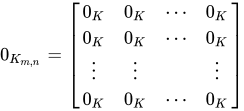
The zero matrix is the additive identity in 

There is exactly one zero matrix of any given size 
The zero matrix also represents the linear transformation which sends all vectors to the zero vector.
09Zero tensor
In mathematics, the zero tensor is a tensor, of any order, all of whose components are zero. The zero tensor of order 
Taking a tensor product of any tensor with any zero tensor results in another zero tensor. Among tensors of a given type, the zero tensor of that type serves as the additive identity among those tensors.
Sources and credits
This article is adapted from the Wikipedia article “Zero element”, written by its contributors and licensed under CC BY-SA 4.0. Fathomly has changed the layout, removed citation markers, navigation and maintenance notices, and adjusted punctuation. This adapted version is shared under the same license. For references, see the original article.
Fathomly is not affiliated with or endorsed by the Wikimedia Foundation. Spotted a problem? Tell us.