Young stellar object
Star in its early stage of evolution

Young stellar object (YSO) denotes a star in its early stage of evolution. This class consists of two groups of objects: protostars and pre-main-sequence stars.
01Classification by spectral energy distribution
A star forms by accumulation of material that falls in to a protostar from a circumstellar disk or envelope. Material in the disk is cooler than the surface of the protostar, so it radiates at longer wavelengths of light producing excess infrared emission. As material in the disk is depleted, the infrared excess decreases. Thus, YSOs are usually classified into evolutionary stages based on the slope of their spectral energy distribution in the mid-infrared, using a scheme introduced by Lada (1987). He proposed three classes (I, II and III), based on the values of intervals of spectral index 
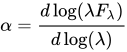
Here 

The 

- Class 0 sources, undetectable at
- Class I sources have
- Flat spectrum sources have
- Class II sources have
- Class III sources have





This classification schema roughly reflects evolutionary sequence. It is believed that most deeply embedded Class 0 sources evolve towards Class I stage, dissipating their circumstellar envelopes. Eventually they become optically visible on the stellar birthline as pre-main-sequence stars.
Class II objects have circumstellar disks and correspond roughly to classical T Tauri stars, while Class III stars have lost their disks and correspond approximately to weak-line T Tauri stars. An intermediate stage where disks can only be detected at longer wavelengths (e.g., at 

02Characteristics
YSOs are also associated with early star evolution phenomena: jets and bipolar outflows, disk winds, masers, Herbig-Haro objects, and protoplanetary disks (circumstellar disks or proplyds).
03Classification of YSOs by mass
These stars may be differentiated by mass: Massive YSOs, intermediate-mass YSOs, and brown dwarfs.
Sources and credits
This article is adapted from the Wikipedia article “Young stellar object”, written by its contributors and licensed under CC BY-SA 4.0. Fathomly has changed the layout, removed citation markers, navigation and maintenance notices, and adjusted punctuation. This adapted version is shared under the same license. For references, see the original article.
Images, from Wikimedia Commons:
- Young stellar objects in the Rho Ophiuchi cloud complex.jpg by NASA/JPL-Caltech/WISE Team, Public domain
- Opo0113i.jpg by Illustration Credit: NASA, ESA, and A. Feild (STScI), Public domain
Fathomly is not affiliated with or endorsed by the Wikimedia Foundation. Spotted a problem? Tell us.
