Spectral index
Measure in astronomy
In astronomy, the spectral index of a source is a measure of the dependence of radiative flux density (that is, radiative flux per unit of frequency) on frequency. Given frequency, 


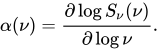
Clearly the power law can only apply over a certain range of frequency because otherwise the integral over all frequencies would be infinite.
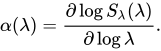
Spectral index is also sometimes defined in terms of wavelength 






01Spectral index of thermal and non-thermal emission
At radio frequencies (i.e., in the low-frequency, long-wavelength limit), where the Rayleigh-Jeans law is a good approximation to the spectrum of thermal radiation, intensity is given by
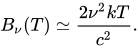

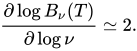


The principal non-thermal emission process, synchrotron radiation, has a spectral index (with the positive sign convention) of 2.5 in the optically thick regime. This occurs at low frequencies. At frequencies high enough for the emission to be optically thin, the spectral index depends on the energy distribution of the high-energy particles responsible for the emission. For typical astronomical synchrotron sources, the spectral index is near −0.7 and rarely above −0.5 or below −1.2.
The spectral index of a source, especially a radio source, can indicate its properties. For example, the spectral index of the emission from an optically thin thermal plasma is −0.1, whereas for an optically thick thermal plasma it is 2. Therefore, a spectral index of −0.1 to 2 at radio frequencies often indicates thermal emission, while a significantly negative spectral index typically indicates synchrotron emission. The observed emission can be affected by several absorption processes, most of which affect the low-frequency emission the most. In other words, the observed emission does not necessarily match the intrinsic emission. Absorption at low frequencies might result in a positive spectral index even if the intrinsic emission has a negative index, and therefore positive spectral index does not guarantee that the emission is thermal.
Sources and credits
This article is adapted from the Wikipedia article “Spectral index”, written by its contributors and licensed under CC BY-SA 4.0. Fathomly has changed the layout, removed citation markers, navigation and maintenance notices, and adjusted punctuation. This adapted version is shared under the same license. For references, see the original article.
Fathomly is not affiliated with or endorsed by the Wikimedia Foundation. Spotted a problem? Tell us.