Basis (linear algebra)
Set of vectors used to define coordinates

In mathematics, a set B of elements of a vector space V is called a basis (pl.: bases) if every element of V can be written in a unique way as a finite linear combination of elements of B. The coefficients of this linear combination are referred to as components or coordinates of the vector with respect to B. The elements of a basis are called basis vectors.
Equivalently, a set B is a basis if its elements are linearly independent and every element of V is a linear combination of elements of B. In other words, a basis is a linearly independent spanning set.
A vector space can have several bases; however all the bases have the same number of elements, called the dimension of the vector space.
This article deals mainly with finite-dimensional vector spaces. However, many of the principles are also valid for infinite-dimensional vector spaces.
Basis vectors find applications in the study of crystal structures and frames of reference.
01Definition
A basis B of a vector space V over a field F (such as the real numbers 

- linear independence: for every finite subset
of B, if
for some
in F, then
; and
- the spanning property: for every vector
in
, one can choose
in
and
in
such that
. In other words,
can be represented as a linear combination of some vectors in
The first property may be equivalently phrased as follows: if a linear combination of vectors in B is equal to the zero vector, then all the scalars coefficients of the combination must be zero.
If B is a basis for V, then every vector 
A vector space that has a finite basis is called finite-dimensional. In this case, the finite subset can be taken as
It is often convenient or even necessary to have an ordering on the basis vectors, for example, when discussing orientation, or when one considers the scalar coefficients of a vector with respect to a basis without referring explicitly to the basis elements. In this case, the ordering is necessary for associating each coefficient with the corresponding basis element. This ordering can be done by numbering the basis elements. In order to emphasize that an order has been chosen, one speaks of an ordered basis, which is therefore not simply an unstructured set, but a sequence, an indexed family, or similar; see § Ordered bases and coordinates below.

02Examples
The set 




More generally, if F is a field, the set 



A different flavor of example is given by polynomial rings. If F is a field, the collection F[X] of all polynomials in one indeterminate X with coefficients in F is an F-vector space. One basis for this space is the monomial basis B, consisting of all monomials: 
03Properties
Many properties of finite bases result from the Steinitz exchange lemma, which states that, for any vector space V, given a finite spanning set S and a linearly independent set L of n elements of V, one may replace n well-chosen elements of S by the elements of L to get a spanning set containing L, having its other elements in S, and having the same number of elements as S.
Most properties resulting from the Steinitz exchange lemma remain true when there is no finite spanning set, but their proofs in the infinite case generally require the axiom of choice or a weaker form of it, such as the ultrafilter lemma.
If V is a vector space over a field F, then:
- If L is a linearly independent subset of a spanning set S ⊆ V, then there is a basis B such that
- V has a basis (this is the preceding property with L being the empty set, and S = V).
- All bases of V have the same cardinality, which is called the dimension of V. This is the dimension theorem.
- A generating set S is a basis of V if and only if it is minimal, that is, no proper subset of S is also a generating set of V.
- A linearly independent set L is a basis if and only if it is maximal, that is, it is not a proper subset of any linearly independent set.

If V is a vector space of dimension n, then:
- A subset of V with n elements is a basis if and only if it is linearly independent.
- A subset of V with n elements is a basis if and only if it is a spanning set of V.
04Coordinates
Let V be a vector space of finite dimension n over a field F, and




Let, as usual, 

The inverse image by 


It follows from what precedes that every ordered basis is the image by a linear isomorphism of the canonical basis of
![Empirical distribution of lengths N of pairwise almost orthogonal chains of vectors that are independently randomly sampled from the n-dimensional cube ''n''</sup>"}},"i":0}}]}' id="mwAfc">[−1, 1]n as a function of dimension, n. Boxplots show the second and third quartiles of this data for each n, red bars correspond to the medians, and blue stars indicate means. Red curve shows theoretical bound given by Eq. (1) and green curve shows a refined estimate.](https://thumb.wikimedia.org/wikipedia/commons/thumb/c/cd/Random_almost_orthogonal_sets.png/500px-Random_almost_orthogonal_sets.png)
05Change of basis
Let V be a vector space of dimension n over a field F. Given two (ordered) bases 



Typically, the new basis vectors are given by their coordinates over the old basis, that is,
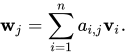


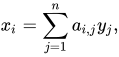
This formula may be concisely written in matrix notation. Let A be the matrix of the 
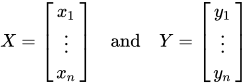

The formula can be proven by considering the decomposition of the vector x on the two bases: one has
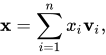

The change-of-basis formula results then from the uniqueness of the decomposition of a vector over a basis, here 
06Related notions
Free module
If one replaces the field occurring in the definition of a vector space by a ring, one gets the definition of a module. For modules, linear independence and spanning sets are defined exactly as for vector spaces, although "generating set" is more commonly used than that of "spanning set".
Like for vector spaces, a basis of a module is a linearly independent subset that is also a generating set. A major difference with the theory of vector spaces is that not every module has a basis. A module that has a basis is called a free module. Free modules play a fundamental role in module theory, as they may be used for describing the structure of non-free modules through free resolutions.
A module over the integers is exactly the same thing as an abelian group. Thus a free module over the integers is also a free abelian group. Free abelian groups have specific properties that are not shared by modules over other rings. Specifically, every subgroup of a free abelian group is a free abelian group, and, if G is a subgroup of a finitely generated free abelian group H (that is an abelian group that has a finite basis), then there is a basis 

Analysis
In the context of infinite-dimensional vector spaces over the real or complex numbers, the term Hamel basis (named after Georg Hamel) or algebraic basis can be used to refer to a basis as defined in this article. This is to make a distinction with other notions of "basis" that exist when infinite-dimensional vector spaces are endowed with extra structure. The most important alternatives are orthogonal bases on Hilbert spaces, Schauder bases, and Markushevich bases on normed linear spaces. In the case of the real numbers 


The common feature of the other notions is that they permit the taking of infinite linear combinations of the basis vectors in order to generate the space. This, of course, requires that infinite sums are meaningfully defined on these spaces, as is the case for topological vector spaces, a large class of vector spaces including e.g. Hilbert spaces, Banach spaces, or Fréchet spaces.
The preference of other types of bases for infinite-dimensional spaces is justified by the fact that the Hamel basis becomes "too big" in Banach spaces: If X is an infinite-dimensional normed vector space that is complete (i.e. X is a Banach space), then any Hamel basis of X is necessarily uncountable. This is a consequence of the Baire category theorem. The completeness as well as infinite dimension are crucial assumptions in the previous claim. Indeed, finite-dimensional spaces have by definition finite bases and there are infinite-dimensional (non-complete) normed spaces that have countable Hamel bases. Consider 


Example
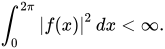
In the study of Fourier series, one learns that the functions {1} ∪ { sin(nx), cos(nx) : n = 1, 2, 3, ... } are an "orthogonal basis" of the (real or complex) vector space of all (real or complex valued) functions on the interval [0, 2π] that are square-integrable on this interval, i.e., functions f satisfying
The functions {1} ∪ { sin(nx), cos(nx) : n = 1, 2, 3, ... } are linearly independent, and every function f that is square-integrable on [0, 2π] is an "infinite linear combination" of them, in the sense that

for suitable (real or complex) coefficients ak, bk. But many square-integrable functions cannot be represented as finite linear combinations of these basis functions, which therefore do not comprise a Hamel basis. Every Hamel basis of this space is much bigger than this merely countably infinite set of functions. Hamel bases of spaces of this kind are typically not useful, whereas orthonormal bases of these spaces are essential in Fourier analysis.
Geometry
The geometric notions of an affine space, projective space, convex set, and cone have related notions of basis. An affine basis for an n-dimensional affine space is 

Random basis
For a probability distribution in 
It is difficult to check numerically the linear dependence or exact orthogonality. Therefore, the notion of ε-orthogonality is used. For spaces with inner product, x is ε-orthogonal to y if 
In high dimensions, two independent random vectors are with high probability almost orthogonal, and the number of independent random vectors, which all are with given high probability pairwise almost orthogonal, grows exponentially with dimension. More precisely, consider equidistribution in n-dimensional ball. Choose N independent random vectors from a ball (they are independent and identically distributed). Let θ be a small positive number. Then for
 | Eq. 1 |
N random vectors are all pairwise ε-orthogonal with probability 1 − θ. This N growth exponentially with dimension n and 
The figure (right) illustrates distribution of lengths N of pairwise almost orthogonal chains of vectors that are independently randomly sampled from the n-dimensional cube [−1, 1]n as a function of dimension, n. A point is first randomly selected in the cube. The second point is randomly chosen in the same cube. If the angle between the vectors was within π/2 ± 0.037π/2 then the vector was retained. At the next step a new vector is generated in the same hypercube, and its angles with the previously generated vectors are evaluated. If these angles are within π/2 ± 0.037π/2 then the vector is retained. The process is repeated until the chain of almost orthogonality breaks, and the number of such pairwise almost orthogonal vectors (length of the chain) is recorded. For each n, 20 pairwise almost orthogonal chains were constructed numerically for each dimension. Distribution of the length of these chains is presented.
07Proof that every vector space has a basis
Let V be any vector space over some field F. Let X be the set of all linearly independent subsets of V.
The set X is nonempty since the empty set is an independent subset of V, and it is partially ordered by inclusion, which is denoted, as usual, by ⊆.
Let Y be a subset of X that is totally ordered by ⊆, and let LY be the union of all the elements of Y (which are themselves certain subsets of V).
Since (Y, ⊆) is totally ordered, every finite subset of LY is a subset of an element of Y, which is a linearly independent subset of V, and hence LY is linearly independent. Thus LY is an element of X. Therefore, LY is an upper bound for Y in (X, ⊆): it is an element of X, that contains every element of Y.
As X is nonempty, and every totally ordered subset of (X, ⊆) has an upper bound in X, Zorn's lemma asserts that X has a maximal element. In other words, there exists some element Lmax of X satisfying the condition that whenever Lmax ⊆ L for some element L of X, then L = Lmax.
It remains to prove that Lmax is a basis of V. Since Lmax belongs to X, we already know that Lmax is a linearly independent subset of V.
If there were some vector w of V that is not in the span of Lmax, then w would not be an element of Lmax either. Let Lw = Lmax ∪ {w}. This set is an element of X, that is, it is a linearly independent subset of V (because w is not in the span of Lmax, and Lmax is independent). As Lmax ⊆ Lw, and Lmax ≠ Lw (because Lw contains the vector w that is not contained in Lmax), this contradicts the maximality of Lmax. Thus this shows that Lmax spans V.
Hence Lmax is linearly independent and spans V. It is thus a basis of V, and this proves that every vector space has a basis.
This proof relies on Zorn's lemma, which is equivalent to the axiom of choice. Conversely, it has been proved that if every vector space has a basis, then the axiom of choice is true. Thus the two assertions are equivalent.
Sources and credits
This article is adapted from the Wikipedia article “Basis (linear algebra)”, written by its contributors and licensed under CC BY-SA 4.0. Fathomly has changed the layout, removed citation markers, navigation and maintenance notices, and adjusted punctuation. This adapted version is shared under the same license. For references, see the original article.
Images, from Wikimedia Commons:
- 3d two bases same vector.svg by Maschen, CC0
- Basis graph (no label).svg by Spindled at English Wikipedia, CC BY-SA 3.0
- Random almost orthogonal sets.png by Agor153, CC BY 3.0
Fathomly is not affiliated with or endorsed by the Wikimedia Foundation. Spotted a problem? Tell us.
