Variation ratio
The variation ratio is a simple measure of statistical dispersion in nominal distributions; it is the simplest measure of qualitative variation.
It is defined as the proportion of cases which are not in the mode category:
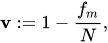
where fm is the frequency (number of cases) of the mode, and N is the total number of cases. While a simple measure, it is notable in that some texts and guides suggest or imply that the dispersion of nominal measurements cannot be ascertained. It is defined for instance by (Freeman 1965).
Just as with the range or standard deviation, the larger the variation ratio, the more differentiated or dispersed the data are; and the smaller the variation ratio, the more concentrated and similar the data are.
01An example
A group which is 55% female and 45% male has a proportion of 0.55 female (the mode is 0.55), therefore its variation ratio is

Similarly, in a group of 100 people where 60 people like beer, 25 people like wine, and the rest (15) prefer cocktails, the variation ratio is

Sources and credits
This article is adapted from the Wikipedia article “Variation ratio”, written by its contributors and licensed under CC BY-SA 4.0. Fathomly has changed the layout, removed citation markers, navigation and maintenance notices, and adjusted punctuation. This adapted version is shared under the same license. For references, see the original article.
Fathomly is not affiliated with or endorsed by the Wikimedia Foundation. Spotted a problem? Tell us.