Trace operator
Boundary condition for generalized functions
In mathematical analysis, the trace operator extends the notion of the restriction of a function to the boundary of its domain to "generalized" functions in a Sobolev space. This is particularly important for the study of partial differential equations with prescribed boundary conditions (boundary value problems), where weak solutions may not be regular enough to satisfy the boundary conditions in the classical sense of functions.
01Motivation
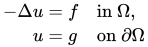
On a bounded, smooth domain , consider the problem of solving Poisson's equation with inhomogeneous Dirichlet boundary conditions:
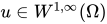
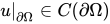
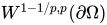
with given functions and
with regularity discussed in the application section below. The weak solution
of this equation must satisfy
for all
.
The -regularity of
is sufficient for the well-definedness of this integral equation. It is not apparent, however, in which sense
can satisfy the boundary condition
on
: by definition,
is an equivalence class of functions which can have arbitrary values on
since this is a null set with respect to the n-dimensional Lebesgue measure.
If there holds
by Sobolev's embedding theorem, such that
can satisfy the boundary condition in the classical sense, i.e. the restriction of
to
agrees with the function
(more precisely: there exists a representative of
in
with this property). For
with
such an embedding does not exist and the trace operator
presented here must be used to give meaning to
. Then
with
is called a weak solution to the boundary value problem if the integral equation above is satisfied. For the definition of the trace operator to be reasonable, there must hold
for sufficiently regular
.

02Trace theorem
The trace operator can be defined for functions in the Sobolev spaces with
, see the section below for possible extensions of the trace to other spaces. Let
for
be a bounded domain with Lipschitz boundary. Then there exists a bounded linear trace operator
such that extends the classical trace, i.e.
for all
.
The continuity of implies that
for all
with constant only depending on and
. The function
is called trace of
and is often simply denoted by
. Other common symbols for
include
and
.
Construction
This paragraph follows Evans, where more details can be found, and assumes that has a
-boundary. A proof (of a stronger version) of the trace theorem for Lipschitz domains can be found in Gagliardo. On a
-domain, the trace operator can be defined as continuous linear extension of the operator
to the space . By density of
in
such an extension is possible if
is continuous with respect to the
-norm. The proof of this, i.e. that there exists
(depending on
and
) such that
for all
,
is the central ingredient in the construction of the trace operator. A local variant of this estimate for -functions is first proven for a locally flat boundary using the divergence theorem. By transformation, a general
-boundary can be locally straightened to reduce to this case, where the
-regularity of the transformation requires that the local estimate holds for
-functions.
With this continuity of the trace operator in an extension to
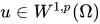
exists by abstract arguments and
for
can be characterized as follows. Let
be a sequence approximating
by density. By the proven continuity of
in
the sequence
is a Cauchy sequence in
and
with limit taken in
.
The extension property holds for
by construction, but for any
there exists a sequence
which converges uniformly on
to
, verifying the extension property on the larger set
.
The case p = ∞
If is bounded and has a
-boundary then by Morrey's inequality there exists a continuous embedding
, where
denotes the space of Lipschitz continuous functions. In particular, any function
has a classical trace
and there holds
03Functions with trace zero
04Image of the trace operator
For p > 1
The trace operator is not surjective onto if
, i.e. not every function in
is the trace of a function in
. As elaborated below the image consists of functions which satisfy an
-version of Hölder continuity.
Abstract characterization
An abstract characterization of the image of can be derived as follows. By the isomorphism theorems there holds

where denotes the quotient space of the Banach space
by the subspace
and the last identity follows from the characterization of
from above. Equipping the quotient space with the quotient norm defined by
the trace operator is then a surjective, bounded linear operator
.
Characterization using Sobolev-Slobodeckij spaces
A more concrete representation of the image of can be given using Sobolev-Slobodeckij spaces which generalize the concept of Hölder continuous functions to the
-setting. Since
is a (n-1)-dimensional Lipschitz manifold embedded into
an explicit characterization of these spaces is technically involved. For simplicity consider first a planar domain
. For
define the (possibly infinite) norm
which generalizes the Hölder condition . Then

equipped with the previous norm is a Banach space (a general definition of for non-integer
can be found in the article for Sobolev-Slobodeckij spaces). For the (n-1)-dimensional Lipschitz manifold
define
by locally straightening
and proceeding as in the definition of
.
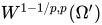
The space can then be identified as the image of the trace operator and there holds that
is a surjective, bounded linear operator.
For p = 1
For the image of the trace operator is
and there holds that
is a surjective, bounded linear operator.
05Right-inverse: trace extension operator
The trace operator is not injective since multiple functions in can have the same trace (or equivalently,
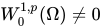
). The trace operator has however a well-behaved right-inverse, which extends a function defined on the boundary to the whole domain. Specifically, for
there exists a bounded, linear trace extension operator
,
using the Sobolev-Slobodeckij characterization of the trace operator's image from the previous section, such that
for all

and, by continuity, there exists with
.
Notable is not the mere existence but the linearity and continuity of the right inverse. This trace extension operator must not be confused with the whole-space extension operators which play a fundamental role in the theory of Sobolev spaces.

06Extension to other spaces
Higher derivatives
Many of the previous results can be extended to with higher differentiability
if the domain is sufficiently regular. Let
denote the exterior unit normal field on
.
Since
can encode differentiability properties in tangential direction only the normal derivative
is of additional interest for the trace theory for
. Similar arguments apply to higher-order derivatives for
.
Let and
be a bounded domain with
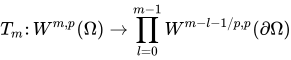
-boundary. Then there exists a surjective, bounded linear higher-order trace operator
with Sobolev-Slobodeckij spaces for non-integer
defined on
through transformation to the planar case
for
, whose definition is elaborated in the article on Sobolev-Slobodeckij spaces. The operator
extends the classical normal traces in the sense that
for all
Furthermore, there exists a bounded, linear right-inverse of , a higher-order trace extension operator
.
Finally, the spaces , the completion of
in the
-norm, can be characterized as the kernel of
, i.e.
.
Less regular spaces
No trace in Lp
There is no sensible extension of the concept of traces to for
since any bounded linear operator which extends the classical trace must be zero on the space of test functions
, which is a dense subset of
, implying that such an operator would be zero everywhere.
Generalized normal trace
Let denote the distributional divergence of a vector field
. For
and bounded Lipschitz domain
define
which is a Banach space with norm
.
Let denote the exterior unit normal field on
. Then there exists a bounded linear operator
,
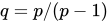
where is the conjugate exponent to
and
denotes the continuous dual space to a Banach space
, such that
extends the normal trace
for
in the sense that
.
The value of the normal trace operator for
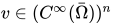
is defined by application of the divergence theorem to the vector field
where
is the trace extension operator from above.
Application. Any weak solution to

in a bounded Lipschitz domain
has a normal derivative in the sense of
. This follows as
since
and
. This result is notable since in Lipschitz domains in general
, such that
may not lie in the domain of the trace operator
.
07Application
The theorems presented above allow a closer investigation of the boundary value problem
on a Lipschitz domain from the motivation. Since only the Hilbert space case
is investigated here, the notation
is used to denote
etc. As stated in the motivation, a weak solution
to this equation must satisfy
and
for all
,
where the right-hand side must be interpreted for as a duality product with the value

.
Existence and uniqueness of weak solutions
The characterization of the range of implies that for
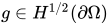
to hold the regularity
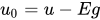
is necessary. This regularity is also sufficient for the existence of a weak solution, which can be seen as follows. By the trace extension theorem there exists
such that
. Defining
by
we have that
and thus
by the characterization of
as space of trace zero. The function
then satisfies the integral equation
for all
.
Thus the problem with inhomogeneous boundary values for could be reduced to a problem with homogeneous boundary values for
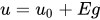
, a technique which can be applied to any linear differential equation. By the Riesz representation theorem there exists a unique solution
to this problem. By uniqueness of the decomposition
, this is equivalent to the existence of a unique weak solution
to the inhomogeneous boundary value problem.
Continuous dependence on the data
It remains to investigate the dependence of on

and
. Let
denote constants independent of
and
. By continuous dependence of
on the right-hand side of its integral equation, there holds
and thus, using that and
by continuity of the trace extension operator, it follows that
and the solution map
is therefore continuous.
Sources and credits
This article is adapted from the Wikipedia article “Trace operator”, written by its contributors and licensed under CC BY-SA 4.0. Fathomly has changed the layout, removed citation markers, navigation and maintenance notices, and adjusted punctuation. This adapted version is shared under the same license. For references, see the original article.
Images, from Wikimedia Commons:
- Trace operator illustration.png by Oleg Alexandrov, Public domain
Fathomly is not affiliated with or endorsed by the Wikimedia Foundation. Spotted a problem? Tell us.