Total algebra
Generalization of monoid ring
In abstract algebra, the total algebra of a monoid is a generalization of the monoid ring that allows for infinite sums of elements of a ring. Suppose that S is a monoid with the property that, for all 
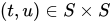



and with the multiplication law given by:
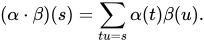
The sum on the right-hand side has finite support, and so is well-defined in R.
These operations turn
An example is the ring of formal power series, where the monoid S is the natural numbers. The product is then the Cauchy product.
Sources and credits
This article is adapted from the Wikipedia article “Total algebra”, written by its contributors and licensed under CC BY-SA 4.0. Fathomly has changed the layout, removed citation markers, navigation and maintenance notices, and adjusted punctuation. This adapted version is shared under the same license. For references, see the original article.
Fathomly is not affiliated with or endorsed by the Wikimedia Foundation. Spotted a problem? Tell us.