Monoid ring
Algebraic structure
In abstract algebra, a monoid ring is a ring constructed from a ring and a monoid, just as a group ring is constructed from a ring and a group.
01Definition
Let R be a ring and let G be a monoid. The monoid ring or monoid algebra of G over R, denoted R[G] or RG, is the set of formal sums 


Alternatively, one can identify the element ![g\in R[G]](https://wikimedia.org/api/rest_v1/media/math/render/svg/1c0ca2e73ba35c35345c584d8c97d972536bfc77)
.
If G is a group, then R[G] is also called the group ring of G over R.
02Universal property
Given R and G, there is a ring homomorphism α: R → R[G] sending each r to r1 (where 1 is the identity element of G), and a monoid homomorphism β: G → R[G] (where the latter is viewed as a monoid under multiplication) sending each g to 1g (where 1 is the multiplicative identity of R). We have that α(r) commutes with β(g) for all r in R and g in G.
The universal property of the monoid ring states that given a ring S, a ring homomorphism α': R → S, and a monoid homomorphism β': G → S to the multiplicative monoid of S, such that α'(r) commutes with β'(g) for all r in R and g in G, there is a unique ring homomorphism γ: R[G] → S such that composing α and β with γ produces α' and β '.
03Augmentation
The augmentation is the ring homomorphism η: R[G] → R defined by
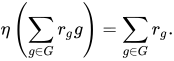
The kernel of η is called the augmentation ideal. It is a free R-module with basis consisting of 1 , g for all g in G not equal to 1.
04Examples
Given a ring R and the (additive) monoid of natural numbers N (or {xn} viewed multiplicatively), we obtain the ring R[{xn}] =: R[x] of polynomials over R. The monoid Nn (with the addition) gives the polynomial ring with n variables: R[Nn] =: R[X1, ..., Xn].
05Generalization
If G is a semigroup, the same construction yields a semigroup ring R[G].
Sources and credits
This article is adapted from the Wikipedia article “Monoid ring”, written by its contributors and licensed under CC BY-SA 4.0. Fathomly has changed the layout, removed citation markers, navigation and maintenance notices, and adjusted punctuation. This adapted version is shared under the same license. For references, see the original article.
Fathomly is not affiliated with or endorsed by the Wikimedia Foundation. Spotted a problem? Tell us.
