Threshold graph
Graph formed by adding isolated or universal vertices

In graph theory, a threshold graph is a graph that can be constructed from a one-vertex graph by repeated applications of the following two operations:
- Addition of a single isolated vertex to the graph.
- Addition of a single dominating vertex to the graph, i.e. a single vertex that is connected to all other vertices.
For example, the graph of the figure is a threshold graph. It can be constructed by beginning with a single-vertex graph (vertex 1), and then adding black vertices as isolated vertices and red vertices as dominating vertices, in the order in which they are numbered.
Threshold graphs were first introduced by Chvátal & Hammer (1977). A chapter on threshold graphs appears in Golumbic (1980), and the book Mahadev & Peled (1995) is devoted to them.
01Alternative definitions
An equivalent definition is the following: a graph is a threshold graph if there are a real number 



Another equivalent definition is this: a graph is a threshold graph if there are a real number 


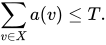
The name "threshold graph" comes from these definitions: S is the "threshold" for the property of being an edge, or equivalently T is the threshold for being independent.
Threshold graphs also have a forbidden graph characterization: A graph is a threshold graph if and only if it no four of its vertices form an induced subgraph that is a three-edge path graph, a four-edge cycle graph, or a two-edge matching.
02Decomposition
From the definition which uses repeated addition of vertices, one can derive an alternative way of uniquely describing a threshold graph, by means of a string of symbols. 


Sources and credits
This article is adapted from the Wikipedia article “Threshold graph”, written by its contributors and licensed under CC BY-SA 4.0. Fathomly has changed the layout, removed citation markers, navigation and maintenance notices, and adjusted punctuation. This adapted version is shared under the same license. For references, see the original article.
Images, from Wikimedia Commons:
- Threshold graph.png by User:Mlampis, Public domain
Fathomly is not affiliated with or endorsed by the Wikimedia Foundation. Spotted a problem? Tell us.

