Tetration
Arithmetic operation

In mathematics, tetration (or hyper-4) is an operation based on iterated, or repeated, exponentiation. There is no universal notation for tetration, though Knuth's up arrow notation 

Under the definition as repeated exponentiation, 


Tetration is the hyperoperation after exponentiation and before pentation. Along with the other hyperoperations, tetration is used for the notation of very large numbers. The name was coined by Reuben Goodstein from the prefix tetra- (meaning "four") and the word "iteration".
Tetration can also be defined recursively as

This form allows for the extension of tetration to more general domains for n than the natural numbers such as real, complex, or ordinal numbers.
The two inverses of tetration are called super-root and super-logarithm. They are respectively analogous to the operations of taking n-th roots and taking logarithms. None of the three functions are elementary.
01Introduction
The first four hyperoperations are shown here, with tetration being considered the fourth in the series. The unary operation succession, defined as 
- Addition
n copies of 1 added to a combined by succession.
- Multiplication
n copies of a combined by addition.
- Exponentiation
n copies of a combined by multiplication.
- Tetration
n copies of a combined by exponentiation. Importantly, nested exponents are calculated from right to left:
means
and not
Succession, 


The parameter 


The recursive definition is equivalent to repeated exponentiation for natural heights; however, this definition allows for extensions to the other heights such as 


02Terminology
There are many terms for tetration, each of which has some logic behind it, but some have not become commonly used for one reason or another. Here is a comparison of each term with its rationale and counter-rationale.
- The term tetration, introduced by Goodstein in his 1947 paper Transfinite Ordinals in Recursive Number Theory (generalizing the recursive base-representation used in Goodstein's theorem to use higher operations), has gained dominance. It was also popularized in Rudy Rucker's Infinity and the Mind.
- The term superexponentiation was published by Bromer in his paper Superexponentiation in 1987. It was used earlier by Ed Nelson in his book Predicative Arithmetic, Princeton University Press, 1986.
- The term hyperpower is a natural combination of hyper and power, which aptly describes tetration. The problem lies in the meaning of hyper with respect to the hyperoperation sequence. When considering hyperoperations, the term hyper refers to all ranks, and the term super refers to rank 4, or tetration. So under these considerations hyperpower is misleading, since it is only referring to tetration.
- The term power tower is occasionally used, in the form "the power tower of order n" for n occurrences of the a variable:
. Exponentiation is easily misconstrued: note that the operation of raising to a power is right-associative (see below). That is, tetration is iterated exponentiation starting from the top right side of the expression with an instance
. Exponentiating the next leftward
, then
, and so on.
Owing in part to some shared terminology and similar notational symbolism, tetration is often confused with closely related functions and expressions. Here are a few related terms:
| Terminology | Form |
|---|---|
| Tetration |  |
| Iterated exponentials |  |
| Nested exponentials (also towers) |  |
| Infinite exponentials (also towers) |  |
In the first two expressions, a is the base, and the number of times a appears is the height (add one for x). In the third expression, n is the height, but each of the bases is different.
Care must be taken when referring to iterated exponentials, as it is common to call expressions of this form iterated exponentiation, which is ambiguous, as this can either mean iterated powers or iterated exponentials.

03Notation
There are many different notation styles that can be used to express tetration. Some notations can also be used to describe other hyperoperations, while some are limited to tetration and have no immediate extension.
| Name | Form | Description |
|---|---|---|
| Knuth's up-arrow notation |  |
Allows extension by putting more arrows, or, even more powerfully, an indexed arrow. |
| Conway chained arrow notation |  |
Allows extension by increasing the number 2 (equivalent with the extensions above), but also, even more powerfully, by extending the chain. |
| Ackermann function |  |
Allows the special case  to be written in terms of the Ackermann function. to be written in terms of the Ackermann function. |
| Iterated exponential notation |  |
Allows simple extension to iterated exponentials from initial values other than 1. |
| Hooshmand notations | ![{\begin{aligned}&\operatorname {uxp} _{a}n\\[2pt]&a^{\frac {n}{}}\end{aligned}}](https://wikimedia.org/api/rest_v1/media/math/render/svg/d44510324a0e36390e6a2a190dc9cc5597244759) |
Used by M. H. Hooshmand [2006]. |
| Hyperoperation notations | ![{\begin{aligned}&a[4]n\\[2pt]&H_{4}(a,n)\end{aligned}}](https://wikimedia.org/api/rest_v1/media/math/render/svg/748ac1b86caad44f63e3dd7b50768a79d4b534f6) |
Allows extension by increasing the number 4; this gives the family of hyperoperations. |
| Double caret notation | a^^n | Since the up-arrow is used identically to the caret (^), tetration may be written as (^^); convenient for ASCII. |
One notation above uses iterated exponential notation; this is defined in general as follows:
with n as.
There are not as many notations for iterated exponentials, but here are a few:
| Name | Form | Description |
|---|---|---|
| Standard notation |  |
Euler coined the notation 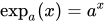 , and iteration notation , and iteration notation  has been around about as long. has been around about as long. |
| Knuth's up-arrow notation |  |
Allows for super-powers and super-exponential function by increasing the number of arrows; used in the article on large numbers. |
| Text notation | exp_a^n(x) | Based on standard notation; convenient for ASCII. |
| J notation | x^^:(n-1)x | Repeats the exponentiation. See J (programming language). |
| Infinity barrier notation |  |
Jonathan Bowers coined this, and it can be extended to higher hyper-operations. |

04Examples
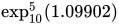
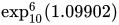
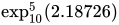
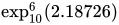
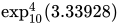
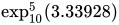
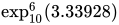
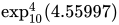
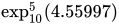
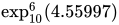
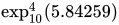
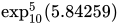
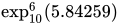
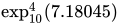
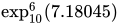
Because of the extremely fast growth of tetration, most values in the following table are too large to write in scientific notation. In these cases, iterated exponential notation is used to express them in base 10. The values containing a decimal point are approximate. Usually, the limit that can be calculated in a numerical calculation program such as Wolfram Alpha is 3↑↑4, and the number of digits up to 3↑↑5 can be expressed.
 |
 |
 |
 |
 |
 |
 |
|---|---|---|---|---|---|---|
| 1 | 1 | 1 | 1 | 1 | 1 | 1 |
| 2 | 4 (22) | 16 (24) | 65,536 (216) | 2.00353 × 1019,728 (265,536) | 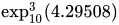 (106.03123×1019,727) (106.03123×1019,727) |
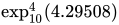 |
| 3 | 27 (33) | 7,625,597,484,987
(327) |
1.25801 × 103,638,334,640,024 (37,625,597,484,987) | 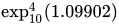
(106.00225×103,638,334,640,023) |
 |
 |
| 4 | 256 (44) | 1.34078 × 10154 (4256) | 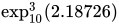 (108.07230×10153) (108.07230×10153) |
 |
 |
 |
| 5 | 3,125 (55) | 1.91101 × 102,184 (53,125) | 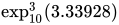 (101.33574×102,184) (101.33574×102,184) |
 |
 |
 |
| 6 | 46,656 (66) | 2.65912 × 1036,305 (646,656) | 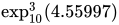 (102.0692×1036,305) (102.0692×1036,305) |
 |
 |
 |
| 7 | 823,543 (77) | 3.75982 × 10695,974 (7823,543) | 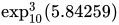 (103.17742×10695,974) (103.17742×10695,974) |
 |
 |
 |
| 8 | 16,777,216 (88) | 6.01452 × 1015,151,335 | 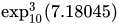 (105.43165×1015,151,335) (105.43165×1015,151,335) |
 |
 |
 |
| 9 | 387,420,489 (99) | 4.28125 × 10369,693,099 | 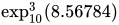 (104.08535×10369,693,099) (104.08535×10369,693,099) |
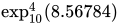 |
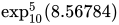 |
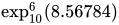 |
| 10 | 10,000,000,000 (1010) | 1010,000,000,000 |  (101010,000,000,000) (101010,000,000,000) |
 |
 |
 |
Remark: If x does not differ from 10 by orders of magnitude, then for all 


05Extensions
Tetration can be extended in two different ways; in the formula 

Extension of domain for bases
Base zero
The exponential 


Thus we could consistently define 

Under this extension, 

Complex bases
Since complex numbers can be raised to powers, tetration can be applied to bases of the form z = a + bi (where a and b are real). For example, in nz with z = i, tetration is achieved by using the principal branch of the natural logarithm; using Euler's formula we get the relation

This suggests a recursive definition for n+1i = a′ + b′i given any ni = a + bi:
![{\begin{aligned}a'&=e^{-{\frac {1}{2}}{\pi b}}\cos {\frac {\pi a}{2}}\\[2pt]b'&=e^{-{\frac {1}{2}}{\pi b}}\sin {\frac {\pi a}{2}}\end{aligned}}](https://wikimedia.org/api/rest_v1/media/math/render/svg/42ede7788090fc4d176fe752d23871f2f7830733)
The following approximate values can be derived:
 |
Approximate value |
|---|---|
 |
i |
 |
0.2079 |
 |
0.9472 + 0.3208i |
 |
0.0501 + 0.6021i |
 |
0.3872 + 0.0305i |
 |
0.7823 + 0.5446i |
 |
0.1426 + 0.4005i |
 |
0.5198 + 0.1184i |
 |
0.5686 + 0.6051i |
Solving the inverse relation, as in the previous section, yields the expected 0i = 1 and −1i = 0, with negative values of n giving infinite results on the imaginary axis. Plotted in the complex plane, the entire sequence spirals to the limit 0.4383 + 0.3606i, which could be interpreted as the value where n is infinite.
Such tetration sequences have been studied since the time of Euler, but are poorly understood due to their chaotic behavior. Most published research historically has focused on the convergence of the infinitely iterated exponential function. Current research has greatly benefited from the advent of powerful computers with fractal and symbolic mathematics software. Much of what is known about tetration comes from general knowledge of complex dynamics and specific research of the exponential map.
Extensions of the domain for different heights
Infinite heights
Tetration can be extended to infinite heights; i.e., for certain a values in 
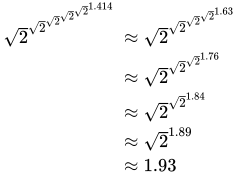
In general, the infinitely iterated exponential 

This may be extended to complex numbers z with the definition:

where W represents Lambert's W function. This formula follows from the assumption that 


As the limit y = ∞x (if existent on the positive real line, i.e. for e−e ≤ x ≤ e1/e) must satisfy xy = y, we see that x ↦ y = ∞x is (the lower branch of) the inverse function of y ↦ x = y1/y.
Negative heights
We can reverse the recursive rule for tetration,
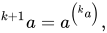
to write

Substituting −1 for k gives
.
Smaller negative values cannot be well defined in this way. Substituting −2 for k in the same equation gives

which is not well defined. They can, however, sometimes be considered sets.
For 


for any
.
Linear approximation for real heights
A linear approximation (solution to the continuity requirement, approximation to the differentiability requirement) is given by:
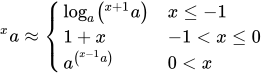
hence:
| Approximation | Domain |
|---|---|
 |
for −1 < x < 0 |
 |
for 0 < x < 1 |
 |
for 1 < x < 2 |
and so on. However, it is only piecewise differentiable; at integer values of x, the derivative is multiplied by 



A main theorem in Hooshmand's paper states: Let 

for all
and
is differentiable on (−1, 0),
is a nondecreasing or nonincreasing function on (−1, 0), and


then
for all

where 


The proof is that the second through fourth conditions trivially imply that f is a linear function on [−1, 0].
The linear approximation to natural tetration function 
If
for all
,
,
then 
The proof is much the same as before; the recursion equation ensures that 
Therefore, the linear approximation to natural tetration is the only solution of the equation
Higher-order approximations for real heights
Beyond linear approximations, a quadratic approximation (to the differentiability requirement) is given by:

which is differentiable for all 
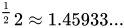
Because of the way it is calculated, this function does not "cancel out", contrary to exponents, where 
.
Just as there is a quadratic approximation, cubic approximations and methods for generalizing to approximations of degree n also exist, although they are much more unwieldy.
Complex heights
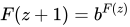
In 2017, it was proved that there exists a unique function 



06Non-elementary recursiveness
Tetration (restricted to 

We denote the right hand side by 





07Inverse operations
Exponentiation has two inverse operations: roots and logarithms. Analogously, the inverses of tetration are often called the super-root, and the super-logarithm (In fact, all hyperoperations of order 3 or higher have analogous inverses); for example, in the function 
Super-root
The super-root is the inverse operation of tetration with respect to the base: if 
![{\sqrt[{n}]{x}}_{s}](https://wikimedia.org/api/rest_v1/media/math/render/svg/91ceac95b8e3013df90c5fe936f35321b51c80bb)
![{\sqrt[{4}]{x}}_{s}](https://wikimedia.org/api/rest_v1/media/math/render/svg/08ed854d4090deb3ff970d47311d1b19b132f8a2)
For example,

so 2 is the fourth super-root of 65536 ![\left({\sqrt[{4}]{65{,}536}}_{s}=2\right)](https://wikimedia.org/api/rest_v1/media/math/render/svg/4d4adde637cd8f05ef9f4dcf0f2a35bd0752ab27)
Square super-root
The 2nd-order super-root, square super-root, or super square root has two equivalent notations, 


or

The function also illustrates the reflective nature of the root and logarithm functions, as the equation below only holds true when 
![{\sqrt[{y}]{x}}=\log _{y}x.](https://wikimedia.org/api/rest_v1/media/math/render/svg/9448f5c7c2a9d7a46e8dbfa104a78275345a977e)
Like square roots, the square super-root of x may not have a single solution. Unlike square roots, determining the number of square super-roots of x may be difficult. In general, if 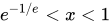

and if 


At 

Other super-roots
One of the simpler and faster formulas for a third-degree super-root is the recursive formula. If 


This recursive formula makes use of the explicit representation of the square super-root via the Lambert W function given above, as we can represent 

For each integer n > 2, the function nx is defined and increasing for x ≥ 1, and n1 = 1, so that the n-th super-root of x,
However, if the linear approximation above is used, then 

In the same way as the square super-root, terminology for other super-roots can be based on the normal roots: "cube super-roots" can be expressed as ![{\sqrt[{3}]{x}}_{s}](https://wikimedia.org/api/rest_v1/media/math/render/svg/138ec38afdb3ebf2fc8135bbb8cb65bff6befe61)
Just as with the extension of tetration to infinite heights, the super-root can be extended to n = ∞, being well-defined if 1/e ≤ x ≤ e. Note that ![x={^{\infty }y}=y^{\left[^{\infty }y\right]}=y^{x},](https://wikimedia.org/api/rest_v1/media/math/render/svg/7f7ebd4142d912bab943cb87409998b01d1db9f5)

![{\sqrt[{\infty }]{x}}_{s}=x^{1/x}](https://wikimedia.org/api/rest_v1/media/math/render/svg/b3ddabf1268a3e3defd5c54f467c228a9b577ddb)
![{\sqrt[{\infty }]{2}}_{s}=2^{1/2}={\sqrt {2}}](https://wikimedia.org/api/rest_v1/media/math/render/svg/898b11064bfad6045a6409a07d8dea136187e403)
It follows from the Gelfond-Schneider theorem that super-root 
![{\sqrt[{3}]{n}}_{s}](https://wikimedia.org/api/rest_v1/media/math/render/svg/a97577f561f9772efcb44d1dc7f43beb9099ac47)
Super-logarithm
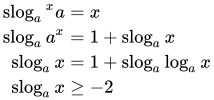
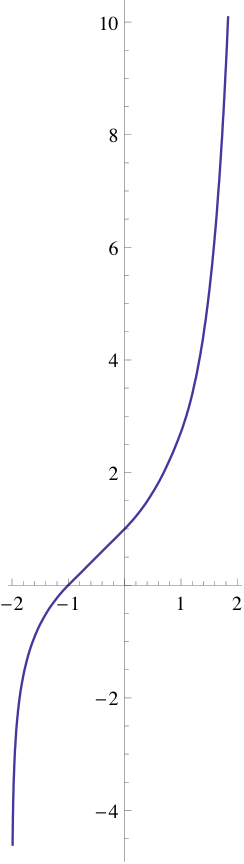
Once a continuous increasing (in x) definition of tetration, xa, is selected, the corresponding super-logarithm 

The function sloga x satisfies:
08Open questions
Other than the problems with the extensions of tetration, there are several open questions concerning tetration, particularly when concerning the relations between number systems such as integers and irrational numbers:
- It is not known whether there is an integer
for which nπ is an integer, because we can not calculate precisely enough the numbers of digits after the decimal points of
. It is similar for ne for
, as we are not aware of any other methods besides some direct computation. In fact, since
, then
. Given
and
, then
for
, given Schanuel's conjecture.
- It is not known whether nq is rational for any positive integer n and positive non-integer rational q. For example, it is not known whether the positive root of the equation 4x = 2 is rational.
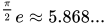
- It is not known whether eπ or πe (defined using Kneser's extension) are rationals or not.

09Applications
For each graph H on h vertices and each ε > 0, define

Then each graph G on n vertices with at most nh/D copies of H can be made H-free by removing at most εn2 edges.
Sources and credits
This article is adapted from the Wikipedia article “Tetration”, written by its contributors and licensed under CC BY-SA 4.0. Fathomly has changed the layout, removed citation markers, navigation and maintenance notices, and adjusted punctuation. This adapted version is shared under the same license. For references, see the original article.
Images, from Wikimedia Commons:
- TetrationComplexColor.png by AJRobbins at English Wikipedia, Public domain
- TetrationConvergence2D.svg by User:AJRobbins, Public domain
- Tetration period.png by en:User:Daniel Geisler, CC0
- Tetration escape.png by en:User:Daniel Geisler, CC0
- Infinite power tower.svg by RicHard-59, User:爪丹了 (gif), User:Acdx (png), CC BY-SA 3.0
- TetrationConvergence3D.png by Sam Derbyshire at English Wikipedia, CC BY-SA 3.0
- Real-tetration.png by AJRobbins at English Wikipedia, Public domain
- Approximations of 0.5 tetratrated to the x.png by IntegralPython, CC BY-SA 4.0
Fathomly is not affiliated with or endorsed by the Wikimedia Foundation. Spotted a problem? Tell us.
