Tensor product
Mathematical operation on vector spaces
In mathematics, the tensor product 






An element of the form 

The tensor product of two vector spaces captures the properties of all bilinear maps in the sense that a bilinear map from 


Tensor products are used in many application areas, including physics and engineering. For example, in general relativity, the gravitational field is described through the metric tensor, which is a tensor field with one tensor at each point of the space-time manifold, and each belonging to the tensor product of the cotangent space at the point with itself.
01Definitions and constructions
The tensor product of two vector spaces is a vector space that is defined up to an isomorphism. There are several equivalent ways to define it. Most consist of defining explicitly a vector space that is called a tensor product, and, generally, the equivalence proof results almost immediately from the basic properties of the vector spaces that are so defined.
The tensor product can also be defined through a universal property; see § Universal property, below. As for every universal property, all objects that satisfy the property are isomorphic through a unique isomorphism that is compatible with the universal property. When this definition is used, the other definitions may be viewed as constructions of objects satisfying the universal property and as proofs that there are objects satisfying the universal property, that is that tensor products exist.
From bases
Let V and W be two vector spaces over a field F, with respective bases 

The tensor product 


The set 
Equivalently, we can define 







Hence, we see that the value of 

Then we can express any bilinear form 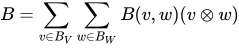

In either construction, the tensor product of two vectors is defined from their decomposition on the bases. More precisely, taking the basis decompositions of 

![{\begin{aligned}x\otimes y&={\biggl (}\sum _{v\in B_{V}}x_{v}\,v{\biggr )}\otimes {\biggl (}\sum _{w\in B_{W}}y_{w}\,w{\biggr )}\\[5mu]&=\sum _{v\in B_{V}}\sum _{w\in B_{W}}x_{v}y_{w}\,v\otimes w.\end{aligned}}](https://wikimedia.org/api/rest_v1/media/math/render/svg/ec33afd3c07c2c62f39c18eb9f9ad12451cf6ee0)
This definition is quite clearly derived from the coefficients of 


If arranged into a rectangular array, the coordinate vector of 
A limitation of this definition of the tensor product is that, if one changes bases, a different tensor product is defined. However, the decomposition on one basis of the elements of the other basis defines a canonical isomorphism between the two tensor products of vector spaces, which allows identifying them. Also, contrarily to the two following alternative definitions, this definition cannot be extended into a definition of the tensor product of modules over a ring.
As a quotient space
A construction of the tensor product that is basis independent can be obtained in the following way.
Let V and W be two vector spaces over a field F.
One considers first a vector space L that has the Cartesian product 


Let R be the linear subspace of L that is spanned by the relations that the tensor product must satisfy. More precisely, R is spanned by the elements of one of the forms:
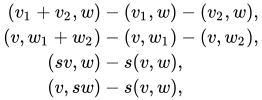
where 


Then, the tensor product is defined as the quotient space:

and the image of
It is straightforward to prove that the result of this construction satisfies the universal property considered below. (A very similar construction can be used to define the tensor product of modules.)
Universal property
In this section, the universal property satisfied by the tensor product is described. As for every universal property, two objects that satisfy the property are related by a unique isomorphism. It follows that this is a (non-constructive) way to define the tensor product of two vector spaces. In this context, the preceding constructions of tensor products may be viewed as proofs of existence of the tensor product so defined.
A consequence of this approach is that every property of the tensor product can be deduced from the universal property, and that, in practice, one may forget the method that has been used to prove its existence.
The "universal-property definition" of the tensor product of two vector spaces is the following (recall that a bilinear map is a function that is separately linear in each of its arguments):
- The tensor product of two vector spaces V and W is a vector space denoted as
from
, there is a unique linear map
, such that
(that is,
for every
Linearly disjoint
Like the universal property above, the following characterization may also be used to determine whether or not a given vector space and given bilinear map form a tensor product.
Theorem, Let 







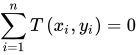
- if all
are linearly independent then all
are
, and
- if all
are linearly independent then all
are
Equivalently, 

For example, it follows immediately that if 


As another example, suppose that 


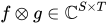





![{\begin{alignedat}{4}\;&&X\times Y&&\;\to \;&Z\\[0.3ex]&&(f,g)&&\;\mapsto \;&f\otimes g\\\end{alignedat}}](https://wikimedia.org/api/rest_v1/media/math/render/svg/0685c78a42c6a6ebac7b1b3f31969bbf1896cef1)

02Properties
Dimension
If V and W are vector spaces of finite dimension, then
This results from the fact that a basis of
Associativity
The tensor product is associative in the sense that, given three vector spaces 

that maps 

This allows omitting parentheses in the tensor product of more than two vector spaces or vectors.
Commutativity as vector space operation
The tensor product of two vector spaces

that maps 
On the other hand, even when 

The map 



induces a linear automorphism of 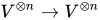

03Tensor product of linear maps
Given a linear map 

is the unique linear map such that:

The tensor product 
Given two linear maps 

is the unique linear map that satisfies:

One has:

In terms of category theory, this means that the tensor product is a bifunctor from the category of vector spaces to itself.
If f and g are both injective or surjective, then the same is true for all above defined linear maps. In particular, the tensor product with a vector space is an exact functor; this means that every exact sequence is mapped to an exact sequence (tensor products of modules do not transform injections into injections, but they are right exact functors).
By choosing bases of all vector spaces involved, the linear maps f and g can be represented by matrices. Then, depending on how the tensor 

![{\begin{aligned}{\begin{bmatrix}a_{1,1}&a_{1,2}\\a_{2,1}&a_{2,2}\\\end{bmatrix}}\otimes {\begin{bmatrix}b_{1,1}&b_{1,2}\\b_{2,1}&b_{2,2}\\\end{bmatrix}}&={\begin{bmatrix}a_{1,1}{\begin{bmatrix}b_{1,1}&b_{1,2}\\b_{2,1}&b_{2,2}\\\end{bmatrix}}&a_{1,2}{\begin{bmatrix}b_{1,1}&b_{1,2}\\b_{2,1}&b_{2,2}\\\end{bmatrix}}\\[3pt]a_{2,1}{\begin{bmatrix}b_{1,1}&b_{1,2}\\b_{2,1}&b_{2,2}\\\end{bmatrix}}&a_{2,2}{\begin{bmatrix}b_{1,1}&b_{1,2}\\b_{2,1}&b_{2,2}\\\end{bmatrix}}\\\end{bmatrix}}\\&={\begin{bmatrix}a_{1,1}b_{1,1}&a_{1,1}b_{1,2}&a_{1,2}b_{1,1}&a_{1,2}b_{1,2}\\a_{1,1}b_{2,1}&a_{1,1}b_{2,2}&a_{1,2}b_{2,1}&a_{1,2}b_{2,2}\\a_{2,1}b_{1,1}&a_{2,1}b_{1,2}&a_{2,2}b_{1,1}&a_{2,2}b_{1,2}\\a_{2,1}b_{2,1}&a_{2,1}b_{2,2}&a_{2,2}b_{2,1}&a_{2,2}b_{2,2}\\\end{bmatrix}}.\end{aligned}}](https://wikimedia.org/api/rest_v1/media/math/render/svg/1223968534d5f18d34806ac28c6d1faea6744a50)
The resultant rank is at most 4, and thus the resultant dimension is 4. rank here denotes the tensor rank i.e. the number of requisite indices (while the matrix rank counts the number of degrees of freedom in the resulting array). 
A dyadic product is the special case of the tensor product between two vectors of the same dimension.
04General tensors
For non-negative integers r and s a type 


There is a product map, called the (tensor) product of tensors:

It is defined by grouping all occurring "factors" V together: writing 


If V is finite dimensional, then picking a basis of V and the corresponding dual basis of 



Thus, the components of the tensor product of two tensors are the ordinary product of the components of each tensor. Another example: let U be a tensor of type (1, 1) with components 




Tensors equipped with their product operation form an algebra, called the tensor algebra, which is graded by the order of a tensor.
Evaluation map and tensor contraction
For tensors of type (1, 1) there is a canonical evaluation map:

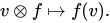
More generally, for tensors of type 
On the other hand, if 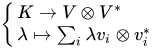


The interplay of evaluation and coevaluation can be used to characterize finite-dimensional vector spaces without referring to bases.
Adjoint representation
The tensor product 






There is a canonical isomorphism 

Under this isomorphism, every u in 
05Linear maps as tensors
Given two finite dimensional vector spaces U, V over the same field K, denote the dual space of U as U*, and the K-vector space of all linear maps from U to V as Hom(U,V). There is an isomorphism:




Its "inverse" can be defined using a basis 

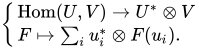
This result implies:


Furthermore, given three vector spaces U, V, W the tensor product is linked to the vector space of all linear maps, as follows:

06Tensor products of modules over a ring
The tensor product of two modules A and B over a commutative ring R is defined in exactly the same way as the tensor product of vector spaces over a field:


More generally, the tensor product can be defined even if the ring is non-commutative. In this case A has to be a right-R-module and B is a left-R-module, and instead of the last two relations above, the relation:

The universal property also carries over, slightly modified: the map 
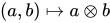
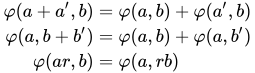
The first two properties make φ a bilinear map of the abelian group 


Tensor product of modules over a non-commutative ring
Let A be a right R-module and B be a left R-module. Then the tensor product of A and B is an abelian group defined by:

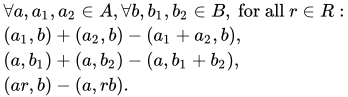
The universal property can be stated as follows. Let G be an abelian group with a map 
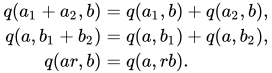
Then there is a unique map 



Furthermore, we can give
- If A is a (S,R)-bimodule, then
.
- If B is a (R,S)-bimodule, then
.
- If A is a (S,R)-bimodule and B is a (R,T)-bimodule, then
- If R is a commutative ring, then A and B are (R,R)-bimodules where
and
. By 3), we can conclude
Computing the tensor product
For vector spaces, the tensor product

More generally, given a presentation of some R-module M, that is, a number of generators 
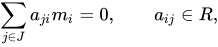

Here 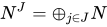



07Tensor product of algebras
Let R be a commutative ring. The tensor product of R-modules applies, in particular, if A and B are R-algebras. In this case, the tensor product 
![R[x]\otimes _{R}R[y]\cong R[x,y].](https://wikimedia.org/api/rest_v1/media/math/render/svg/ec90fcc36d25e63c6826603a7c001a9769f0b6d7)
A particular example is when A and B are fields containing a common subfield R. The tensor product of fields is closely related to Galois theory: if, say, A = R[x] / f(x), where f is some irreducible polynomial with coefficients in R, the tensor product can be calculated as:
![A\otimes _{R}B\cong B[x]/f(x)](https://wikimedia.org/api/rest_v1/media/math/render/svg/7ee63790e6b1781257fb2d994254582369474f23)
![A\otimes _{R}A\cong A[x]/f(x)](https://wikimedia.org/api/rest_v1/media/math/render/svg/bdb0e3d4bf455da8e9b8c7fd62052e8dbbbdc804)

08Eigenconfigurations of tensors
Square matrices 




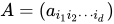




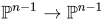

Thus each of the 




09Other examples of tensor products
Topological tensor products
Hilbert spaces generalize finite-dimensional vector spaces to arbitrary dimensions. There is an analogous operation, also called the "tensor product," that makes Hilbert spaces a symmetric monoidal category. It is essentially constructed as the metric space completion of the algebraic tensor product discussed above. However, it does not satisfy the obvious analogue of the universal property defining tensor products; the morphisms for that property must be restricted to Hilbert-Schmidt operators.
In situations where the imposition of an inner product is inappropriate, one can still attempt to complete the algebraic tensor product, as a topological tensor product. However, such a construction is no longer uniquely specified: in many cases, there are multiple natural topologies on the algebraic tensor product.
Tensor product of graded vector spaces
Some vector spaces can be decomposed into direct sums of subspaces. In such cases, the tensor product of two spaces can be decomposed into sums of products of the subspaces (in analogy to the way that multiplication distributes over addition).
Tensor product of representations
Vector spaces endowed with an additional multiplicative structure are called algebras. The tensor product of such algebras is described by the Littlewood-Richardson rule.
Tensor product of algebraic fields
Given two fields that are algebraic extensions of a common base field, their tensor product over the base field is again algebraic over the base field. Specifically, it is the algebraic extension generated by the products of the generators of the original two fields. For example, the tensor product over the rational numbers of ![\mathbb {Q} [{\sqrt {2}}]](https://wikimedia.org/api/rest_v1/media/math/render/svg/eee5632589347f1355af6412f95e450543d1a350)
![\mathbb {Q} [{\sqrt {3}}]](https://wikimedia.org/api/rest_v1/media/math/render/svg/c39be7b78458a1b1720458feb0cccdd7cf710e27)


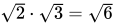
![\mathbb {Q} [{\sqrt {2}},{\sqrt {3}}]](https://wikimedia.org/api/rest_v1/media/math/render/svg/7c2da23a271e183b4c292756c7776c10d97fddea)
Tensor product of quadratic forms
Tensor product of multilinear forms
Given two multilinear forms 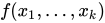
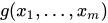

This is a special case of the product of tensors if they are seen as multilinear maps (see also tensors as multilinear maps). Thus the components of the tensor product of multilinear forms can be computed by the Kronecker product.
Tensor product of sheaves of modules
Tensor product of line bundles
Tensor product of fields
Tensor product of graphs
It should be mentioned that, though called "tensor product", this is not a tensor product of graphs in the above sense; actually it is the category-theoretic product in the category of graphs and graph homomorphisms. However it is actually the Kronecker tensor product of the adjacency matrices of the graphs. Compare also the section Tensor product of linear maps above.
Monoidal categories
The most general setting for the tensor product is the monoidal category. It captures the algebraic essence of tensoring, without making any specific reference to what is being tensored. Thus, all tensor products can be expressed as an application of the monoidal category to some particular setting, acting on some particular objects.
10Quotient algebras
A number of important subspaces of the tensor algebra can be constructed as quotients: these include the exterior algebra, the symmetric algebra, the Clifford algebra, the Weyl algebra, and the universal enveloping algebra in general.
The exterior algebra is constructed from the exterior product. Given a vector space V, the exterior product 

When the underlying field of V does not have characteristic 2, then this definition is equivalent to:

The image of 


The symmetric algebra is constructed in a similar manner, from the symmetric product:

More generally:

That is, in the symmetric algebra two adjacent vectors (and therefore all of them) can be interchanged. The resulting objects are called symmetric tensors.
11Tensor product in programming
Array programming languages
Array programming languages may have this pattern built in. For example, in APL the tensor product is expressed as ○.× (for example A ○.× B or A ○.× B ○.× C). In J the tensor product is the dyadic form of */ (for example a */ b or a */ b */ c).
J's treatment also allows the representation of some tensor fields, as a and b may be functions instead of constants. This product of two functions is a derived function, and if a and b are differentiable, then a */ b is differentiable.
However, these kinds of notation are not universally present in array languages. Other array languages may require explicit treatment of indices (for example, MATLAB), and/or may not support higher-order functions such as the Jacobian derivative (for example, Fortran/APL).
Sources and credits
This article is adapted from the Wikipedia article “Tensor product”, written by its contributors and licensed under CC BY-SA 4.0. Fathomly has changed the layout, removed citation markers, navigation and maintenance notices, and adjusted punctuation. This adapted version is shared under the same license. For references, see the original article.
Images, from Wikimedia Commons:
- Another universal tensor prod.svg by IkamusumeFan, CC BY-SA 4.0
Fathomly is not affiliated with or endorsed by the Wikimedia Foundation. Spotted a problem? Tell us.
