Reference articles on history, science, culture and more
Encyclopedia

Summability kernel

Family of functions

In mathematics, a summability kernel is a family or sequence of periodic integrable functions satisfying a certain set of properties, listed below. Certain kernels, such as the Fejér kernel, are particularly useful in Fourier analysis. Summability kernels are related to approximation of the identity; definitions of an approximation of identity vary, but sometimes the definition of an approximation of the identity is taken to be the same as for a summability kernel.

01Definition

Let \mathbb {T} :=\mathbb {R} /\mathbb {Z}. A summability kernel is a sequence (k_{n}) in L^{1}(\mathbb {T} ) that satisfies

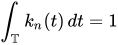
  1. \int _{\mathbb {T} }k_{n}(t)\,dt=1
  2. \int _{\mathbb {T} }|k_{n}(t)|\,dt\leq M (uniformly bounded)
  3. \int _{\delta \leq |t|\leq {\frac {1}{2}}}|k_{n}(t)|\,dt\to 0 as n\to \infty, for every \delta >0.

Note that if k_{n}\geq 0 for all n, i.e. (k_{n}) is a positive summability kernel, then the second requirement follows automatically from the first.

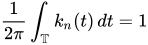
With the more usual convention \mathbb {T} =\mathbb {R} /2\pi \mathbb {Z}, the first equation becomes {\frac {1}{2\pi }}\int _{\mathbb {T} }k_{n}(t)\,dt=1, and the upper limit of integration on the third equation should be extended to \pi, so that the condition 3 above should be

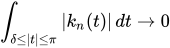
\int _{\delta \leq |t|\leq \pi }|k_{n}(t)|\,dt\to 0 as n\to \infty, for every \delta >0.

This expresses the fact that the mass concentrates around the origin as n increases.

One can also consider \mathbb {R} rather than \mathbb {T}; then (1) and (2) are integrated over \mathbb {R}, and (3) over |t|>\delta.

02Examples

03Convolutions

Let (k_{n}) be a summability kernel, and * denote the convolution operation.

  • If (k_{n}),f\in {\mathcal {C}}(\mathbb {T} ) (continuous functions on \mathbb {T}), then k_{n}*f\to f in {\mathcal {C}}(\mathbb {T} ), i.e. uniformly, as n\to \infty. In the case of the Fejér kernel this is known as Fejér's theorem.
  • If (k_{n}),f\in L^{1}(\mathbb {T} ), then k_{n}*f\to f in L^{1}(\mathbb {T} ), as n\to \infty.
  • If (k_{n}) is radially decreasing symmetric and f\in L^{1}(\mathbb {T} ), then k_{n}*f\to f pointwise a.e., as n\to \infty. This uses the Hardy-Littlewood maximal function. If (k_{n}) is not radially decreasing symmetric, but the decreasing symmetrization {\widetilde {k}}_{n}(x):=\sup _{|y|\geq |x|}k_{n}(y) satisfies \sup _{n\in \mathbb {N} }\|{\widetilde {k}}_{n}\|_{1}<\infty, then a.e. convergence still holds, using a similar argument.
Watch videos about Summability kernelExplainers and documentaries on YouTube (opens in a new tab)

Sources and credits

This article is adapted from the Wikipedia article Summability kernel, written by its contributors and licensed under CC BY-SA 4.0. Fathomly has changed the layout, removed citation markers, navigation and maintenance notices, and adjusted punctuation. This adapted version is shared under the same license. For references, see the original article.

Fathomly is not affiliated with or endorsed by the Wikimedia Foundation. Spotted a problem? Tell us.