Dirichlet kernel
Concept in mathematical analysis

In mathematical analysis, the Dirichlet kernel, is the collection of periodic functions defined as

where n is any nonnegative integer. The kernel functions are periodic with period 
The importance of the Dirichlet kernel comes from its relation to Fourier series. The convolution of 



where

is the 
The Dirichlet kernel was named for Peter Gustav Lejeune Dirichlet.
01Applications
In signal processing, the Dirichlet kernel is often called the periodic sinc function:

where 


where 

In optics, the Dirichlet kernel is part of the mathematical description of the diffraction pattern formed when monochromatic light passes through an aperture with multiple narrow slits of equal width and equally spaced along an axis perpendicular to the optical axis. In this case, 

02L1 norm of the kernel function
Of particular importance is the fact that the 

![[0,2\pi ]](https://wikimedia.org/api/rest_v1/media/math/render/svg/348d40bf3f8b7e1c00c4346440d7e2e4f0cc9b91)


By using a Riemann-sum argument to estimate the contribution in the largest neighbourhood of zero in which

where 
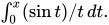
This lack of uniform integrability is behind many divergence phenomena for the Fourier series. For example, together with the uniform boundedness principle, it can be used to show that the Fourier series of a continuous function may fail to converge pointwise, in rather dramatic fashion. See convergence of Fourier series for further details.
A precise proof of the first result that ![\|D_{n}\|_{L^{1}[0,2\pi ]}=\Omega (\log n)](https://wikimedia.org/api/rest_v1/media/math/render/svg/7acb94498470c7756f499dbc2e6dff8a5b307f66)
![{\begin{aligned}\int _{0}^{2\pi }|D_{n}(x)|\,dx&\geq \int _{0}^{\pi }{\frac {\left|\sin[(2n+1)x]\right|}{x}}\,dx\\[5pt]&\geq \sum _{k=0}^{2n}\int _{k\pi }^{(k+1)\pi }{\frac {\left|\sin s\right|}{s}}\,ds\\[5pt]&\geq \left|\sum _{k=0}^{2n}\int _{0}^{\pi }{\frac {\sin s}{(k+1)\pi }}\,ds\right|\\[5pt]&={\frac {2}{\pi }}H_{2n+1}\\[5pt]&\geq {\frac {2}{\pi }}\log(2n+1),\end{aligned}}](https://wikimedia.org/api/rest_v1/media/math/render/svg/9367a8708bfc9c31d250041054d6d860fa58994e)
where we have used the Taylor series identity that 

03Relation to the periodic delta function
The Dirichlet kernel is a periodic function which becomes the Dirac comb, i.e. the periodic delta function, in the limit

with the angular frequency 
This can be inferred from the autoconjugation property of the Dirichlet kernel under forward and inverse Fourier transform:
={\mathcal {F}}^{-1}\left[D_{n}(2\pi x)\right](\xi )=\int _{-\infty }^{\infty }D_{n}(2\pi x)e^{\pm i2\pi \xi x}\,dx=\sum _{k=-n}^{+n}\delta (\xi -k)\equiv \operatorname {comb} _{n}(\xi )](https://wikimedia.org/api/rest_v1/media/math/render/svg/18cf07d5a74d369871627f9f2a97e025b7da69b7)
={\mathcal {F}}^{-1}\left[\operatorname {comb} _{n}\right](x)=\int _{-\infty }^{\infty }\operatorname {comb} _{n}(\xi )e^{\pm i2\pi \xi x}\,d\xi =D_{n}(2\pi x),](https://wikimedia.org/api/rest_v1/media/math/render/svg/56adcde42c72d32ad8115a69826bec62c7914050)
and 


![{\mathcal {F}}[\operatorname {\text{Ш}} ]=\operatorname {\text{Ш}}](https://wikimedia.org/api/rest_v1/media/math/render/svg/c15b99006d26a75e8228fac6b08cb67674840752)

In a different vein, consider 

for every function

(This Fourier series converges to the function almost nowhere.) Therefore, the Dirichlet kernel, which is just the sequence of partial sums of this series, can be thought of as an approximate identity. Abstractly speaking it is not however an approximate identity of positive elements (hence the failures in pointwise convergence mentioned above).
04Proof of the trigonometric identity
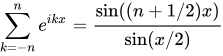
displayed at the top of this article may be established as follows. First recall that the sum of a finite geometric series is
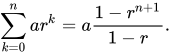
In particular, we have
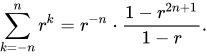
Multiply both the numerator and the denominator by 

In the case 

as required.
Alternative proof of the trigonometric identity
Start with the series
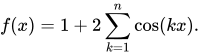
Multiply both sides by 

to reduce the terms in the sum.

which telescopes down to the result.
05Variant of identity
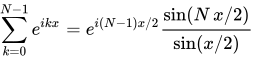
If the sum is only over non-negative integers (which may arise when computing a discrete Fourier transform that is not centered), then using similar techniques we can show the following identity:
Another variant is

and this can be easily proved by using an identity 
Sources and credits
This article is adapted from the Wikipedia article “Dirichlet kernel”, written by its contributors and licensed under CC BY-SA 4.0. Fathomly has changed the layout, removed citation markers, navigation and maintenance notices, and adjusted punctuation. This adapted version is shared under the same license. For references, see the original article.
Images, from Wikimedia Commons:
- Dirichlet kernel anime.gif by Picknick, CC BY-SA 4.0
- Dirichlet kernels.svg by Dirichlet.png: Libsteria derivative work: Azaghal of Belegost, CC BY-SA 4.0
Fathomly is not affiliated with or endorsed by the Wikimedia Foundation. Spotted a problem? Tell us.
