Sum of squares function
Number-theoretical function
In number theory, the sum of squares function is an arithmetic function that gives the number of representations for a given positive integer 


01Definition
The function is defined as

where 
For example, 





02Formulae
k = 2
The number of ways to write a natural number as sum of two squares is given by 

where 

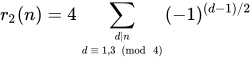
The prime factorization 




 , if all exponents
  are
are  are
are  .
.k = 3
Gauss proved that for a squarefree number 
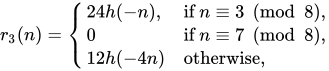
where 

There exist extensions of Gauss' formula to arbitrary integer
k = 4
The number of ways to represent

Representing 


k = 6
The number of ways to represent

where 
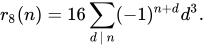
k = 8
Jacobi also found an explicit formula for the case 
03Generating function
The generating function of the sequence
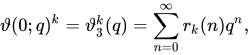
where

04Numerical values
The first 30 values for 
| n | = |  | |  | |  |  |  |  |
|---|---|---|---|---|---|---|---|---|---|
| 0 | 0 | 1 | 1 | 1 | 1 | 1 | 1 | 1 | 1 |
| 1 | 1 | 2 | 4 | 6 | 8 | 10 | 12 | 14 | 16 |
| 2 | 2 | 0 | 4 | 12 | 24 | 40 | 60 | 84 | 112 |
| 3 | 3 | 0 | 0 | 8 | 32 | 80 | 160 | 280 | 448 |
| 4 | 22 | 2 | 4 | 6 | 24 | 90 | 252 | 574 | 1136 |
| 5 | 5 | 0 | 8 | 24 | 48 | 112 | 312 | 840 | 2016 |
| 6 | 2×3 | 0 | 0 | 24 | 96 | 240 | 544 | 1288 | 3136 |
| 7 | 7 | 0 | 0 | 0 | 64 | 320 | 960 | 2368 | 5504 |
| 8 | 23 | 0 | 4 | 12 | 24 | 200 | 1020 | 3444 | 9328 |
| 9 | 32 | 2 | 4 | 30 | 104 | 250 | 876 | 3542 | 12112 |
| 10 | 2×5 | 0 | 8 | 24 | 144 | 560 | 1560 | 4424 | 14112 |
| 11 | 11 | 0 | 0 | 24 | 96 | 560 | 2400 | 7560 | 21312 |
| 12 | 22×3 | 0 | 0 | 8 | 96 | 400 | 2080 | 9240 | 31808 |
| 13 | 13 | 0 | 8 | 24 | 112 | 560 | 2040 | 8456 | 35168 |
| 14 | 2×7 | 0 | 0 | 48 | 192 | 800 | 3264 | 11088 | 38528 |
| 15 | 3×5 | 0 | 0 | 0 | 192 | 960 | 4160 | 16576 | 56448 |
| 16 | 24 | 2 | 4 | 6 | 24 | 730 | 4092 | 18494 | 74864 |
| 17 | 17 | 0 | 8 | 48 | 144 | 480 | 3480 | 17808 | 78624 |
| 18 | 2×32 | 0 | 4 | 36 | 312 | 1240 | 4380 | 19740 | 84784 |
| 19 | 19 | 0 | 0 | 24 | 160 | 1520 | 7200 | 27720 | 109760 |
| 20 | 22×5 | 0 | 8 | 24 | 144 | 752 | 6552 | 34440 | 143136 |
| 21 | 3×7 | 0 | 0 | 48 | 256 | 1120 | 4608 | 29456 | 154112 |
| 22 | 2×11 | 0 | 0 | 24 | 288 | 1840 | 8160 | 31304 | 149184 |
| 23 | 23 | 0 | 0 | 0 | 192 | 1600 | 10560 | 49728 | 194688 |
| 24 | 23×3 | 0 | 0 | 24 | 96 | 1200 | 8224 | 52808 | 261184 |
| 25 | 52 | 2 | 12 | 30 | 248 | 1210 | 7812 | 43414 | 252016 |
| 26 | 2×13 | 0 | 8 | 72 | 336 | 2000 | 10200 | 52248 | 246176 |
| 27 | 33 | 0 | 0 | 32 | 320 | 2240 | 13120 | 68320 | 327040 |
| 28 | 22×7 | 0 | 0 | 0 | 192 | 1600 | 12480 | 74048 | 390784 |
| 29 | 29 | 0 | 8 | 72 | 240 | 1680 | 10104 | 68376 | 390240 |
| 30 | 2×3×5 | 0 | 0 | 48 | 576 | 2720 | 14144 | 71120 | 395136 |
Sources and credits
This article is adapted from the Wikipedia article “Sum of squares function”, written by its contributors and licensed under CC BY-SA 4.0. Fathomly has changed the layout, removed citation markers, navigation and maintenance notices, and adjusted punctuation. This adapted version is shared under the same license. For references, see the original article.
Images, from Wikimedia Commons:
- Sum of two squares theorem.svg by Cmglee, CC BY-SA 4.0
Fathomly is not affiliated with or endorsed by the Wikimedia Foundation. Spotted a problem? Tell us.

