Ringed space
Sheaf of rings in mathematics
In mathematics, a ringed space is a family of (commutative) rings parametrized by open subsets of a topological space together with ring homomorphisms that play roles of restrictions. Precisely, it is a topological space equipped with a sheaf of rings called a structure sheaf. It is an abstraction of the concept of the rings of continuous (scalar-valued) functions on open subsets.
Among ringed spaces, especially important and prominent is a locally ringed space: a ringed space in which the analogy between the stalk at a point and the ring of germs of functions at a point is valid.
Ringed spaces appear in analysis as well as complex algebraic geometry and the scheme theory of algebraic geometry.
Note: In the definition of a ringed space, most expositions tend to restrict the rings to be commutative rings, including Hartshorne and Wikipedia. Éléments de géométrie algébrique, on the other hand, does not impose the commutativity assumption, although the book mostly considers the commutative case.
01Definitions
A ringed space is a topological space
together with a sheaf of rings
on
. The sheaf
is called the structure sheaf of
.
A locally ringed space is a ringed space such that all stalks of
are local rings (i.e. they have unique maximal ideals). Note that it is not required that
be a local ring for every open set
; in fact, this is almost never the case.

02Examples
An arbitrary topological space can be considered a locally ringed space by taking
to be the sheaf of real-valued (or complex-valued) continuous functions on open subsets of
. The stalk at a point
can be thought of as the set of all germs of continuous functions at
; this is a local ring with the unique maximal ideal consisting of those germs whose value at
is
.
If is a manifold with some extra structure, we can also take the sheaf of differentiable, or holomorphic functions. Both of these give rise to locally ringed spaces.
If is an algebraic variety carrying the Zariski topology, we can define a locally ringed space by taking
to be the ring of rational mappings defined on the Zariski-open set
that do not blow up (become infinite) within
. The important generalization of this example is that of the spectrum of any commutative ring; these spectra are also locally ringed spaces. Schemes are locally ringed spaces obtained by "gluing together" spectra of commutative rings.
03Morphisms
A morphism from to
is a pair
, where
is a continuous map between the underlying topological spaces, and
is a morphism from the structure sheaf of
to the direct image of the structure sheaf of X. In other words, a morphism from
to
is given by the following data:
- a continuous map
- a family of ring homomorphisms
for every open set
of
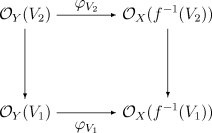
that commute with the restriction maps. That is, if
are two open subsets of
, then the following diagram must commute (the vertical maps are the restriction homomorphisms):
There is an additional requirement for morphisms between locally ringed spaces:
- the ring homomorphisms induced by
between the stalks of
and the stalks of
must be local homomorphisms, i.e. for every
the maximal ideal of the local ring (stalk) at
is mapped into the maximal ideal of the local ring at
.
Two morphisms can be composed to form a new morphism, and we obtain the category of ringed spaces and the category of locally ringed spaces. Isomorphisms in these categories are defined as usual.
04Tangent spaces
Locally ringed spaces have just enough structure to allow the meaningful definition of tangent spaces. Let be a locally ringed space with structure sheaf
; we want to define the tangent space
at the point
. Take the local ring (stalk)
at the point
, with maximal ideal
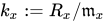
. Then
is a field and
is a vector space over that field (the cotangent space). The tangent space
is defined as the dual of this vector space.
The idea is the following: a tangent vector at should tell you how to "differentiate" "functions" at
, i.e. the elements of
. Now it is enough to know how to differentiate functions whose value at
is zero, since all other functions differ from these only by a constant, and we know how to differentiate constants. So we only need to consider
. Furthermore, if two functions are given with value zero at
, then their product has derivative 0 at
, by the product rule. So we only need to know how to assign "numbers" to the elements of
, and this is what the dual space does.
05Modules over the structure sheaf
Given a locally ringed space , certain sheaves of modules on
occur in the applications, the
-modules. To define them, consider a sheaf
of abelian groups on
. If
is a module over the ring
for every open set
in
, and the restriction maps are compatible with the module structure, then we call
an
-module. In this case, the stalk of
at
will be a module over the local ring (stalk)
, for every
.
A morphism between two such -modules is a morphism of sheaves that is compatible with the given module structures. The category of
-modules over a fixed locally ringed space
is an abelian category.
An important subcategory of the category of -modules is the category of quasi-coherent sheaves on
. A sheaf of
-modules is called quasi-coherent if it is, locally, isomorphic to the cokernel of a map between free
-modules. A coherent sheaf
is a quasi-coherent sheaf that is, locally, of finite type and for every open subset
of
the kernel of any morphism from a free
-module of finite rank to
is also of finite type.
Sources and credits
This article is adapted from the Wikipedia article “Ringed space”, written by its contributors and licensed under CC BY-SA 4.0. Fathomly has changed the layout, removed citation markers, navigation and maintenance notices, and adjusted punctuation. This adapted version is shared under the same license. For references, see the original article.
Images, from Wikimedia Commons:
- LocallyRingedSpace-01.png by Unknown author, Public domain
Fathomly is not affiliated with or endorsed by the Wikimedia Foundation. Spotted a problem? Tell us.