String topology
Branch of topology
String topology, a branch of mathematics, is the study of algebraic structures on the homology of free loop spaces. The field was started by Moira Chas and Dennis Sullivan (1999).
01Motivation
While the singular cohomology of a space has always a product structure, this is not true for the singular homology of a space. Nevertheless, it is possible to construct such a structure for an oriented manifold 






Another case, where the homology of a space has a product, is the (based) loop space 


by going first through the first loop and then through the second one. There is no analogous product structure for the free loop space 



where 


02The Chas-Sullivan product
The idea of the Chas-Sullivan product is to now combine the product structures above. Consider two classes 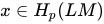
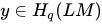



One way to construct this is to use stratifolds (or another geometric definition of homology) to do transversal intersection (after interpreting 
Now we can compose 
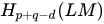
03Remarks
- As in the case of the intersection product, there are different sign conventions concerning the Chas-Sullivan product. In some convention, it is graded commutative, in some it is not.
- The same construction works if we replace
by another multiplicative homology theory
if
- Furthermore, we can replace
by
. By an easy variation of the above construction, we get that
is a module over
if
is a manifold of dimensions
.
- The Serre spectral sequence is compatible with the above algebraic structures for both the fiber bundle
with fiber
and the fiber bundle
for a fiber bundle
, which is important for computations (see Cohen, Jones & Yan (2004) and Meier (2010) harvtxt error: no target: CITEREFMeier2010 (help)).
04The Batalin-Vilkovisky structure
There is an action 
.
Plugging in the fundamental class ![[S^{1}]\in H_{1}(S^{1})](https://wikimedia.org/api/rest_v1/media/math/render/svg/374a4f778fe7286f95c14f452e1b4d7f6f54718f)

of degree 1. One can show that this operator interacts nicely with the Chas-Sullivan product in the sense that they form together the structure of a Batalin-Vilkovisky algebra on 
05Field theories
There are several attempts to construct (topological) field theories via string topology. The basic idea is to fix an oriented manifold 



which fulfills the usual axioms for a topological field theory. The Chas-Sullivan product is associated to the pair of pants. It can be shown that these operations are 0 if the genus of the surface is greater than 0 (Tamanoi (2010)).
Sources and credits
This article is adapted from the Wikipedia article “String topology”, written by its contributors and licensed under CC BY-SA 4.0. Fathomly has changed the layout, removed citation markers, navigation and maintenance notices, and adjusted punctuation. This adapted version is shared under the same license. For references, see the original article.
Fathomly is not affiliated with or endorsed by the Wikimedia Foundation. Spotted a problem? Tell us.