Strategic complements
Game theory concept
In economics and game theory, the decisions of two or more players are called strategic complements if they mutually reinforce one another, and they are called strategic substitutes if they mutually offset one another. These terms were originally coined by Bulow, Geanakoplos, and Klemperer (1985).
To see what is meant by 'reinforce' or 'offset', consider a situation in which the players all have similar choices to make, as in the paper of Bulow et al., where the players are all imperfectly competitive firms that must each decide how much to produce. Then the production decisions are strategic complements if an increase in the production of one firm increases the marginal revenues of the others, because that gives the others an incentive to produce more too. This tends to be the case if there are sufficiently strong aggregate increasing returns to scale and/or the demand curves for the firms' products have a sufficiently low own-price elasticity. On the other hand, the production decisions are strategic substitutes if an increase in one firm's output decreases the marginal revenues of the others, giving them an incentive to produce less.
According to Russell Cooper and Andrew John, strategic complementarity is the basic property underlying examples of multiple equilibria in coordination games.
01Calculus formulation
Mathematically, consider a symmetric game with two players that each have payoff function 


On the other hand, the decisions are strategic substitutes if
02Example
In their original paper, Bulow et al. use a simple model of competition between two firms to illustrate their ideas.
The revenue for firm x with production rates 

while the revenue for firm y with production rate 

At any interior equilibrium, 
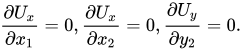
Using vector calculus, geometric algebra, or differential geometry, Bulow et al. showed that the sensitivity
of the Cournot equilibrium to changes in 
![{\begin{bmatrix}{\dfrac {dx_{1}^{*}}{dp_{1}}}\\[2.2ex]{\dfrac {dx_{2}^{*}}{dp_{1}}}\\[2.2ex]{\dfrac {dy_{2}^{*}}{dp_{1}}}\end{bmatrix}}={\begin{bmatrix}{\dfrac {\partial ^{2}U_{x}}{\partial x_{1}\partial x_{1}}}&{\dfrac {\partial ^{2}U_{x}}{\partial x_{1}\partial x_{2}}}&{\dfrac {\partial ^{2}U_{x}}{\partial x_{1}\partial y_{2}}}\\[2.2ex]{\dfrac {\partial ^{2}U_{x}}{\partial x_{1}\partial x_{2}}}&{\dfrac {\partial ^{2}U_{x}}{\partial x_{2}\partial x_{2}}}&{\dfrac {\partial ^{2}U_{x}}{\partial y_{2}\partial x_{2}}}\\[2.2ex]{\dfrac {\partial ^{2}U_{y}}{\partial x_{1}\partial y_{2}}}&{\dfrac {\partial ^{2}U_{y}}{\partial x_{2}\partial y_{2}}}&{\dfrac {\partial ^{2}U_{y}}{\partial y_{2}\partial y_{2}}}\end{bmatrix}}^{-1}{\begin{bmatrix}-{\dfrac {\partial ^{2}U_{x}}{\partial p_{1}\partial x_{1}}}\\[2.2ex]-{\dfrac {\partial ^{2}U_{x}}{\partial p_{1}\partial x_{2}}}\\[2.2ex]-{\dfrac {\partial ^{2}U_{y}}{\partial p_{1}\partial y_{2}}}\end{bmatrix}}](https://wikimedia.org/api/rest_v1/media/math/render/svg/9bb1074b85460d982a391f2f9142a8908d48dec6)
When 
![{\begin{bmatrix}{\dfrac {dx_{1}^{*}}{dp_{1}}}\\[2.2ex]{\dfrac {dx_{2}^{*}}{dp_{1}}}\\[2.2ex]{\dfrac {dy_{2}^{*}}{dp_{1}}}\end{bmatrix}}={\begin{bmatrix}-1&-1&0\\-1&-3&-1\\0&-1&-3\end{bmatrix}}^{-1}{\begin{bmatrix}-1\\0\\0\end{bmatrix}}={\frac {1}{5}}{\begin{bmatrix}8\\-3\\1\end{bmatrix}}](https://wikimedia.org/api/rest_v1/media/math/render/svg/bc09743a8c9f98bddbbec4a76719d7ddbe4b20ab)
This, as price is increased in market 1, Firm x sells more in market 1 and less in market 2, while firm y sells more in market 2. If the Cournot equilibrium of this model is calculated explicitly, we find

03Supermodular games
A game with strategic complements is also called a supermodular game. This was first formalized by Topkis, and studied by Vives. There are efficient algorithms for finding pure-strategy Nash equilibria in such games.
Supermodular games are a particularly important and well-behaved class of games because the principle of strategic complementarity ensures that players' best response functions are monotonic (non-decreasing).
Sources and credits
This article is adapted from the Wikipedia article “Strategic complements”, written by its contributors and licensed under CC BY-SA 4.0. Fathomly has changed the layout, removed citation markers, navigation and maintenance notices, and adjusted punctuation. This adapted version is shared under the same license. For references, see the original article.
Fathomly is not affiliated with or endorsed by the Wikimedia Foundation. Spotted a problem? Tell us.