Supermodular function
Class of mathematical functions
In mathematics, a supermodular function is a function on a lattice that, informally, has the property of being characterized by "increasing differences." Seen from the point of set functions, this can also be viewed as a relationship of "increasing returns", where adding more elements to a subset increases its valuation. In economics, supermodular functions are often used as a formal expression of complementarity in preferences among goods. Supermodular functions are studied and have applications in game theory, economics, lattice theory, combinatorial optimization, and machine learning.
01Definition
Let 


for all 
If the inequality is strict, then 


We can also define supermodular functions where the underlying lattice is the vector space 


for all 


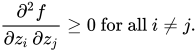
If f is twice continuously differentiable, then supermodularity is equivalent to the condition
02Supermodularity in economics and game theory
The concept of supermodularity is used in the social sciences to analyze how one agent's decision affects the incentives of others.
Consider a symmetric game with a smooth payoff function 


![z_{i}\in [a,b]](https://wikimedia.org/api/rest_v1/media/math/render/svg/583d79f885377ac896c3ad49202c217807832fc6)


The opposite case of supermodularity of
For example, Bulow et al. consider the interactions of many imperfectly competitive firms. When an increase in output by one firm raises the marginal revenues of the other firms, production decisions are strategic complements. When an increase in output by one firm lowers the marginal revenues of the other firms, production decisions are strategic substitutes.
A supermodular utility function is often related to complementary goods. However, this view is disputed.
03Supermodular set functions
Supermodularity can also be defined for set functions, which are functions defined over subsets of a larger set. Many properties of submodular set functions can be rephrased to apply to supermodular set functions.
Intuitively, a supermodular function over a set of subsets demonstrates "increasing returns". This means that if each subset is assigned a real number that corresponds to its value, the value of a subset will always be less than the value of a larger subset which contains it. Alternatively, this means that as we add elements to a set, we increase its value.
Definition
Let 

for all
.
for all
, where
.
A set function
Additional Facts
- If
is submodular, then
is a supermodular function.
- A non-negative supermodular function is also a superadditive function.
04Optimization Techniques
There are specialized techniques for optimizing submodular functions. Theory and enumeration algorithms for finding local and global maxima (minima) of submodular (supermodular) functions can be found in "Maximization of submodular functions: Theory and enumeration algorithms", B. Goldengorin.
Sources and credits
This article is adapted from the Wikipedia article “Supermodular function”, written by its contributors and licensed under CC BY-SA 4.0. Fathomly has changed the layout, removed citation markers, navigation and maintenance notices, and adjusted punctuation. This adapted version is shared under the same license. For references, see the original article.
Fathomly is not affiliated with or endorsed by the Wikimedia Foundation. Spotted a problem? Tell us.