Markov kernel
Concept in probability theory
In probability theory, a Markov kernel (also known as a stochastic kernel or probability kernel) is a map that in the general theory of Markov processes plays the role that the transition matrix does in the theory of Markov processes with a finite state space.
01Formal definition
Let 


![\kappa :{\mathcal {B}}\times X\to [0,1]](https://wikimedia.org/api/rest_v1/media/math/render/svg/6e14346f77cafa02a3bb9f0e58fd64cbef2fadc5)
- For every (fixed)
, the map
is
-measurable
- For every (fixed)
, the map
is a probability measure on
In other words it associates to each point 



02Examples
Simple random walk on the integers
Take 



.
Now the random walk 



where 

General Markov processes with countable state space
More generally take 



,
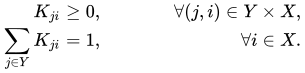
We define a Markov process by defining a transition probability 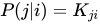


We then define
.
Again the transition probability, the stochastic matrix and the Markov kernel are equivalent reformulations.
Markov kernel defined by a kernel function and a measure
Let 
![k:Y\times X\to [0,\infty ]](https://wikimedia.org/api/rest_v1/media/math/render/svg/cc0c8e93b08e6b794aafb6d0addfb0a89682844f)

,
then 
![{\begin{cases}\kappa :{\mathcal {B}}\times X\to [0,1]\\\kappa (B|x)=\int _{B}k(y,x)\nu (\mathrm {d} y)\end{cases}}](https://wikimedia.org/api/rest_v1/media/math/render/svg/108781193dc73ba702e77da371698684096dec55)
defines a Markov kernel. This example generalises the countable Markov process example where 


Measurable functions
Take 

for all
Note that the indicator function 

This example allows us to think of a Markov kernel as a generalised function with a (in general) random rather than certain value. That is, it is a multivalued function where the values are not equally weighted.
Galton-Watson process
As a less obvious example, take 


where 


03Composition of Markov Kernels
Given measurable spaces 



.
The composition is associative by the Monotone Convergence Theorem and the identity function considered as a Markov kernel (i.e. the delta measure 
This composition defines the structure of a category on the measurable spaces with Markov kernels as morphisms, first defined by Lawvere, the category of Markov kernels.
04Probability Space defined by Probability Distribution and a Markov Kernel
A composition of a probability space 


05Properties
Semidirect product
Let 



Regular conditional distribution
Let 


![\mathbb {E} [\mathbf {1} _{\{X\in B\}}\mid {\mathcal {G}}]](https://wikimedia.org/api/rest_v1/media/math/render/svg/ea3eb6fa30d760bf9cc72ef0e9d1a736f5df0a5c)

![P(X\in B\mid {\mathcal {G}})=\mathbb {E} \left[\mathbf {1} _{\{X\in B\}}\mid {\mathcal {G}}\right]=\kappa (\cdot ,B),\qquad P{\text{-a.s.}}\,\,\forall B\in Y.](https://wikimedia.org/api/rest_v1/media/math/render/svg/f89e174353e6618f937fe541f114cd3746118947)
It is called regular conditional distribution of 
06Generalizations
Transition kernels generalize Markov kernels in the sense that for all

can be any type of (non negative) measure, not necessarily a probability measure.
Sources and credits
This article is adapted from the Wikipedia article “Markov kernel”, written by its contributors and licensed under CC BY-SA 4.0. Fathomly has changed the layout, removed citation markers, navigation and maintenance notices, and adjusted punctuation. This adapted version is shared under the same license. For references, see the original article.
Fathomly is not affiliated with or endorsed by the Wikimedia Foundation. Spotted a problem? Tell us.