Steane code
Code for quantum correction
The Steane code is a tool in quantum error correction introduced by Andrew Steane in 1996. It is a CSS code (Calderbank-Shor-Steane), using the classical binary [7,4,3] Hamming code to correct for both qubit flip errors (X errors) and phase flip errors (Z errors). The Steane code encodes one logical qubit in 7 physical qubits and is able to correct arbitrary single qubit errors.
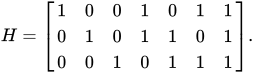
Its check matrix in standard form is

where H is the parity-check matrix of the Hamming code and is given by
The ![[[7,1,3]]](https://wikimedia.org/api/rest_v1/media/math/render/svg/77ca97a28919d5c04a4ee9b5e77cbbb8190718f8)
![[[2^{r}-1,2^{r}-1-2r,3]]](https://wikimedia.org/api/rest_v1/media/math/render/svg/fe00403028ec1dd96e3b8463f0adc09bfefb8b16)

01Expression in the stabilizer formalism
In a quantum error-correcting code, the codespace is the subspace of the overall Hilbert space where all logical states live. In an 
Since the Steane code encodes one logical qubit in 7 physical qubits, the codespace for the Steane code is a 

In the stabilizer formalism, the Steane code has 6 generators:
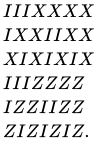
Note that each of the above generators is the tensor product of 7 single-qubit Pauli operations. For instance, 


The logical 
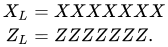
The logical 

![{\begin{aligned}|0\rangle _{L}=&{\frac {1}{\sqrt {8}}}[|0000000\rangle +|1010101\rangle +|0110011\rangle +|1100110\rangle \\&+|0001111\rangle +|1011010\rangle +|0111100\rangle +|1101001\rangle ]\\|1\rangle _{L}=&X_{L}|0\rangle _{L}.\end{aligned}}](https://wikimedia.org/api/rest_v1/media/math/render/svg/b4005e7bab37d36c1ab3710a80a3179353a28d50)
Arbitrary codestates are of the form 
Sources and credits
This article is adapted from the Wikipedia article “Steane code”, written by its contributors and licensed under CC BY-SA 4.0. Fathomly has changed the layout, removed citation markers, navigation and maintenance notices, and adjusted punctuation. This adapted version is shared under the same license. For references, see the original article.
Fathomly is not affiliated with or endorsed by the Wikimedia Foundation. Spotted a problem? Tell us.