CSS code
Class of quantum error correcting codes
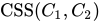
In quantum error correction, Calderbank-Shor-Steane (CSS) codes, named after their inventors, Robert Calderbank, Peter Shor and Andrew Steane, are a special type of stabilizer code constructed from classical linear codes with some special properties. Examples of CSS codes include the Shor code, Steane code, the toric code, and more general surface codes.
01Construction
Let 

![[n,k_{1}]](https://wikimedia.org/api/rest_v1/media/math/render/svg/d1b760a34ce84d3ac1f3183af8e28ee651234add)
![[n,k_{2}]](https://wikimedia.org/api/rest_v1/media/math/render/svg/e04fa207bc8eaeb59e03b6d1a96a182a5d259dad)


![[n,k_{1}-k_{2},d]](https://wikimedia.org/api/rest_v1/media/math/render/svg/9271f0930d48737e6d3f740be8b6389778517f12)

Define for 

![[[n,k_{1}-k_{2},d]]](https://wikimedia.org/api/rest_v1/media/math/render/svg/a8cb40d727f58f03e8d89c2b4021f468c0c3749c)

02Properties
In the stabilizer code formalism, all CSS codes have stabilizers composed of tensor products of Pauli matrices such that each stabilizer contains either only Pauli X operations or only Pauli Z operations. The Shor code and the Steane code are examples of this condition. The five-qubit error correcting code is not a CSS code because it mixes X and Z in its stabilizers.
As with classical linear codes, the limit of how many qubits can be corrected is also given by the Gilbert-Varshamov bound.
Sources and credits
This article is adapted from the Wikipedia article “CSS code”, written by its contributors and licensed under CC BY-SA 4.0. Fathomly has changed the layout, removed citation markers, navigation and maintenance notices, and adjusted punctuation. This adapted version is shared under the same license. For references, see the original article.
Fathomly is not affiliated with or endorsed by the Wikimedia Foundation. Spotted a problem? Tell us.