Star height problem
Problem in formal language theory
In formal language theory, the star height problem is the question whether all regular languages can be expressed using regular expressions of limited star height, i.e. with a limited nesting depth of Kleene stars. Specifically, is a nesting depth of one always sufficient? If not, is there an algorithm to determine how many are required? The problem was first introduced by Eggan in 1963.
01Families of regular languages with unbounded star height
The first question was answered in the negative when in 1963, Eggan gave examples of regular languages of star height 

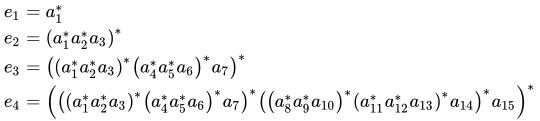
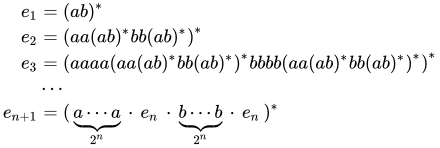
The construction principle for these expressions is that expression 

However, Eggan's examples use a large alphabet, of size 

02Computing the star height of regular languages
Eggan's second question, i.e., whether there exists an algorithm to determine the star height of a language, turned out to be much more difficult. The pure-group languages were the first interesting family of regular languages for which the star height problem was proved to be decidable. The general problem remained open until it was settled by Hashiguchi in 1988, who published an algorithm to determine the star height of any regular language. The algorithm, however, wasn't practical, being of non-elementary complexity:
[The procedure described by Hashiguchi] leads to computations that are by far impossible, even for very small examples. For instance, if L is accepted by a 4 state automaton of loop complexity 3 (and with a small 10 element transition monoid), then a very low minorant of the number of languages to be tested with L for equality is:
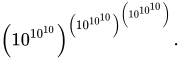
, Lombardy & Sakarovitch (2002).
The number 
A much more efficient algorithm than Hashiguchi's procedure was devised by Kirsten in 2005. This algorithm runs, for a given nondeterministic finite automaton as input, within double-exponential space. Yet the resource requirements of this algorithm still greatly exceed the margins of what is considered practically feasible.
This algorithm has been optimized and generalized to trees by Colcombet and Löding in 2008, as part of the theory of regular cost functions. It has been implemented in 2017 in the tool suite Stamina.
Sources and credits
This article is adapted from the Wikipedia article “Star height problem”, written by its contributors and licensed under CC BY-SA 4.0. Fathomly has changed the layout, removed citation markers, navigation and maintenance notices, and adjusted punctuation. This adapted version is shared under the same license. For references, see the original article.
Fathomly is not affiliated with or endorsed by the Wikimedia Foundation. Spotted a problem? Tell us.
