Six factor formula
Formula used to calculate nuclear chain reaction growth rate
The six-factor formula is used in nuclear engineering to determine the multiplication of a nuclear chain reaction in a non-infinite medium.
| Symbol | Name | Meaning | Formula | Typical thermal reactor value |
|---|---|---|---|---|
 |
Thermal fission factor (eta) | neutrons produced from fission/absorption in fuel isotope |  |
1.65 |
 |
Thermal utilization factor | neutrons absorbed by the fuel isotope/neutrons absorbed anywhere |  |
0.71 |
 |
Resonance escape probability | fission neutrons slowed to thermal energies without absorption/total fission neutrons | 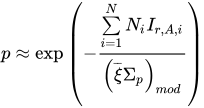 |
0.87 |
 |
Fast fission factor (epsilon) | total number of fission neutrons/number of fission neutrons from just thermal fissions | 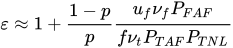 |
1.02 |
 |
Fast non-leakage probability | number of fast neutrons that do not leak from reactor/number of fast neutrons produced by all fissions |  |
0.97 |
 |
Thermal non-leakage probability | number of thermal neutrons that do not leak from reactor/number of thermal neutrons produced by all fissions | 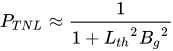 |
0.99 |

The symbols are defined as:
,
and
are the average number of neutrons produced per fission in the medium (2.43 for uranium-235).
and
are the microscopic fission and absorption cross sections for fuel, respectively.
and
are the macroscopic absorption cross sections in fuel and in total, respectively.
is the macroscopic fission cross-section.
is the number density of atoms of a specific nuclide.
is the resonance integral for absorption of a specific nuclide.
is the average lethargy gain per scattering event.
- Lethargy is defined as decrease in neutron energy.
(fast utilization) is the probability that a fast neutron is absorbed in fuel.
is the probability that a fast neutron absorption in fuel causes fission.
is the probability that a thermal neutron absorption in fuel causes fission.
is the geometric buckling.
is the diffusion length of thermal neutrons.
where
is the diffusion coefficient.
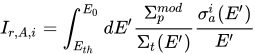
is the age to thermal.
where
is the energy of the neutron at birth.
![\tau =\int _{E_{th}}^{E'}dE''{\frac {1}{E''}}{\frac {D(E'')}{{\overline {\xi }}\left[D(E''){B_{g}}^{2}+\Sigma _{t}(E')\right]}}](https://wikimedia.org/api/rest_v1/media/math/render/svg/46740576c97170f8a677df00cb76237bceeed065)
01Multiplication
The multiplication factor, k, is defined as (see nuclear chain reaction):
- k = number of neutrons in one generation/number of neutrons in preceding generation
- If k is greater than 1, the chain reaction is supercritical, and the neutron population will grow exponentially.
- If k is less than 1, the chain reaction is subcritical, and the neutron population will exponentially decay.
- If k = 1, the chain reaction is critical and the neutron population will remain constant.
Sources and credits
This article is adapted from the Wikipedia article “Six factor formula”, written by its contributors and licensed under CC BY-SA 4.0. Fathomly has changed the layout, removed citation markers, navigation and maintenance notices, and adjusted punctuation. This adapted version is shared under the same license. For references, see the original article.
Fathomly is not affiliated with or endorsed by the Wikimedia Foundation. Spotted a problem? Tell us.


