Number density
Degree of concentration of countable objects

The number density (symbol: n or ρN) is an intensive quantity used to describe the degree of concentration of countable objects (particles, molecules, phonons, cells, galaxies, etc.) in physical space: three-dimensional volumetric number density, two-dimensional areal number density, or one-dimensional linear number density. Population density is an example of areal number density. The term number concentration (symbol: lowercase n, or C, to avoid confusion with amount of substance indicated by uppercase N) is sometimes used in chemistry for the same quantity, particularly when comparing with other concentrations.
01Definition
Volume number density is the number of specified objects per unit volume:

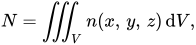
Here it is assumed that N is large enough that rounding of the count to the nearest integer does not introduce much of an error, but V is chosen to be small enough that the resulting n does not depend much on the size or shape of the volume V because of large-scale features.
Area number density is the number of specified objects per unit area, A:


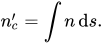
Column number density is a kind of areal density, the number or count of a substance per unit area, obtained integrating volumetric number density along a vertical path:
02Units
In SI units, number density is measured in m−3, although cm−3 is often used. However, these units are not quite practical when dealing with atoms or molecules of gases, liquids or solids at room temperature and atmospheric pressure, because the resulting numbers are extremely large (on the order of 1020). Using the number density of an ideal gas at 0 °C and 1 atm as a yardstick: n0 = 1 amg = 2.6867774 × 1025 m−3 is often introduced to define a relative number density (a dimensionless quantity), for any substances at any conditions (not necessarily limited to an ideal gas at 0 °C and 1 atm).
03Usage
Using the number density as a function of spatial coordinates, the total number of objects N in the entire volume V can be calculated as
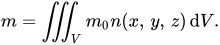
Similar expressions are valid for electric charge or any other extensive quantity associated with countable objects. For example, replacing m with q (total charge) and m0 with q0 (charge of each object) in the above equation will lead to a correct expression for charge.
The number density of solute molecules in a solvent is sometimes called concentration, although usually concentration is expressed as a number of moles per unit volume (and thus called molar concentration).
04Relation to other quantities
Molar concentration
For any substance, the number density can be expressed in terms of its amount concentration c (in mol/m3) as

Mass density
For atoms or molecules of a well-defined molar mass M (in kg/mol), the number density can sometimes be expressed in terms of their mass density ρm (in kg/m3) as

05Examples
The following table lists common examples of number densities at 1 atm and 20 °C, unless otherwise noted.
| Material | Number density, n | Amount concentration, c | Mass density, ρm | Molar mass, M | |
|---|---|---|---|---|---|
| (1027 m−3 = 1021 cm−3) | (amg) | (103 mol/m3 = mol/L) | (103 kg/m3 = g/cm3) | (10−3 kg/mol = g/mol) | |
| Ideal gas | 0.02504 | 0.932 | 0.04158 | 41.58 × 10⁻⁶ M | M |
| Dry air | 0.02504 | 0.932 | 0.04158 | 1.2041 × 10⁻³ | 28.9644 |
| Water | 33.3679 | 1,241.93 | 55.4086 | 0.99820 | 18.01524 |
| Diamond | 176.2 | 6,556 | 292.5 | 3.513 | 12.01 |
Sources and credits
This article is adapted from the Wikipedia article “Number density”, written by its contributors and licensed under CC BY-SA 4.0. Fathomly has changed the layout, removed citation markers, navigation and maintenance notices, and adjusted punctuation. This adapted version is shared under the same license. For references, see the original article.
Images, from Wikimedia Commons:
- School of big eye scad.jpg by SteveD., CC BY 2.0
Fathomly is not affiliated with or endorsed by the Wikimedia Foundation. Spotted a problem? Tell us.