Singular integral
Functions in harmonic analysis mathematics
In mathematics, singular integrals are central to harmonic analysis and are intimately connected with the study of partial differential equations. Broadly speaking a singular integral is an integral operator

whose kernel function 


01The Hilbert transform
The archetypal singular integral operator is the Hilbert transform 



The most straightforward higher dimension analogues of these are the Riesz transforms, which replace 
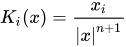
where 


02Singular integrals of convolution type
A singular integral of convolution type is an operator 


 | 1 |
Suppose that the kernel satisfies:
- The size condition on the Fourier transform of
- The smoothness condition: for some
,


Then it can be shown that
Property 1. is needed to ensure that convolution (1) with the tempered distribution p.v.
![\operatorname {p.v.} \,\,K[\phi ]=\lim _{\epsilon \to 0^{+}}\int _{|x|>\epsilon }\phi (x)K(x)\,dx](https://wikimedia.org/api/rest_v1/media/math/render/svg/fe3e495d3c9e5b56ae62be193e178f27921330e2)
is a well-defined Fourier multiplier on 

which is quite easy to check. It is automatic, for instance, if
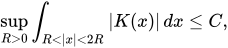
then it can be shown that 1. follows.
The smoothness condition 2. is also often difficult to check in principle, the following sufficient condition of a kernel

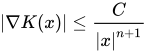
Observe that these conditions are satisfied for the Hilbert and Riesz transforms, so this result is an extension of those result.
03Singular integrals of non-convolution type
These are even more general operators. However, since our assumptions are so weak, it is not necessarily the case that these operators are bounded on
Calderón-Zygmund kernels
A function 
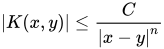


Singular integrals of non-convolution type

whenever 

Calderón, Zygmund operators
A singular integral of non-convolution type

for all smooth compactly supported ƒ.
It can be proved that such operators are, in fact, also bounded on all 
The  theorem
The
A normalised bump is a smooth function 



for all normalised bumps 


The 

 is weakly bounded;
 is in
is in  is in
is in  is the transpose operator of
Sources and credits
This article is adapted from the Wikipedia article “Singular integral”, written by its contributors and licensed under CC BY-SA 4.0. Fathomly has changed the layout, removed citation markers, navigation and maintenance notices, and adjusted punctuation. This adapted version is shared under the same license. For references, see the original article.
Fathomly is not affiliated with or endorsed by the Wikimedia Foundation. Spotted a problem? Tell us.