Simple precedence grammar
Context-free formal grammar
In computer science, a simple precedence grammar is a context-free formal grammar that can be parsed with a simple precedence parser. The concept was first created in 1964 by Claude Pair, and was later rediscovered, from ideas due to Robert Floyd, by Niklaus Wirth and Helmut Weber who published a paper, entitled EULER: a generalization of ALGOL, and its formal definition, published in 1966 in the Communications of the ACM.
01Formal definition
G = (N, Σ, P, S) is a simple precedence grammar if all the production rules in P comply with the following constraints:
- There are no erasing rules (ε-productions)
- There are no useless rules (unreachable symbols or unproductive rules)
- For each pair of symbols X, Y (X, Y
(N ∪ Σ)) there is only one Wirth-Weber precedence relation.
- G is uniquely inversible
02Simple precedence parser
A simple precedence parser is a type of bottom-up parser for context-free grammars that can be used only by simple precedence grammars.
The implementation of the parser is quite similar to the generic bottom-up parser. A stack is used to store a viable prefix of a sentential form from a rightmost derivation. The symbols ⋖, ≐ and ⋗ are used to identify the pivot, and to know when to Shift or when to Reduce.
Implementation
- Compute the Wirth-Weber precedence relationship table for a grammar with initial symbol S.
- Initialize a stack with the starting marker $.
- Append an ending marker $ to the string being parsed (Input).
- Until Stack equals "$ S" and Input equals "$"
- Search the table for the relationship between Top(stack) and NextToken(Input)
- if the relationship is ⋖ or ≐
- Shift:
- Push(Stack, relationship)
- Push(Stack, NextToken(Input))
- RemoveNextToken(Input)
- if the relationship is ⋗
- Reduce:
- SearchProductionToReduce(Stack)
- Remove the Pivot from the Stack
- Search the table for the relationship between the nonterminal from the production and first symbol in the stack (Starting from top)
- Push(Stack, relationship)
- Push(Stack, Non terminal)
SearchProductionToReduce (Stack)
- Find the topmost ⋖ in the stack; this and all the symbols above it are the Pivot.
- Find the production of the grammar which has the Pivot as its right side.
Example
Given following language, which can parse arithmetic expressions with the multiplication and addition operations:
E --> E + T' | T' T' --> T T --> T * F | F F --> ( E' ) | num E' --> Enum is a terminal, and the lexer parse any integer as num; E represents an arithmetic expression, T is a term and F is a factor.
and the Parsing table:
| E | E' | T | T' | F | + | * | ( | ) | num | $ | |
|---|---|---|---|---|---|---|---|---|---|---|---|
| E | ≐ | ⋗ | |||||||||
| E' | ≐ | ||||||||||
| T | ⋗ | ≐ | ⋗ | ⋗ | |||||||
| T' | ⋗ | ⋗ | ⋗ | ||||||||
| F | ⋗ | ⋗ | ⋗ | ⋗ | |||||||
| + | ⋖ | ≐ | ⋖ | ⋖ | ⋖ | ||||||
| * | ≐ | ⋖ | ⋖ | ||||||||
| ( | ⋖ | ≐ | ⋖ | ⋖ | ⋖ | ⋖ | ⋖ | ||||
| ) | ⋗ | ⋗ | ⋗ | ⋗ | |||||||
| num | ⋗ | ⋗ | ⋗ | ⋗ | |||||||
| $ | ⋖ | ⋖ | ⋖ | ⋖ | ⋖ | ⋖ |
| STACK | PRECEDENCE | INPUT | ACTION |
|---|---|---|---|
| $ | ⋖ | 2 * ( 1 + 3 )$ | SHIFT |
| $ ⋖ 2 | ⋗ | * ( 1 + 3 )$ | REDUCE (F -> num) |
| $ ⋖ F | ⋗ | * ( 1 + 3 )$ | REDUCE (T -> F) |
| $ ⋖ T | ≐ | * ( 1 + 3 )$ | SHIFT |
| $ ⋖ T ≐ * | ⋖ | ( 1 + 3 )$ | SHIFT |
| $ ⋖ T ≐ * ⋖ ( | ⋖ | 1 + 3 )$ | SHIFT |
| $ ⋖ T ≐ * ⋖ ( ⋖ 1 | ⋗ | + 3 )$ | REDUCE 4× (F -> num) (T -> F) (T' -> T) (E ->T ') |
| $ ⋖ T ≐ * ⋖ ( ⋖ E | ≐ | + 3 )$ | SHIFT |
| $ ⋖ T ≐ * ⋖ ( ⋖ E ≐ + | ⋖ | 3 )$ | SHIFT |
| $ ⋖ T ≐ * ⋖ ( ⋖ E ≐ + < 3 | ⋗ | )$ | REDUCE 3× (F -> num) (T -> F) (T' -> T) |
| $ ⋖ T ≐ * ⋖ ( ⋖ E ≐ + ≐ T | ⋗ | )$ | REDUCE 2× (E -> E + T) (E' -> E) |
| $ ⋖ T ≐ * ⋖ ( ≐ E' | ≐ | )$ | SHIFT |
| $ ⋖ T ≐ * ⋖ ( ≐ E' ≐ ) | ⋗ | $ | REDUCE (F -> ( E' )) |
| $ ⋖ T ≐ * ≐ F | ⋗ | $ | REDUCE (T -> T * F) |
| $ ⋖ T | ⋗ | $ | REDUCE 2× (T' -> T) (E -> T') |
| $ ⋖ E | $ | ACCEPT |
03Wirth-Weber precedence relationship
In computer science, a Wirth-Weber relationship between a pair of symbols 
The goal is to identify when the viable prefixes have the pivot and must be reduced. A 


Formal definition

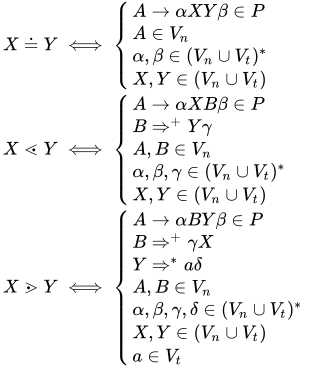
Precedence relations computing algorithm
We will define three sets for a symbol:
- Head*(X) is X if X is a terminal, and if X is a non-terminal, Head*(X) is the set with only the terminals belonging to Head+(X). This set is equivalent to First-set or Fi(X) described in LL parser.
- Head+(X) and Tail+(X) are ∅ if X is a terminal.
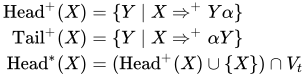
The pseudocode for computing relations is:
- RelationTable := ∅
- For each production
- For each two adjacent symbols X Y in α
- add(RelationTable,
)
- add(RelationTable,
)
- add(RelationTable,
)
- add(RelationTable,
- For each two adjacent symbols X Y in α
- add(RelationTable,
) where S is the initial non terminal of the grammar, and $ is a limit marker
- add(RelationTable,
) where S is the initial non terminal of the grammar, and $ is a limit marker

Example 1

- Head+(a) = ∅
- Head+(S) = {a, c}
- Head+(b) = ∅
- Head+(c) = ∅
- Tail+(a) = ∅
- Tail+(S) = {b, c}
- Tail+(b) = ∅
- Tail+(c) = ∅
- Head*(a) = a
- Head*(S) = {a, c}
- Head*(b) = b
- Head*(c) = c
- a Next to S
- S Next to S
- S Next to b
- a Next to S
- there is only one symbol, so no relation is added.


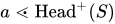


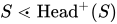








- precedence table
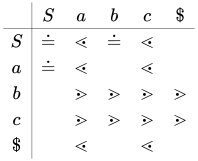
Example 2
![S\to a|aT|[S]](https://wikimedia.org/api/rest_v1/media/math/render/svg/56e3446f56012d2e8b6dbcc51d57ec030a338dcd)

- Head+( S ) = { a, [ }
- Head+( a ) = ∅
- Head+( T ) = { b }
- Head+( [ ) = ∅
- Head+( ] ) = ∅
- Head+( b ) = ∅
- Tail+( S ) = { a, T, ], b }
- Tail+( a ) = ∅
- Tail+( T ) = { b, T }
- Tail+( [ ) = ∅
- Tail+( ] ) = ∅
- Tail+( b ) = ∅
- Head*( S ) = { a, [ }
- Head*( a ) = a
- Head*( T ) = { b }
- Head*( [ ) = [
- Head*( ] ) = ]
- Head*( b ) = b

- a Next to T
- a Next to T


![S\to [S]](https://wikimedia.org/api/rest_v1/media/math/render/svg/ee50b6958472283dfaa228f8c159ef586681b615)
- [ Next to S
- [ Next to S


- S Next to ]
- S Next to ]
![S\doteq ]](https://wikimedia.org/api/rest_v1/media/math/render/svg/1284b981412a510b580c3dabfa7590a7bd7922dd)
![\mathrm {Tail} ^{+}(S)\gtrdot \mathrm {Head} ^{*}(])](https://wikimedia.org/api/rest_v1/media/math/render/svg/2a49a4263e198f18e84bd2d758bd0513da1ba53a)
![a\gtrdot ]](https://wikimedia.org/api/rest_v1/media/math/render/svg/5e458d62714aa1d5433e4a0484e435fd2297cc52)
![T\gtrdot ]](https://wikimedia.org/api/rest_v1/media/math/render/svg/52d9a2389ec97bb72f9357583dee6df843fd3714)
![]\gtrdot ]](https://wikimedia.org/api/rest_v1/media/math/render/svg/6cb8652498bffd0605c33be702ff3a091dfa5c68)
![b\gtrdot ]](https://wikimedia.org/api/rest_v1/media/math/render/svg/7b35535fcb3f2f5264e57af0ab7977dfd3af0257)

- b Next to T
- b Next to T


- precedence table
![{\begin{array}{c|ccccccc}&S&T&a&b&[&]&\$\\\hline S&&&&&&\doteq &\doteq \\T&&&&&&\gtrdot &\gtrdot \\a&&\doteq &&\lessdot &&\gtrdot &\gtrdot \\b&&\doteq &&\lessdot &&\gtrdot &\gtrdot \\{\text{[}}&\doteq &&\lessdot &&\lessdot &&\\]&&&&&&\gtrdot &\gtrdot \\\$&\doteq &&\lessdot &&\lessdot &&\end{array}}](https://wikimedia.org/api/rest_v1/media/math/render/svg/b964c44c9fa0b977fba266f30211535bcfbed025)
Sources and credits
This article is adapted from the Wikipedia article “Simple precedence grammar”, written by its contributors and licensed under CC BY-SA 4.0. Fathomly has changed the layout, removed citation markers, navigation and maintenance notices, and adjusted punctuation. This adapted version is shared under the same license. For references, see the original article.
Fathomly is not affiliated with or endorsed by the Wikimedia Foundation. Spotted a problem? Tell us.