Simon's problem
Problem in computer science
In computational complexity theory and quantum computing, Simon's problem is a computational problem that is proven to be solved exponentially faster on a quantum computer than on a classical (that is, traditional) computer. The quantum algorithm solving Simon's problem, usually called Simon's algorithm, served as the inspiration for Shor's algorithm. Both problems are special cases of the abelian hidden subgroup problem, which is now known to have efficient quantum algorithms.
The problem is set in the model of decision tree complexity or query complexity and was conceived by Daniel R. Simon in 1994. Simon exhibited a quantum algorithm that solves Simon's problem exponentially faster with exponentially fewer queries than the best probabilistic (or deterministic) classical algorithm. In particular, Simon's algorithm uses a linear number of queries and any classical probabilistic algorithm must use an exponential number of queries.
This problem yields an oracle separation between the complexity classes BPP (bounded-error classical query complexity) and BQP (bounded-error quantum query complexity). This is the same separation that the Bernstein-Vazirani algorithm achieves, and different from the separation provided by the Deutsch-Jozsa algorithm, which separates P and EQP. Unlike the Bernstein-Vazirani algorithm, Simon's algorithm's separation is exponential.
Because this problem assumes the existence of a highly-structured "black box" oracle to achieve its speedup, this problem has little practical value. However, without such an oracle, exponential speedups cannot easily be proven, since this would prove that P is different from PSPACE.
01Problem description
Simon's problem considers access to a function 


- If
such that, for all
,
if and only if
where 
Note that if 
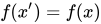


- Given black-box or oracle access to
,
, determine whether
(decision version), or output
Note also that the promise on

Example
The following function is an example of a function that satisfies the required property for 
|
 |
|---|---|
| 000 | 101 |
| 001 | 010 |
| 010 | 000 |
| 011 | 110 |
| 100 | 000 |
| 101 | 110 |
| 110 | 101 |
| 111 | 010 |
In this case, 
For example, the input strings 


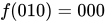
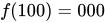


In this example the function f is indeed a two-to-one function where 
Problem hardness
Intuitively, this is a hard problem to solve in a "classical" way, even if one uses randomness and accepts a small probability of error. The intuition behind the hardness is reasonably simple: if you want to solve the problem classically, you need to find two different inputs 


02Simon's algorithm
The algorithm as a whole uses a subroutine to execute the following two steps:
- Run the quantum subroutine an expected
times to get a list of linearly independent bitstrings
.
- Each
satisfies
, so we can solve the system of equations this produces to get
Quantum subroutine
The quantum circuit (see the picture) is the implementation of the quantum part of Simon's algorithm. The quantum subroutine of the algorithm makes use of the Hadamard transform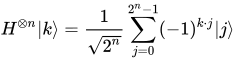

First, the algorithm starts with two registers, initialized to 
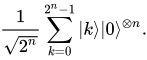
Query the oracle 
.
Apply another Hadamard transform to the first register. This will produce the state
![{\frac {1}{\sqrt {2^{n}}}}\sum _{k=0}^{2^{n}-1}\left[{\frac {1}{\sqrt {2^{n}}}}\sum _{j=0}^{2^{n}-1}(-1)^{j\cdot k}|j\rangle \right]|f(k)\rangle =\sum _{j=0}^{2^{n}-1}|j\rangle \left[{\frac {1}{2^{n}}}\sum _{k=0}^{2^{n}-1}(-1)^{j\cdot k}|f(k)\rangle \right].](https://wikimedia.org/api/rest_v1/media/math/render/svg/847a7b468c5c15ed2b3216f03f13618cd31d0f33)
Finally, we measure the first register (the algorithm also works if the second register is measured before the first, but this is unnecessary). The probability of measuring a state 
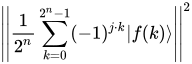
and
and
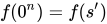
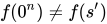
For the first case, 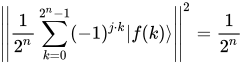



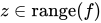



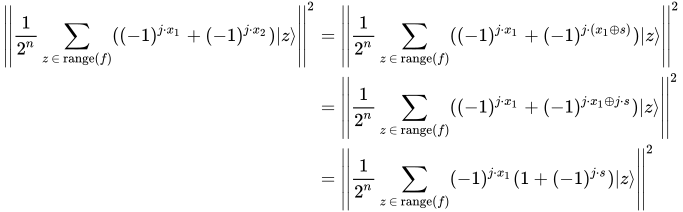


Thus, both when
Classical post-processing
We run the quantum part of the algorithm until we have a linearly independent list of bitstrings 
The probability that 
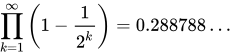



We can repeat Simon's algorithm a constant number of times to increase the probability of success arbitrarily, while still having the same time complexity.
03Explicit examples of Simon's algorithm for few qubits
One qubit
Consider the simplest instance of the algorithm, with 

If 


Thus applying an Hadamard and measuring the first register always gives the outcome 

We recover 

Two qubits
Consider now the case with 



Suppose on the other hand 





Similar reasoning applies to the other cases: if 


To recover

04Complexity
Simon's algorithm requires 

05Simon's algorithm Qiskit implementation
The quantum circuit shown here is from a simple example of how Simon's algorithm can be implemented in Python using Qiskit, an open-source quantum computing software development framework by IBM.
Sources and credits
This article is adapted from the Wikipedia article “Simon's problem”, written by its contributors and licensed under CC BY-SA 4.0. Fathomly has changed the layout, removed citation markers, navigation and maintenance notices, and adjusted punctuation. This adapted version is shared under the same license. For references, see the original article.
Images, from Wikimedia Commons:
- Simons algorithm.svg by Bender2k14, CC BY-SA 3.0
- Example Qiskit quantum circuit that implements Simon's algorithm.png by JavaFXpert, CC0
Fathomly is not affiliated with or endorsed by the Wikimedia Foundation. Spotted a problem? Tell us.
