Short integer solution problem
Computational problem used in cryptography
Short integer solution (SIS) and ring-SIS problems are two average-case problems that are used in lattice-based cryptography constructions. Lattice-based cryptography began in 1996 from a seminal work by Miklós Ajtai who presented a family of one-way functions based on SIS problem. He showed that it is secure in an average case if the shortest vector problem 


Average case problems are the problems that are hard to be solved for some randomly selected instances. For cryptography applications, worst case complexity is not sufficient, and we need to guarantee cryptographic construction are hard based on average case complexity.
01Lattices
A full rank lattice 



where 
Remark: Given 



02Ideal lattice
Definition: Rotational shift operator on 


Cyclic lattices
Micciancio introduced cyclic lattices in his work in generalizing the compact knapsack problem to arbitrary rings. A cyclic lattice is a lattice that is closed under rotational shift operator. Formally, cyclic lattices are defined as follows:
Definition: A lattice 

Examples:
itself is a cyclic lattice.
- Lattices corresponding to any ideal in the quotient polynomial ring
are cyclic:
consider the quotient polynomial ring 

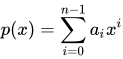


Define the embedding coefficient 

![{\begin{aligned}\quad \rho :R&\rightarrow \mathbb {Z} ^{n}\\[4pt]p(x)=\sum _{i=0}^{n-1}a_{i}x^{i}&\mapsto (a_{0},\ldots ,a_{n-1})\end{aligned}}](https://wikimedia.org/api/rest_v1/media/math/render/svg/3b19ef05928355e61a925130e56f50ce32cae8b4)
Let 


Theorem: 

proof:


Let 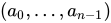
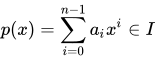

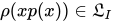


Let 
Define the set of polynomials 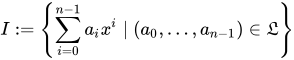
- Since
- Since
.
Hence, 
Ideal lattices
Source:
Let ![f(x)\in \mathbb {Z} [x]](https://wikimedia.org/api/rest_v1/media/math/render/svg/cb8266c32dfc2904dc4331ea8906ad341a05ce1c)

![(f(x)):=f(x)\cdot \mathbb {Z} [x]=\{f(x)g(x):\forall g(x)\in \mathbb {Z} [x]\}.](https://wikimedia.org/api/rest_v1/media/math/render/svg/c970d48b2090104e40be59fc404919c712d29107)
The quotient polynomial ring ![R=\mathbb {Z} [x]/(f(x))](https://wikimedia.org/api/rest_v1/media/math/render/svg/1cff04a320199577d049d268772b9ff80b3f7919)
![\mathbb {Z} [x]](https://wikimedia.org/api/rest_v1/media/math/render/svg/0d4da3ac703cc7721ebba91a53f6752de7157124)

![R=\mathbb {Z} [x]/(f(x))=\left\{\sum _{i=0}^{n-1}a_{i}x^{i}:a_{i}\in \mathbb {Z} \right\}](https://wikimedia.org/api/rest_v1/media/math/render/svg/a93ba3d1d81e47803821bcde400820a3f39cef90)
where addition and multiplication are reduced modulo
Consider the embedding coefficient
Definition: ![R=\mathbb {Z} [x]/(p(x))](https://wikimedia.org/api/rest_v1/media/math/render/svg/b0cbb1fc048ee6ee33cc951fdd57a63a5b61771a)

![p(x)\in \mathbb {Z} [x]](https://wikimedia.org/api/rest_v1/media/math/render/svg/6eb44fd7ae38db591820a0c9c939c1a7f3d0038a)
Remark:
- It turns out that
for even small
is typically easy on ideal lattices. The intuition is that the algebraic symmetries causes the minimum distance of an ideal to lie within a narrow, easily computable range.
- By exploiting the provided algebraic symmetries in ideal lattices, one can convert a short nonzero vector into
are equivalent with a small loss. Furthermore, even for quantum algorithms,
03Short integer solution problem
The Short Integer Solution (SIS) problem is an average case problem that is used in lattice-based cryptography constructions. Lattice-based cryptography began in 1996 from a seminal work by Ajtai who presented a family of one-way functions based on the SIS problem. He showed that it is secure in an average case if
SISq,n,m,β
Let 


![A=[{\boldsymbol {a_{1}}}|\cdots |{\boldsymbol {a_{m}}}]](https://wikimedia.org/api/rest_v1/media/math/render/svg/fb0b879ee77261eca27b6d7f024c6a6bdd31a8f3)


,
.
A solution to SIS without the required constraint on the length of the solution (


In order to guarantee 
, and

Theorem: For any 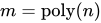


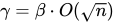
R-SISq,n,m,β
The SIS problem solved over an ideal ring is also called the Ring-SIS or R-SIS problem. This problem considers a quotient polynomial ring ![R_{q}=\mathbb {Z} _{q}[x]/(f(x))](https://wikimedia.org/api/rest_v1/media/math/render/svg/5e2c371303cca07ba0ab4699422357da1f051d66)
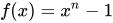


We then define the problem as follows:
Select 


,
.
Recall that to guarantee existence of a solution to SIS problem, we require 

Definition: The nega-circulant matrix of 
![{\text{for}}\quad b=\sum _{i=0}^{n-1}b_{i}x^{i}\in R,\quad \operatorname {rot} (b):={\begin{bmatrix}b_{0}&-b_{n-1}&\ldots &-b_{1}\\[0.3em]b_{1}&b_{0}&\ldots &-b_{2}\\[0.3em]\vdots &\vdots &\ddots &\vdots \\[0.3em]b_{n-1}&b_{n-2}&\ldots &b_{0}\end{bmatrix}}](https://wikimedia.org/api/rest_v1/media/math/render/svg/3a9663affde7dc867475147d16af19f77f691c05)
When the quotient polynomial ring is ![R=\mathbb {Z} [x]/(x^{n}+1)](https://wikimedia.org/api/rest_v1/media/math/render/svg/2cf3edc35924ffa32d7bede76021d86741f78638)


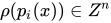

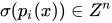
Moreover, R-SIS problem is a special case of SIS problem where the matrix 
![A=[\operatorname {rot} (a_{1})|\cdots |\operatorname {rot} (a_{m})]](https://wikimedia.org/api/rest_v1/media/math/render/svg/485989a638e349ec007ea9e2e0c3ddd8f2293061)
M-SISq,n,d,m,β
The SIS problem solved over a module lattice is also called the Module-SIS or M-SIS problem. Like R-SIS, this problem considers the quotient polynomial ring 


We then define the problem as follows:
Select 

.
While M-SIS is a less compact variant of SIS than R-SIS, the M-SIS problem is asymptotically at least as hard as R-SIS and therefore gives a tighter bound on the hardness assumption of SIS. This makes assuming the hardness of M-SIS a safer, but less efficient underlying assumption when compared to R-SIS.
Sources and credits
This article is adapted from the Wikipedia article “Short integer solution problem”, written by its contributors and licensed under CC BY-SA 4.0. Fathomly has changed the layout, removed citation markers, navigation and maintenance notices, and adjusted punctuation. This adapted version is shared under the same license. For references, see the original article.
Fathomly is not affiliated with or endorsed by the Wikimedia Foundation. Spotted a problem? Tell us.