Shor's algorithm
Quantum algorithm for integer factorization
Shor's algorithm is a quantum algorithm for finding the prime factors of an integer. It was developed in 1994 by the American mathematician Peter Shor. It is one of the few known quantum algorithms with compelling potential applications and strong evidence of superpolynomial speedup compared to best known classical (non-quantum) algorithms. However, beating classical computers may require quantum computers with millions of qubits due to the overhead caused by quantum error correction.
Shor proposed multiple similar algorithms for solving the factoring problem, the discrete logarithm problem, and the period-finding problem. "Shor's algorithm" usually refers to the factoring algorithm, but may refer to any of the three algorithms. The discrete logarithm algorithm and the factoring algorithm are instances of the period-finding algorithm, and all three are instances of the hidden subgroup problem.
On a quantum computer, to factor an integer , Shor's algorithm runs in polynomial time, meaning the time taken is polynomial in
. It takes quantum gates of order
using fast multiplication, or even
using the asymptotically fastest multiplication algorithm currently known due to Harvey and van der Hoeven, thus demonstrating that the integer factorization problem is in complexity class BQP. Shor's algorithm is asymptotically faster than the most scalable classical factoring algorithm, the general number field sieve, which works in sub-exponential time:
.
01Feasibility and implications
Assuming a quantum computer with a sufficient number of qubits could operate without succumbing to quantum noise and other quantum-decoherence phenomena, then Shor's algorithm could be used to break public-key cryptography schemes, such as
- The RSA scheme
- The finite-field Diffie-Hellman key exchange
- The elliptic-curve Diffie-Hellman key exchange
RSA can be broken if factoring large integers is computationally feasible. As far as is known, this is not possible using classical (non-quantum) computers; no classical algorithm is known that can factor integers in polynomial time. However, Shor's algorithm shows that factoring integers can be done with a polynomial complexity circuit on an ideal quantum computer. Thus, it might be feasible to defeat RSA by constructing a large enough quantum computer. This was a powerful motivator for the design and construction of quantum computers, and for the study of new quantum-computer algorithms. It has also facilitated research on new cryptosystems that are secure from quantum computers, collectively called post-quantum cryptography (PQC).
Physical implementation
As of 2026, the high error rates of quantum computers and limited number of physical qubits available for quantum error correction, laboratory demonstrations of Shor's algorithm obtain correct results in only a fraction of attempts, and have only succeeded with small semiprimes.
In 2001, Shor's algorithm was demonstrated by a group at IBM, who factored into
, using an NMR implementation of a quantum computer with seven qubits. After IBM's implementation, two independent groups implemented Shor's algorithm using photonic qubits. In 2012, the factorization of
was performed with solid-state qubits. Later, in 2012, the factorization of
was achieved. In 2016, the factorization of
was performed again using trapped-ion qubits. However, none of these demonstrations fulfill the requirements of Shor’s algorithm: they compile the circuit using prior knowledge of the solution, and some have even oversimplified the algorithm in a way that makes it equivalent to coin flipping.

02Algorithm
The problem that we are trying to solve is: given an odd composite number , find its integer factors.
To achieve this, Shor's algorithm consists of two parts:
- A classical reduction of the factoring problem to the problem of order-finding. This reduction is similar to that used for other factoring algorithms, such as the quadratic sieve.
- A quantum algorithm to solve the order-finding problem.
Classical reduction
A complete factoring algorithm is possible if we're able to efficiently factor arbitrary into just two integers
and
greater than 1, since if either
or
are not prime, then the factoring algorithm can in turn be run on those until only primes remain.
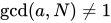
A basic observation is that, using Euclid's algorithm, we can always compute the GCD between two integers efficiently. In particular, this means we can check efficiently whether is even, in which case 2 is trivially a factor. Let us thus assume that
is odd for the remainder of this discussion. Afterwards, we can use efficient classical algorithms to check whether
is a prime power. For prime powers, efficient classical factorization algorithms exist, hence the rest of the quantum algorithm may assume that
is not a prime power.
If those easy cases do not produce a nontrivial factor of , the algorithm proceeds to handle the remaining case. We pick a random integer
A possible nontrivial divisor of
can be found by computing
, which can be done classically and efficiently using the Euclidean algorithm. If this produces a nontrivial factor (meaning
), the algorithm is finished, and the other nontrivial factor is
. If a nontrivial factor was not identified, then this means that
and the choice of
are coprime, so
is contained in the multiplicative group of integers modulo
, having a multiplicative inverse modulo
. Thus,
has a multiplicative order
modulo
, meaning
and is the smallest positive integer satisfying this congruence.
The quantum subroutine finds . It can be seen from the congruence that
divides
, written
. This can be factored using difference of squares:
Since we have factored the expression in this way, the algorithm doesn't work for odd
(because
must be an integer), meaning that the algorithm would have to restart with a new
. Hereafter we can therefore assume that
is even. It cannot be the case that
, since this would imply
, which would contradictorily imply that
would be the order of
, which was already
. At this point, it may or may not be the case that
. If
does not divide
, then this means that we are able to find a nontrivial factor of
. We compute
If
, then
was true, and a nontrivial factor of
cannot be achieved from
, and the algorithm must restart with a new
. Otherwise, we have found a nontrivial factor of
, with the other being
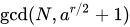
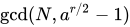
, and the algorithm is finished. For this step, it is also equivalent to compute
; it will produce a nontrivial factor if
is nontrivial, and will not if it's trivial (where
).
The algorithm restated shortly follows: let be odd, and not a prime power. We want to output two nontrivial factors of
.
- Pick a random number
.
- Compute
, the greatest common divisor of
and
.
- If
, then
is a nontrivial factor of
, with the other factor being
, and we are done.
- Otherwise, use the quantum subroutine to find the order
of
.
- If
is odd, then go back to step 1.
- Compute
. If
is nontrivial, the other factor is
, and we're done. Otherwise, go back to step 1.
It has been shown that this will be likely to succeed after a few runs. In practice, a single call to the quantum order-finding subroutine is enough to completely factor with very high probability of success if one uses a more advanced reduction.
Quantum order-finding subroutine
The goal of the quantum subroutine of Shor's algorithm is, given coprime integers and

, to find the order
of
modulo
, the smallest positive integer
such that
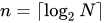
. To achieve this, Shor's algorithm uses a quantum circuit involving two registers. The second register uses
qubits, where
is the smallest integer such that
, i.e.,
. The size of the first register determines how accurate of an approximation the circuit produces. It can be shown that using
qubits gives sufficient accuracy to find
. The exact quantum circuit depends on the parameters
and
, which define the problem. The following description of the algorithm uses bra-ket notation to denote quantum states, and
to denote the tensor product.
The algorithm consists of two main steps:
- Use quantum phase estimation with unitary matrix
representing the operation of multiplying by
(modulo
), and input state
(where the second register is
made from
qubits). The eigenvalues of this
encode information about the period, and
can be seen to be writable as a sum of its eigenvectors. Thanks to these properties, the quantum phase estimation stage gives as output a random integer of the form
for random
.
- Use the continued fractions algorithm to extract the period
from the measurement outcomes obtained in the previous stage. This is a procedure to post-process (with a classical computer) the measurement data obtained from measuring the output quantum states, and retrieve the period.
The connection with quantum phase estimation was not discussed in the original formulation of Shor's algorithm, but was later proposed by Alexei Kitaev.
Quantum phase estimation
In general the quantum phase estimation algorithm, for any unitary and eigenstate
such that
, sends input states
to output states close to
, where
is a superposition of integers close to
. In other words, it sends each eigenstate
of
to a state containing information close to the associated eigenvalue. For the purposes of quantum order-finding, we employ this strategy using the unitary defined by the action
The action of
on states
with
is not crucial to the functioning of the algorithm, but needs to be included to ensure that the overall transformation is a well-defined quantum gate. Implementing the circuit for quantum phase estimation with
requires being able to efficiently implement the gates
. This can be accomplished via modular exponentiation, which is the slowest part of the algorithm.
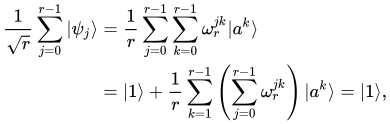
The gate thus defined satisfies , which immediately implies that its eigenvalues are the
-th roots of unity
. Furthermore, each eigenvalue
has an eigenvector of the form
, and these eigenvectors are such that
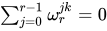
where the last identity follows from the geometric series formula, which implies
.
Using quantum phase estimation on an input state would then return the integer
with high probability. More precisely, the quantum phase estimation circuit sends
to
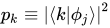
such that the resulting probability distribution
is peaked around
, with
. This probability can be made arbitrarily close to 1 using extra qubits.
Applying the above reasoning to the input , quantum phase estimation thus results in the evolution
Measuring the first register, we now have a balanced probability
to find each
, each one giving an integer approximation to
, which can be divided by
to get a decimal approximation for
.
Continued-fraction algorithm to retrieve the period
Then, we apply the continued-fraction algorithm to find integers and
, where
gives the best fraction approximation for the approximation measured from the circuit, for
and coprime
and
. The number of qubits in the first register,
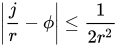
, which determines the accuracy of the approximation, guarantees that
given the best approximation from the superposition of
was measured (which can be made arbitrarily likely by using extra bits and truncating the output). However, while
and
are coprime, it may be the case that
and
are not coprime. Because of that,
and
may have lost some factors that were in
and
. This can be remedied by rerunning the quantum order-finding subroutine an arbitrary number of times, to produce a list of fraction approximations
where
is the number of times the subroutine was run. Each
will have different factors taken out of it because the circuit will (likely) have measured multiple different possible values of
. To recover the actual
value, we can take the least common multiple of each
:
The least common multiple will be the order
of the original integer
with high probability. In practice, a single run of the quantum order-finding subroutine is in general enough if more advanced post-processing is used.
Choosing the size of the first register
Phase estimation requires choosing the size of the first register to determine the accuracy of the algorithm, and for the quantum subroutine of Shor's algorithm, qubits is sufficient to guarantee that the optimal bitstring measured from phase estimation (meaning the
where
is the most accurate approximation of the phase from phase estimation) will allow the actual value of
to be recovered.
Each before measurement in Shor's algorithm represents a superposition of integers approximating
. Let
represent the most optimal integer in
. The following theorem guarantees that the continued fractions algorithm will recover
from
:
Theorem, If and
are
bit integers, and
then the continued fractions algorithm run on
will recover both
and
.
As is the optimal bitstring from phase estimation,
is accurate to
by
bits. Thus,
which implies that the continued fractions algorithm will recover
and
(or with their greatest common divisor taken out).
The bottleneck
The runtime bottleneck of Shor's algorithm is quantum modular exponentiation, which is by far slower than the quantum Fourier transform and classical pre-/post-processing. There are several approaches to constructing and optimizing circuits for modular exponentiation. The simplest and (currently) most practical approach is to mimic conventional arithmetic circuits with reversible gates, starting with ripple-carry adders. Knowing the base and the modulus of exponentiation facilitates further optimizations. Reversible circuits typically use on the order of gates for
qubits. Alternative techniques asymptotically improve gate counts by using quantum Fourier transforms, but are not competitive with fewer than 600 qubits owing to high constants.

03Period finding and discrete logarithms
Shor's algorithms for the discrete log and the order finding problems are instances of an algorithm solving the period finding problem. All three are instances of the hidden subgroup problem.
Shor's algorithm for discrete logarithms
Given a group with order
and generator
, suppose we know that
, for some
, and we wish to compute
, which is the discrete logarithm:
. Consider the abelian group
, where each factor corresponds to modular addition of values. Now, consider the function
This gives us an abelian hidden subgroup problem, where corresponds to a group homomorphism. The kernel corresponds to the multiples of
. So, if we can find the kernel, we can find
. A quantum algorithm for solving this problem exists. This algorithm is, like the factor-finding algorithm, due to Peter Shor and both are implemented by creating a superposition through using Hadamard gates, followed by implementing
as a quantum transform, followed finally by a quantum Fourier transform. Due to this, the quantum algorithm for computing the discrete logarithm is also occasionally referred to as "Shor's Algorithm."
The order-finding problem can also be viewed as a hidden subgroup problem. To see this, consider the group of integers under addition, and for a given such that:
, the function
For any finite abelian group , a quantum algorithm exists for solving the hidden subgroup for
in polynomial time.
Sources and credits
This article is adapted from the Wikipedia article “Shor's algorithm”, written by its contributors and licensed under CC BY-SA 4.0. Fathomly has changed the layout, removed citation markers, navigation and maintenance notices, and adjusted punctuation. This adapted version is shared under the same license. For references, see the original article.
Images, from Wikimedia Commons:
- Asymmetric encryption scheme.png by MarcT0K (icons by JGraph), CC BY 4.0
- Shor's algorithm.svg by Bender2k14, CC BY-SA 4.0
Fathomly is not affiliated with or endorsed by the Wikimedia Foundation. Spotted a problem? Tell us.