Replica trick
Mathematical limit applied in statistical physics
In the statistical physics of spin glasses and other systems with quenched disorder, the replica trick is a mathematical technique based on the application of the formula:
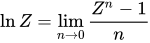
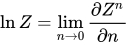

It is typically used to simplify the calculation of 


The crux of the replica trick is that while the disorder averaging is done assuming 
It is occasionally necessary to require the additional property of replica symmetry breaking (RSB) in order to obtain physical results, which is associated with the breakdown of ergodicity.
01General formulation
It is generally used for computations involving analytic functions (can be expanded in power series).
Expand 

A particular case which is of great use in physics is in averaging the thermodynamic free energy,
![F=-k_{\rm {B}}T\ln Z[J_{ij}],](https://wikimedia.org/api/rest_v1/media/math/render/svg/2e779dcfbfb6d2c55a0666c7ec106933ca7426a6)
over values of 
The partition function is then given by
![Z[J_{ij}]\sim e^{-\beta J_{ij}}.](https://wikimedia.org/api/rest_v1/media/math/render/svg/69e5d8eecdb4377cd0a3ce63bd6d18a23f69990a)
Notice that if we were calculating just ![Z[J_{ij}]](https://wikimedia.org/api/rest_v1/media/math/render/svg/6e3d85a0a88c37720ea27e57e80ae7da7800ad76)
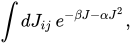
a standard Gaussian integral which can be easily computed (e.g. completing the square).
To calculate the free energy, we use the replica trick: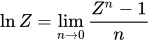


Clearly, such an argument poses many mathematical questions, and the resulting formalism for performing the limit
When using mean-field theory to perform one's calculations, taking this limit often requires introducing extra order parameters, a property known as "replica symmetry breaking" which is closely related to ergodicity breaking and slow dynamics within disorder systems.
02Physical applications
The replica trick is used in determining ground states of statistical mechanical systems, in the mean-field approximation. Typically, for systems in which the determination of ground state is easy, one can analyze fluctuations near the ground state. Otherwise one uses the replica method. An example is the case of a quenched disorder in a system like a spin glass with different types of magnetic links between spins, leading to many different configurations of spins having the same energy.
Outside condensed-matter physics, the replica method has been used as a heuristic analytical tool in information theory and signal processing. Examples include statistical-mechanical analyses of error-correcting codes and image restoration, large-system CDMA multiuser detection, and compressed sensing.
In the statistical physics of systems with quenched disorder, any two states with the same realization of the disorder (or in case of spin glasses, with the same distribution of ferromagnetic and antiferromagnetic bonds) are called replicas of each other. For systems with quenched disorder, one typically expects that macroscopic quantities will be self-averaging, whereby any macroscopic quantity for a specific realization of the disorder will be indistinguishable from the same quantity calculated by averaging over all possible realizations of the disorder. Introducing replicas allows one to perform this average over different disorder realizations.
In the case of a spin glass, we expect the free energy per spin (or any self averaging quantity) in the thermodynamic limit to be independent of the particular values of ferromagnetic and antiferromagnetic couplings between individual sites, across the lattice. So, we explicitly find the free energy as a function of the disorder parameter (in this case, parameters of the distribution of ferromagnetic and antiferromagnetic bonds) and average the free energy over all realizations of the disorder (all values of the coupling between sites, each with its corresponding probability, given by the distribution function). As free energy takes the form:
![F={\overline {F[J_{ij}]}}=-k_{B}T\,{\overline {\ln Z[J]}}](https://wikimedia.org/api/rest_v1/media/math/render/svg/9e00d71718888c2ea1f53f2c9dc2763d3b6819b1)
where 


03REM: the easiest replica problem
The random energy model (REM) is one of the simplest models of statistical mechanics of disordered systems, and probably the simplest model to show the meaning and power of the replica trick to the level 1 of replica symmetry breaking. The model is especially suitable for this introduction because an exact result by a different procedure is known, and the replica trick can be proved to work by crosschecking of results.
04Alternative methods
The cavity method is an alternative method, often of simpler use than the replica method, for studying disordered mean-field problems. It has been devised to deal with models on locally tree-like graphs.
Another alternative method is the supersymmetric method. The use of the supersymmetry method provides a mathematical rigorous alternative to the replica trick, but only in non-interacting systems. See for example the book:
Also, it has been demonstrated that the Keldysh formalism provides a viable alternative to the replica approach.
05Remarks
The first of the above identities is easily understood via Taylor expansion:
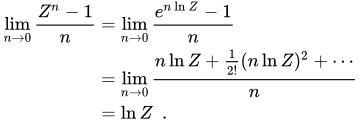
For the second identity, one simply uses the definition of the derivative
![{\begin{aligned}\lim _{n\rightarrow 0}{\dfrac {\partial Z^{n}}{\partial n}}&=\lim _{n\rightarrow 0}{\dfrac {\partial e^{n\ln Z}}{\partial n}}\\[5pt]&=\lim _{n\rightarrow 0}Z^{n}\ln Z\\[5pt]&=Z^{0}\ln Z=\ln Z~~.\end{aligned}}](https://wikimedia.org/api/rest_v1/media/math/render/svg/eaea7b5d362955818a580c5f71d91448bd3d407b)
Euler used a version of the replica trick in his study of the Lambert W function.
Sources and credits
This article is adapted from the Wikipedia article “Replica trick”, written by its contributors and licensed under CC BY-SA 4.0. Fathomly has changed the layout, removed citation markers, navigation and maintenance notices, and adjusted punctuation. This adapted version is shared under the same license. For references, see the original article.
Fathomly is not affiliated with or endorsed by the Wikimedia Foundation. Spotted a problem? Tell us.