Exponential type
Type of complex function with growth bounded by an exponential function

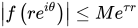
In complex analysis, a branch of mathematics, a holomorphic function is said to be of exponential type C if its growth is bounded by the exponential function for some real-valued constant
as
. When a function is bounded in this way, it is then possible to express it as certain kinds of convergent summations over a series of other complex functions, as well as understanding when it is possible to apply techniques such as Borel summation, or, for example, to apply the Mellin transform, or to perform approximations using the Euler-Maclaurin formula. The general case is handled by Nachbin's theorem, which defines the analogous notion of
-type for a general function
as opposed to
.
01Basic idea
A function defined on the complex plane is said to be of exponential type if there exist real-valued constants
and
such that
in the limit of . Here, the complex variable
was written as
to emphasize that the limit must hold in all directions
. Letting
stand for the infimum of all such
, one then says that the function
is of exponential type
.
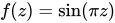
For example, let . Then one says that
is of exponential type
, since
is the smallest number that bounds the growth of
along the imaginary axis. So, for this example, Carlson's theorem cannot apply, as it requires functions of exponential type less than
. Similarly, the Euler-Maclaurin formula cannot be applied either, as it, too, expresses a theorem ultimately anchored in the theory of finite differences.

02Formal definition
A holomorphic function is said to be of exponential type
if for every
there exists a real-valued constant
such that
for where
.
We say
is of exponential type if
is of exponential type
for some
. The number
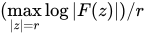
is the exponential type of . The limit superior here means the limit of the supremum of the ratio outside a given radius as the radius goes to infinity. This is also the limit superior of the maximum of the ratio at a given radius as the radius goes to infinity. The limit superior may exist even if the maximum at radius
does not have a limit as
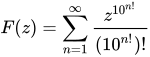
goes to infinity. For example, for the function
the value of
at is dominated by the n−1st term and this goes to zero as
goes to infinity, but
is nevertheless of exponential type 1, as can be seen by looking at the points
.
03Exponential type with respect to a symmetric convex body
Stein (1957) has given a generalization of exponential type for entire functions of several complex variables.
Suppose is a convex, compact, and symmetric subset of
. It is known that for every such
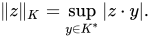
there is an associated norm
with the property that
In other words, is the unit ball in
with respect to
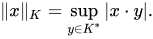
. The set
is called the polar set and is also a convex, compact, and symmetric subset of . Furthermore, we can write
We extend from
to
by
An entire function of
-complex variables is said to be of exponential type with respect to
if for every
there exists a real-valued constant
such that
for all .
04Fréchet space
Collections of functions of exponential type can form a complete uniform space, namely a Fréchet space, by the topology induced by the countable family of norms
Sources and credits
This article is adapted from the Wikipedia article “Exponential type”, written by its contributors and licensed under CC BY-SA 4.0. Fathomly has changed the layout, removed citation markers, navigation and maintenance notices, and adjusted punctuation. This adapted version is shared under the same license. For references, see the original article.
Images, from Wikimedia Commons:
- ExtremeGaussian.png by Michael Kelly - Mkelly86, CC BY 3.0
- Example exponential type 1 function.png by Eric Kvaalen, CC BY-SA 4.0
Fathomly is not affiliated with or endorsed by the Wikimedia Foundation. Spotted a problem? Tell us.