Scale factor (cosmology)
Expansion of the universe parameter
The expansion of the universe is parametrized by a dimensionless scale factor 
In the early stages of the Big Bang, most of the energy was in the form of radiation, and that radiation was the dominant influence on the expansion of the universe. Later, with cooling from the expansion the roles of matter and radiation changed and the universe entered a matter-dominated era. Recent results suggest that we have already entered an era dominated by dark energy, but examination of the roles of matter and radiation are most important for understanding the early universe.
Using the dimensionless scale factor to characterize the expansion of the universe, the effective energy densities of radiation and matter scale differently. This leads to a radiation-dominated era in the very early universe but a transition to a matter-dominated era at a later time and, since about 4 billion years ago, a subsequent dark-energy-dominated era.
01Concept
The scale factor in cosmology is a geometrical scaling factor that tracks relative expansion.
For three galaxies, their relative positions, 


The scale factor can be introduced by writing the line element of spacetime, 


where 


Models of the universe specify the value of the scale factor as a function of cosmic time. At earlier times the factor is less than one. The scale factor is independent of location and direction.
The scale factor is dimensionless, with 


02Relation to Hubble's law
The Hubble parameter is defined as:

where the dot represents a time derivative. The Hubble parameter varies with time, not with space, with the Hubble constant 
Writing any distance 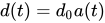
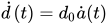

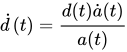

Current evidence suggests that the expansion of the universe is accelerating, which means that the second derivative of the scale factor 


03Relationship to redshift
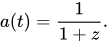
According to the Friedmann-Lemaître-Robertson-Walker metric which is used to model the expanding universe, if at present time we receive light from a distant object with a redshift of z, then the scale factor at the time the object originally emitted that light is
04Chronology
Qualitatively, the scale factor of the universe had three different dependencies on time. During each era the scale factor responded to the dominant energy form.
Radiation-dominated era
After Inflation, and until about 47,000 years after the Big Bang, the dynamics of the early universe were set by radiation (referring generally to the constituents of the universe which moved relativistically, principally photons and neutrinos).
For a radiation-dominated universe the evolution of the scale factor in the Friedmann-Lemaître-Robertson-Walker metric is obtained solving the Friedmann equations:

Matter-dominated era
Between about 47,000 years and 9.8 billion years after the Big Bang, the energy density of matter exceeded both the energy density of radiation and the vacuum energy density.
When the early universe was about 47,000 years old (redshift 3600), mass-energy density surpassed the radiation energy, although the universe remained optically thick to radiation until the universe was about 378,000 years old (redshift 1100). This second moment in time (close to the time of recombination), at which the photons which compose the cosmic microwave background radiation were last scattered, is often mistaken as marking the end of the radiation era.
For a matter-dominated universe the evolution of the scale factor in the Friedmann-Lemaître-Robertson-Walker metric is obtained solving the Friedmann equations:

Dark energy-dominated era
In physical cosmology, the dark energy-dominated era is proposed as the last of the three phases of the known universe, beginning when the Universe was about 9.8 billion years old. In the era of cosmic inflation, the Hubble parameter is also thought to be constant, so the expansion law of the dark energy-dominated era also holds for the inflationary prequel of the big bang.
The cosmological constant is given the symbol Λ, and, considered as a source term in the Einstein field equation, can be viewed as equivalent to a "mass" of empty space, or dark energy. Since this increases with the volume of the universe, the expansion pressure is effectively constant, independent of the scale of the universe, while the other terms decrease with time. Thus, as the density of other forms of matter, dust and radiation, drops to very low concentrations, the cosmological constant (or "dark energy") term will eventually dominate the energy density of the Universe. Recent measurements of the change in Hubble constant with time, based on observations of distant supernovae, show this acceleration in expansion rate, indicating the presence of such dark energy.
For a dark energy-dominated universe, the evolution of the scale factor in the Friedmann-Lemaître-Robertson-Walker metric is easily obtained solving the Friedmann equations:

Sources and credits
This article is adapted from the Wikipedia article “Scale factor (cosmology)”, written by its contributors and licensed under CC BY-SA 4.0. Fathomly has changed the layout, removed citation markers, navigation and maintenance notices, and adjusted punctuation. This adapted version is shared under the same license. For references, see the original article.
Images, from Wikimedia Commons:
- ScaleFactorBasics.svg by Johnjbarton, CC0
Fathomly is not affiliated with or endorsed by the Wikimedia Foundation. Spotted a problem? Tell us.

