Optical depth
Physics concept regarding radiation transparency and attenuation

In physics, optical depth or optical thickness is the natural logarithm of the ratio of incident to transmitted radiant power through a material. Thus, the larger the optical depth, the smaller the fraction of transmitted radiant power through the medium. Spectral optical depth or spectral optical thickness is the natural logarithm of the ratio of incident to transmitted spectral radiant power through a material.
Optical depth is a dimensionless quantity. Although it is a monotonically increasing function of path length, it is not a physical distance itself, approaching zero as the path length vanishes. The use of the term "optical density" for optical depth is discouraged.
In chemistry, a closely related quantity called absorbance (or decadic absorbance) is used instead of optical depth. Absorbance uses the common logarithm (base 10) of the ratio of incident to transmitted radiant power. It relates to optical depth by a factor of loge(10).
01Mathematical definitions
Optical depth
The optical depth of a material, denoted by 

where
is the radiant flux received (incident) by that material;
is the radiant flux transmitted by that material;
is the transmittance of that material.
The decadic absorbance 

Spectral optical depth
The spectral optical depth in frequency (

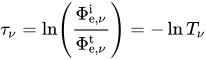

where
and
are the incident and transmitted spectral radiant fluxes in frequency;
is the spectral transmittance in frequency;
and
are the incident and transmitted spectral radiant fluxes in wavelength;
is the spectral transmittance in wavelength.
Spectral absorbance relates to spectral optical depth via:


02Relationship with attenuation
Attenuation
Optical depth quantifies the attenuation of transmitted radiant power in a medium. Attenuation can occur via absorption, scattering, reflection, and other physical processes.
According to the Beer-Lambert law, the transmitted flux decays exponentially with optical depth:

The fractional attenuation (

where 


Attenuation coefficient
The optical depth along a path of length 


If 

In terms of the attenuation cross-section 


where 
03Applications
Atomic physics
In atomic physics, the spectral optical depth of a cloud of resonant two-level atoms can be determined from quantum-mechanical dipole transitions:

where
is the transition dipole moment;
is the total number of atoms;
is the frequency of the incident radiation;
is the speed of light;
is the reduced Planck constant;
is the vacuum permittivity;
is the natural linewidth of the atomic transition;
is the normalized spectral line profile shape.
Atmospheric sciences
In atmospheric sciences, optical depth often refers to a vertical path extending from Earth's surface to outer space. For a slanted line of sight at zenith angle 


yielding a total transmittance of:

The total atmospheric optical depth encompasses contributions from Rayleigh scattering, aerosol optical depth (AOD), and trace gas absorption, routinely measured using Sun photometers.
With altitude 

giving a sea-level vertical optical depth of:

where:
is the absorption coefficient;
is the species mixing ratio;
is the air density at sea level;
is the atmospheric scale height;
For a uniform plane-parallel cloud layer, optical depth can be parameterized as:
![\tau =Q_{\text{e}}\left[{\frac {9\pi L^{2}HN}{16\rho _{\text{l}}^{2}}}\right]^{1/3}](https://wikimedia.org/api/rest_v1/media/math/render/svg/55db7994895f56d70bcb4c335925d77deaf8bff6)
where:
is the extinction efficiency;
is the liquid water path;
is the droplet number concentration;
is the density of liquid water.
Thus, for a constant cloud thickness and total liquid water content, optical depth scales with droplet concentration as 
Astronomy
In astronomy, optical depth governs radiation escape from stellar atmospheres, planetary rings, and nebulae. In stellar physics, the photosphere is defined as the atmospheric depth where 
For planetary rings, optical depth measures the fraction of light blocked by ring material during stellar occultations.
Sources and credits
This article is adapted from the Wikipedia article “Optical depth”, written by its contributors and licensed under CC BY-SA 4.0. Fathomly has changed the layout, removed citation markers, navigation and maintenance notices, and adjusted punctuation. This adapted version is shared under the same license. For references, see the original article.
Images, from Wikimedia Commons:
- Aerosol Optical Depth (haze) at Geronimo Creek Observatory, Texas (1990-2016).jpg by Forrest M. Mims III, CC BY-SA 4.0
Fathomly is not affiliated with or endorsed by the Wikimedia Foundation. Spotted a problem? Tell us.
