Quaternionic representation
Representation of a group or algebra in terms of an algebra with quaternionic structure
In the mathematical field of representation theory, a quaternionic representation is a representation on a complex vector space V with an invariant quaternionic structure, i.e., an antilinear equivariant map

which satisfies

Together with the imaginary unit i and the antilinear map k := ij, j equips V with the structure of a quaternionic vector space (i.e., V becomes a module over the division algebra of quaternions). From this point of view, quaternionic representation of a group G is a group homomorphism φ: G → GL(V, H), the group of invertible quaternion-linear transformations of V. In particular, a quaternionic matrix representation of g assigns a square matrix of quaternions ρ(g) to each element g of G such that ρ(e) is the identity matrix and

Quaternionic representations of associative and Lie algebras can be defined in a similar way.
01Properties and related concepts
If V is a unitary representation and the quaternionic structure j is a unitary operator, then V admits an invariant complex symplectic form ω, and hence is a symplectic representation. This always holds if V is a representation of a compact group (e.g. a finite group) and in this case quaternionic representations are also known as symplectic representations. Such representations, amongst irreducible representations, can be picked out by the Frobenius-Schur indicator.
Quaternionic representations are similar to real representations in that they are isomorphic to their complex conjugate representation. Here a real representation is taken to be a complex representation with an invariant real structure, i.e., an antilinear equivariant map
which satisfies

A representation which is isomorphic to its complex conjugate, but which is not a real representation, is sometimes called a pseudoreal representation.
Real and pseudoreal representations of a group G can be understood by viewing them as representations of the real group algebra R[G]. Such a representation will be a direct sum of central simple R-algebras, which, by the Artin-Wedderburn theorem, must be matrix algebras over the real numbers or the quaternions. Thus a real or pseudoreal representation is a direct sum of irreducible real representations and irreducible quaternionic representations. It is real if no quaternionic representations occur in the decomposition.
02Examples
A common example involves the quaternionic representation of rotations in three dimensions. Each (proper) rotation is represented by a quaternion with unit norm. There is an obvious one-dimensional quaternionic vector space, namely the space H of quaternions themselves under left multiplication. By restricting this to the unit quaternions, we obtain a quaternionic representation of the spinor group Spin(3).
This representation ρ: Spin(3) → GL(1,H) also happens to be a unitary quaternionic representation because
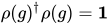
for all g in Spin(3).
Another unitary example is the spin representation of Spin(5). An example of a non-unitary quaternionic representation would be the two dimensional irreducible representation of Spin(5,1).
More generally, the spin representations of Spin(d) are quaternionic when d equals 3 + 8k, 4 + 8k, and 5 + 8k dimensions, where k is an integer. In physics, one often encounters the spinors of Spin(d, 1). These representations have the same type of real or quaternionic structure as the spinors of Spin(d − 1).
Among the compact real forms of the simple Lie groups, irreducible quaternionic representations only exist for the Lie groups of type A4k+1, B4k+1, B4k+2, Ck, D4k+2, and E7.
Sources and credits
This article is adapted from the Wikipedia article “Quaternionic representation”, written by its contributors and licensed under CC BY-SA 4.0. Fathomly has changed the layout, removed citation markers, navigation and maintenance notices, and adjusted punctuation. This adapted version is shared under the same license. For references, see the original article.
Fathomly is not affiliated with or endorsed by the Wikimedia Foundation. Spotted a problem? Tell us.