Reference articles on history, science, culture and more
Encyclopedia

Real structure

Mathematics concept

In mathematics, a real structure on a complex vector space is a way to decompose the complex vector space in the direct sum of two real vector spaces. The prototype of such a structure is the field of complex numbers itself, considered as a complex vector space over itself and with the conjugation map \sigma :{\mathbb {C} }\to {\mathbb {C} }\,, with \sigma (z)={\bar {z}}, giving the "canonical" real structure on {\mathbb {C} }\,, that is {\mathbb {C} }={\mathbb {R} }\oplus i{\mathbb {R} }\,.

The conjugation map is antilinear: \sigma (\lambda z)={\bar {\lambda }}\sigma (z)\, and \sigma (z_{1}+z_{2})=\sigma (z_{1})+\sigma (z_{2})\,.

01Vector space

A real structure on a complex vector space V is an antilinear involution \sigma :V\to V. A real structure defines a real subspace V_{\mathbb {R} }\subset V, its fixed locus, and the natural map

V_{\mathbb {R} }\otimes _{\mathbb {R} }{\mathbb {C} }\to V

is an isomorphism. Conversely any vector space that is the complexification of a real vector space has a natural real structure.

One first notes that every complex space V has a realification obtained by taking the same vectors as in the original set and restricting the scalars to be real. If t\in V\, and t\neq 0 then the vectors t\, and it\, are linearly independent in the realification of V. Hence:

\dim _{\mathbb {R} }V=2\dim _{\mathbb {C} }V

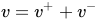
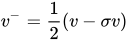
Naturally, one would wish to represent V as the direct sum of two real vector spaces, the "real and imaginary parts of V". There is no canonical way of doing this: such a splitting is an additional real structure in V. It may be introduced as follows. Let \sigma :V\to V\, be an antilinear map such that \sigma \circ \sigma =id_{V}\,, that is an antilinear involution of the complex space V. Any vector v\in V\, can be written {v=v^{+}+v^{-}}\,, where v^{+}={1 \over {2}}(v+\sigma v) and v^{-}={1 \over {2}}(v-\sigma v)\,.

Therefore, one gets a direct sum of vector spaces V=V^{+}\oplus V^{-}\, where:

V^{+}=\{v\in V|\sigma v=v\} and V^{-}=\{v\in V|\sigma v=-v\}\,.

Both sets V^{+}\, and V^{-}\, are real vector spaces. The linear map K:V^{+}\to V^{-}\,, where K(t)=it\,, is an isomorphism of real vector spaces, whence:

\dim _{\mathbb {R} }V^{+}=\dim _{\mathbb {R} }V^{-}=\dim _{\mathbb {C} }V\,.

The first factor V^{+}\, is also denoted by V_{\mathbb {R} }\, and is left invariant by \sigma \,, that is \sigma (V_{\mathbb {R} })\subset V_{\mathbb {R} }\,. The second factor V^{-}\, is usually denoted by iV_{\mathbb {R} }\,. The direct sum V=V^{+}\oplus V^{-}\, reads now as:

V=V_{\mathbb {R} }\oplus iV_{\mathbb {R} }\,,

i.e. as the direct sum of the "real" V_{\mathbb {R} }\, and "imaginary" iV_{\mathbb {R} }\, parts of V. This construction strongly depends on the choice of an antilinear involution of the complex vector space V. The complexification of the real vector space V_{\mathbb {R} }\,, i.e., V^{\mathbb {C} }=V_{\mathbb {R} }\otimes _{\mathbb {R} }\mathbb {C} \, admits a natural real structure and hence is canonically isomorphic to the direct sum of two copies of V_{\mathbb {R} }\,:

V_{\mathbb {R} }\otimes _{\mathbb {R} }\mathbb {C} =V_{\mathbb {R} }\oplus iV_{\mathbb {R} }\,.

It follows a natural linear isomorphism V_{\mathbb {R} }\otimes _{\mathbb {R} }\mathbb {C} \to V\, between complex vector spaces with a given real structure.

A real structure on a complex vector space V, that is an antilinear involution \sigma :V\to V\,, may be equivalently described in terms of the linear map {\hat {\sigma }}:V\to {\bar {V}}\, from the vector space V\, to the complex conjugate vector space {\bar {V}}\, defined by

v\mapsto {\hat {\sigma }}(v):={\overline {\sigma (v)}}\,.

02Algebraic variety

For an algebraic variety defined over a subfield of the real numbers, the real structure is the complex conjugation acting on the points of the variety in complex projective or affine space. Its fixed locus is the space of real points of the variety (which may be empty).

03Scheme

For a scheme defined over a subfield of the real numbers, complex conjugation is in a natural way a member of the Galois group of the algebraic closure of the base field. The real structure is the Galois action of this conjugation on the extension of the scheme over the algebraic closure of the base field. The real points are the points whose residue field is fixed (which may be empty).

04Reality structure

In mathematics, a reality structure on a complex vector space V is a decomposition of V into two real subspaces, called the real and imaginary parts of V:

V=V_{\mathbb {R} }\oplus iV_{\mathbb {R} }.

Here VR is a real subspace of V, i.e. a subspace of V considered as a vector space over the real numbers. If V has complex dimension n (real dimension 2n), then VR must have real dimension n.

The standard reality structure on the vector space \mathbb {C} ^{n} is the decomposition

\mathbb {C} ^{n}=\mathbb {R} ^{n}\oplus i\,\mathbb {R} ^{n}.

In the presence of a reality structure, every vector in V has a real part and an imaginary part, each of which is a vector in VR:

v=\operatorname {Re} \{v\}+i\,\operatorname {Im} \{v\}

In this case, the complex conjugate of a vector v is defined as follows:

{\overline {v}}=\operatorname {Re} \{v\}-i\,\operatorname {Im} \{v\}

This map v\mapsto {\overline {v}} is an antilinear involution, i.e.

{\overline {\overline {v}}}=v,\quad {\overline {v+w}}={\overline {v}}+{\overline {w}},\quad {\text{and}}\quad {\overline {\alpha v}}={\overline {\alpha }}\,{\overline {v}}.

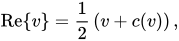
Conversely, given an antilinear involution v\mapsto c(v) on a complex vector space V, it is possible to define a reality structure on V as follows. Let

\operatorname {Re} \{v\}={\frac {1}{2}}\left(v+c(v)\right),

and define

V_{\mathbb {R} }=\left\{\operatorname {Re} \{v\}\mid v\in V\right\}.

Then

V=V_{\mathbb {R} }\oplus iV_{\mathbb {R} }.

This is actually the decomposition of V as the eigenspaces of the real linear operator c. The eigenvalues of c are +1 and 1, with eigenspaces VR and i VR, respectively. Typically, the operator c itself, rather than the eigenspace decomposition it entails, is referred to as the reality structure on V.

Watch videos about Real structureExplainers and documentaries on YouTube (opens in a new tab)

Sources and credits

This article is adapted from the Wikipedia article Real structure, written by its contributors and licensed under CC BY-SA 4.0. Fathomly has changed the layout, removed citation markers, navigation and maintenance notices, and adjusted punctuation. This adapted version is shared under the same license. For references, see the original article.

Fathomly is not affiliated with or endorsed by the Wikimedia Foundation. Spotted a problem? Tell us.

Continue exploring

Related topics

Antilinear map

In mathematics, a function f : V → W {\displaystyle f:V\to W} between two complex vector spaces is said to be antilinear or conjugate-linear if f = f ( x ) + f ( y ) (additivity) f ( s x ) = s ¯ f ( x ) (conjugate homogeneity) {\displaystyle {\begin{alignedat}{9}f(x+y)&=f(x)+f(y)&&\qquad {\text{ (additivity) }}\\f(sx)&={\overline {s}}f(x)&&\qquad {\text{ (conjugate homogeneity) }}\\\end{alignedat}}} hold for all vectors x , y ∈ V {\displaystyle x,y\in V} and every complex number s , {\displaystyle s,} where s ¯ {\displaystyle {\overline {s}}} denotes the complex conjugate of s . {\displaystyle s.} Antilinear maps stand in contrast to linear maps, which are additive maps that are homogeneous rather than conjugate homogeneous.

Complex conjugate

In mathematics, the complex conjugate of a complex number is the number with an equal real part and an imaginary part equal in magnitude but with opposite sign. That is, if a {\displaystyle a} and b {\displaystyle b} are real numbers, then the complex conjugate of a + b i {\displaystyle a+bi} is ⁠ a − b i {\displaystyle a-bi} ⁠.

Complex conjugate of a vector space

In mathematics, the complex conjugate of a complex vector space V {\displaystyle V\,} is a complex vector space V ¯ {\displaystyle {\overline {V}}} that has the same elements and additive group structure as V , {\displaystyle V,} but whose scalar multiplication involves conjugation of the scalars. In other words, the scalar multiplication of V ¯ {\displaystyle {\overline {V}}} satisfies α ∗ v = α ¯ ⋅ v {\displaystyle \alpha \,*\,v={\,{\overline {\alpha }}\cdot \,v\,}} where ∗ {\displaystyle *} is the scalar multiplication of V ¯ {\displaystyle {\overline {V}}} and ⋅ {\displaystyle \cdot } is the scalar multiplication of V .