Quantale
Algebraic structure
In mathematics, quantales are certain partially ordered algebraic structures that generalize locales (point free topologies) as well as various multiplicative lattices of ideals from ring theory and functional analysis (C*-algebras, von Neumann algebras). Quantales are sometimes referred to as complete residuated semigroups.
01Overview
A quantale is a complete lattice 

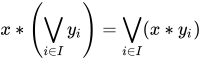
and
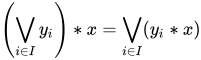
for all 



for all 

A unital quantale may be defined equivalently as a monoid in the category Sup of complete join-semilattices.
A unital quantale is an idempotent semiring under join and multiplication.
A unital quantale in which the identity is the top element of the underlying lattice is said to be strictly two-sided (or simply integral).
A commutative quantale is a quantale whose multiplication is commutative. A frame, with its multiplication given by the meet operation, is a typical example of a strictly two-sided commutative quantale. Another simple example is provided by the unit interval together with its usual multiplication.
An idempotent quantale is a quantale whose multiplication is idempotent. A frame is the same as an idempotent strictly two-sided quantale.
An involutive quantale is a quantale with an involution
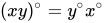
that preserves joins:
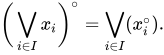
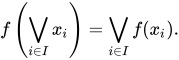
A quantale homomorphism is a map 


Sources and credits
This article is adapted from the Wikipedia article “Quantale”, written by its contributors and licensed under CC BY-SA 4.0. Fathomly has changed the layout, removed citation markers, navigation and maintenance notices, and adjusted punctuation. This adapted version is shared under the same license. For references, see the original article.
Fathomly is not affiliated with or endorsed by the Wikimedia Foundation. Spotted a problem? Tell us.