Reference articles on history, science, culture and more
Encyclopedia

Positive linear functional

In mathematics, more specifically in functional analysis, a positive linear functional on an ordered vector space (V,\leq ) is a linear functional f on V so that for all positive elements v\in V, that is v\geq 0, it holds that f(v)\geq 0.

In other words, a positive linear functional is guaranteed to take nonnegative values for positive elements. The significance of positive linear functionals lies in results such as Riesz-Markov-Kakutani representation theorem.

When V is a complex vector space, it is assumed that for all v\geq 0, f(v) is real. As in the case when V is a C*-algebra with its partially ordered subspace of self-adjoint elements, sometimes a partial order is placed on only a subspace W\subseteq V, and the partial order does not extend to all of V, in which case the positive elements of V are the positive elements of W, by abuse of notation. This implies that for a C*-algebra, a positive linear functional sends any x\in V equal to s^{\ast }s for some s\in V to a real number, which is equal to its complex conjugate, and therefore all positive linear functionals preserve the self-adjointness of such x. This property is exploited in the GNS construction to relate positive linear functionals on a C*-algebra to inner products.

01Sufficient conditions for continuity of all positive linear functionals

There is a comparatively large class of ordered topological vector spaces on which every positive linear form is necessarily continuous. This includes all topological vector lattices that are sequentially complete.

Theorem Let X be an Ordered topological vector space with positive cone C\subseteq X and let {\mathcal {B}}\subseteq {\mathcal {P}}(X) denote the family of all bounded subsets of X. Then each of the following conditions is sufficient to guarantee that every positive linear functional on X is continuous:

  1. C has non-empty topological interior (in X).
  2. X is complete and metrizable and X=C-C.
  3. X is bornological and C is a semi-complete strict {\mathcal {B}}-cone in X.
  4. X is the inductive limit of a family \left(X_{\alpha }\right)_{\alpha \in A} of ordered Fréchet spaces with respect to a family of positive linear maps where X_{\alpha }=C_{\alpha }-C_{\alpha } for all \alpha \in A, where C_{\alpha } is the positive cone of X_{\alpha }.

02Continuous positive extensions

The following theorem is due to H. Bauer and independently, to Namioka.

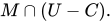
Theorem: Let X be an ordered topological vector space (TVS) with positive cone C, let M be a vector subspace of E, and let f be a linear form on M. Then f has an extension to a continuous positive linear form on X if and only if there exists some convex neighborhood U of 0 in X such that \operatorname {Re} f is bounded above on M\cap (U-C).
Corollary: Let X be an ordered topological vector space with positive cone C, let M be a vector subspace of E. If C\cap M contains an interior point of C then every continuous positive linear form on M has an extension to a continuous positive linear form on X.
Corollary: Let X be an ordered vector space with positive cone C, let M be a vector subspace of E, and let f be a linear form on M. Then f has an extension to a positive linear form on X if and only if there exists some convex absorbing subset W in X containing the origin of X such that \operatorname {Re} f is bounded above on M\cap (W-C).

Proof: It suffices to endow X with the finest locally convex topology making W into a neighborhood of 0\in X.

03Examples

Consider, as an example of V, the C*-algebra of complex square matrices with the positive elements being the positive-definite matrices. The trace function defined on this C*-algebra is a positive functional, as the eigenvalues of any positive-definite matrix are positive, and so its trace is positive.

Consider the Riesz space \mathrm {C} _{\mathrm {c} }(X) of all continuous complex-valued functions of compact support on a locally compact Hausdorff space X. Consider a Borel regular measure \mu on X, and a functional \psi defined by \psi (f)=\int _{X}f(x)d\mu (x)\quad {\text{ for all }}f\in \mathrm {C} _{\mathrm {c} }(X). Then, this functional is positive (the integral of any positive function is a positive number). Moreover, any positive functional on this space has this form, as follows from the Riesz-Markov-Kakutani representation theorem.

04Positive linear functionals (C*-algebras)

Let M be a C*-algebra (more generally, an operator system in a C*-algebra A) with identity 1. Let M^{+} denote the set of positive elements in M.

A linear functional \rho on M is said to be positive if \rho (a)\geq 0, for all a\in M^{+}.

Theorem. A linear functional \rho on M is positive if and only if \rho is bounded and \|\rho \|=\rho (1).

Cauchy-Schwarz inequality

If \rho is a positive linear functional on a C*-algebra A, then one may define a semidefinite sesquilinear form on A by \langle a,b\rangle =\rho (b^{\ast }a). Thus from the Cauchy-Schwarz inequality we have \left|\rho (b^{\ast }a)\right|^{2}\leq \rho (a^{\ast }a)\cdot \rho (b^{\ast }b).

05Applications to economics

Given a space C, a price system can be viewed as a continuous, positive, linear functional on C.

Watch videos about Positive linear functionalExplainers and documentaries on YouTube (opens in a new tab)

Sources and credits

This article is adapted from the Wikipedia article Positive linear functional, written by its contributors and licensed under CC BY-SA 4.0. Fathomly has changed the layout, removed citation markers, navigation and maintenance notices, and adjusted punctuation. This adapted version is shared under the same license. For references, see the original article.

Fathomly is not affiliated with or endorsed by the Wikimedia Foundation. Spotted a problem? Tell us.