Convergence of measures
Mathematical concept
In mathematics, more specifically measure theory, there are various notions of the convergence of measures. For an intuitive general sense of what is meant by convergence of measures, consider a sequence of measures μn on a space, sharing a common collection of measurable sets. Such a sequence might represent an attempt to construct 'better and better' approximations to a desired measure μ that is difficult to obtain directly. The meaning of 'better and better' is subject to all the usual caveats for taking limits; for any error tolerance ε > 0 we require there be N sufficiently large for n ≥ N to ensure the 'difference' between μn and μ is smaller than ε. Various notions of convergence specify precisely what the word 'difference' should mean in that description; these notions are not equivalent to one another, and vary in strength.
Three of the most common notions of convergence are described below.
01Informal descriptions
This section attempts to provide a rough intuitive description of three notions of convergence, using terminology developed in calculus courses; this section is necessarily imprecise as well as inexact, and the reader should refer to the formal clarifications in subsequent sections. In particular, the descriptions here do not address the possibility that the measure of some sets could be infinite, or that the underlying space could exhibit pathological behavior, and additional technical assumptions are needed for some of the statements. The statements in this section are however all correct if μn is a sequence of probability measures on a Polish space.
The various notions of convergence formalize the assertion that the 'average value' of each 'sufficiently nice' function should converge:
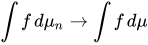
To formalize this requires a careful specification of the set of functions under consideration and how uniform the convergence should be.
The notion of weak convergence requires this convergence to take place for every continuous bounded function f. This notion treats convergence for different functions f independently of one another, i.e., different functions f may require different values of N ≤ n to be approximated equally well (thus, convergence is non-uniform in f).
The notion of setwise convergence formalizes the assertion that the measure of each measurable set should converge:

Again, no uniformity over the set A is required.
Intuitively, considering integrals of 'nice' functions, this notion provides more uniformity than weak convergence. As a matter of fact, when considering sequences of measures with uniformly bounded
variation on a Polish space, setwise convergence implies the convergence 
The notion of total variation convergence formalizes the assertion that the measure of all measurable sets should converge uniformly, i.e. for every ε > 0 there exists N such that 
02Total variation convergence of measures
This is the strongest notion of convergence shown on this page and is defined as follows. Let 

Here the supremum is taken over f ranging over the set of all measurable functions from X to [−1, 1]. This is in contrast, for example, to the Wasserstein metric, where the definition is of the same form, but the supremum is taken over f ranging over the set of those measurable functions from X to [−1, 1] which have Lipschitz constant at most 1; and also in contrast to the Radon metric, where the supremum is taken over f ranging over the set of continuous functions from X to [−1, 1]. In the case where X is a Polish space, the total variation metric coincides with the Radon metric.
If μ and ν are both probability measures, then the total variation distance is also given by

The equivalence between these two definitions can be seen as a particular case of the Monge-Kantorovich duality. From the two definitions above, it is clear that the total variation distance between probability measures is always between 0 and 2.
To illustrate the meaning of the total variation distance, consider the following thought experiment. Assume that we are given two probability measures μ and ν, as well as a random variable X. We know that X has law either μ or ν but we do not know which one of the two. Assume that these two measures have prior probabilities 0.5 each of being the true law of X. Assume now that we are given one single sample distributed according to the law of X and that we are then asked to guess which one of the two distributions describes that law. The quantity

then provides a sharp upper bound on the prior probability that our guess will be correct.
Given the above definition of total variation distance, a sequence μn of measures defined on the same measure space is said to converge to a measure μ in total variation distance if for every ε > 0, there exists an N such that for all n > N, one has that

03Setwise convergence of measures
For
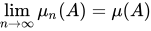
for every set 
Typical arrow notations are 

For example, as a consequence of the Riemann-Lebesgue lemma, the sequence μn of measures on the interval [−1, 1] given by μn(dx) = (1 + sin(nx))dx converges setwise to Lebesgue measure, but it does not converge in total variation.
In a measure theoretical or probabilistic context setwise convergence is often referred to as strong convergence (as opposed to weak convergence). This can lead to some ambiguity because in functional analysis, strong convergence usually refers to convergence with respect to a norm.
04Weak convergence of measures
In mathematics and statistics, weak convergence is one of many types of convergence relating to the convergence of measures. It depends on a topology on the underlying space and thus is not a purely measure-theoretic notion.
There are several equivalent definitions of weak convergence of a sequence of measures, some of which are (apparently) more general than others. The equivalence of these conditions is sometimes known as the Portmanteau theorem.
Definition. Let 





for all bounded, continuous functions
;
for every upper semi-continuous function
for every lower semi-continuous function
for all closed sets
of space
for all open sets
of space
for all continuity sets
of measure
In the case 


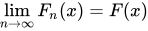

For example, the sequence where 

This definition of weak convergence can be extended for 

where

If
If
There are many "arrow notations" for this kind of convergence: the most frequently used are 


Weak convergence of random variables
Let 
Comparison with vague convergence
Let 
![[0,1]](https://wikimedia.org/api/rest_v1/media/math/render/svg/738f7d23bb2d9642bab520020873cccbef49768d)
the class of continuous functions
the class of continuous functions
the class of continuous bounded functions
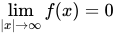
We have 


Vague Convergence
A sequence of measures 


Weak Convergence
A sequence of measures 
In general, these two convergence notions are not equivalent.
In a probability setting, vague convergence and weak convergence of probability measures are equivalent assuming tightness. That is, a tight sequence of probability measures 
The weak limit of a sequence of probability measures, provided it exists, is a probability measure. In general, if tightness is not assumed, a sequence of probability (or sub-probability) measures may not necessarily converge vaguely to a true probability measure, but rather to a sub-probability measure (a measure such that 

Weak convergence of measures as an example of weak-* convergence
Despite having the same name as weak convergence in the context of functional analysis, weak convergence of measures is actually an example of weak-* convergence. The definitions of weak and weak-* convergences used in functional analysis are as follows:
Let 
- A sequence
in
if
as
for all
. One writes
as
- A sequence of
converges in the weak-* topology to
provided that
for all
. That is, convergence occurs in the point-wise sense. In this case, one writes
as
To illustrate how weak convergence of measures is an example of weak-* convergence, we give an example in terms of vague convergence (see above). Let 


for all 
For compact 
Sources and credits
This article is adapted from the Wikipedia article “Convergence of measures”, written by its contributors and licensed under CC BY-SA 4.0. Fathomly has changed the layout, removed citation markers, navigation and maintenance notices, and adjusted punctuation. This adapted version is shared under the same license. For references, see the original article.
Fathomly is not affiliated with or endorsed by the Wikimedia Foundation. Spotted a problem? Tell us.