Pair potential
Potential energy of two interacting objects as a function of their distance
In physics, a pair potential is a function that describes the potential energy of two interacting objects solely as a function of the distance between them.
Some interactions, like Coulomb's law in electrodynamics or Newton's law of universal gravitation in mechanics naturally have this form for simple spherical objects. For other types of more complex interactions or objects it is useful and common to approximate the interaction by a pair potential, for example interatomic potentials in physics and computational chemistry that use approximations like the Lennard-Jones and Morse potentials.
01Functional form
The total energy of a system of 


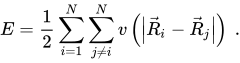
Equivalently, this can be expressed as
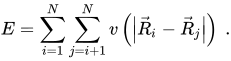
This expression uses the fact that interaction is symmetric between particles 


02Potential range
A fundamental property of a pair potential is its range. It is expected that pair potentials go to zero for infinite distance as particles that are too far apart do not interact. In some cases the potential goes quickly to zero and the interaction for particles that are beyond a certain distance can be assumed to be zero, these are said to be short-range potentials. Other potentials, like the Coulomb or gravitational potential, are long range: they go slowly to zero and the contribution of particles at long distances still contributes to the total energy.
03Computational cost
The total energy expression for pair potentials is quite simple to use for analytical and computational work. It has some limitations however, as the computational cost is proportional to the square of number of particles. This might be prohibitively expensive when the interaction between large groups of objects needs to be calculated.
For short-range potentials the sum can be restricted only to include particles that are close, reducing the cost to linearly proportional to the number of particles.
04Infinitely periodic systems
In some cases it is necessary to calculate the interaction between an infinite number of particles arranged in a periodic pattern.
05Beyond pair potentials
An example of a potential energy function that is not a pair potential is the three-body Axilrod-Teller potential. Another example is the Stillinger-Weber potential for silicon, which includes the angle in a triangle of silicon atoms as an input parameter.
06Common pair potentials
Some commonly used pair potentials are listed below.
Sources and credits
This article is adapted from the Wikipedia article “Pair potential”, written by its contributors and licensed under CC BY-SA 4.0. Fathomly has changed the layout, removed citation markers, navigation and maintenance notices, and adjusted punctuation. This adapted version is shared under the same license. For references, see the original article.
Fathomly is not affiliated with or endorsed by the Wikimedia Foundation. Spotted a problem? Tell us.