Buckingham potential
Physical model of intermolecular interactions
In theoretical chemistry, the Buckingham potential is a model of intermolecular interactions based on pair potentials developed by Richard Buckingham. The model describes repulsion by the Pauli exclusion principle and attraction by van der Waals forces between all atom pairs that are not directly bonded as a function of the interatomic distance 
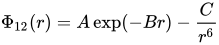
is given by two terms that represent the attraction and the repulsion, respectively. The constants, 


Buckingham proposed this as a simplification of the Lennard-Jones potential, in a theoretical study of the equation of state for gaseous helium, neon and argon.
As explained in Buckingham's original paper and, e.g., in section 2.2.5 of Jensen's text, the repulsion is due to the interpenetration of the closed electron shells. "There is therefore some justification for choosing the repulsive part (of the potential) as an exponential function". The Buckingham potential has been used extensively in simulations of molecular dynamics.
Because the exponential term converges to a constant with decreasing distance, while the 
01Modified Buckingham (Exp-Six) potential
The modified Buckingham potential, also called the "exp-six" potential, is used to calculate the interatomic forces for gases based on Chapman and Cowling collision theory. The potential has the form
![\Phi _{12}(r)={\frac {\epsilon }{1-6/\alpha }}\left[{\frac {6}{\alpha }}\exp \left[\alpha \left(1-{\frac {r}{r_{min}}}\right)\right]-\left({\frac {r_{min}}{r}}\right)^{6}\right]](https://wikimedia.org/api/rest_v1/media/math/render/svg/80e3fc27abeca3b8e89135ee679c5c10bdedc9d1)
where 


02Coulomb-Buckingham potential
The Coulomb-Buckingham potential is an extension of the Buckingham potential for application to ionic systems (e.g. ceramic materials). The formula for the interaction is

where A, B, and C are suitable constants and the additional term is the electrostatic potential energy.
The above equation may be written in its alternate form as
![\Phi (r)=\varepsilon \left\{{\frac {6}{\alpha -6}}\exp \left(\alpha \left[1-{\frac {r}{r_{0}}}\right]\right)-{\frac {\alpha }{\alpha -6}}\left({\frac {r_{0}}{r}}\right)^{6}\right\}+{\frac {q_{1}q_{2}}{4\pi \varepsilon _{0}r}}](https://wikimedia.org/api/rest_v1/media/math/render/svg/9272eda4ce5c807ddfc2819e6a256f5c01c05959)
where 

03Beest Kramer van Santen (BKS) potential
The BKS potential is a force field that may be used to simulate the interatomic potential between Silica glass atoms. Rather than relying only on experimental data, the BKS potential is derived by combining ab initio quantum chemistry methods on small silica clusters to describe accurate interaction between nearest-neighbors, which is the function of accurate force field. The experimental data is applied to fit larger scale force information beyond nearest neighbors. By combining the microscopic and macroscopic information, the applicability of the BKS potential has been extended to both the silica polymorphs and other tetrahedral network oxides systems that have same cluster structure, such as aluminophosphates, carbon and silicon.
The form of this interatomic potential is the usual Buckingham form, with the addition of a Coulomb force term. The formula for the BKS potential is expressed as
![\Phi _{ij}(r)=\left[A_{ij}\exp \left(-B_{ij}r_{ij}\right)-{\frac {C_{ij}}{r_{ij}^{6}}}\right]+{\frac {q_{i}q_{j}}{r_{ij}}}](https://wikimedia.org/api/rest_v1/media/math/render/svg/0fdd6c4774148ed9d2e47245e4f470dd56c7053a)
where 


The BKS potential parameters for common atoms are shown below:
| i-j | Aij(eV) | Bij(Å−1) | Cij(eV•Å6) |
|---|---|---|---|
| O - O | 1388.7730 | 2.76000 | 175.0000 |
| O - Si | 18,003.757 | 4.87318 | 133.5381 |
| Si - Si | 0 | 0 | 0 |
| Al - O | 16,008.5345 | 4.79667 | 130.5659 |
| Al - Al | 0 | 0 | 0 |
| P - O | 9,034.2080 | 5.19098 | 19.8793 |
| P - P | 0 | 0 | 0 |
An updated version of the BKS potential introduced a new repulsive term to prevent atom overlapping. The modified potential is taken as
![\Phi _{12}(r)=\left[A_{12}\exp \left(-B_{12}r_{12}\right)-{\frac {C_{12}}{r_{12}^{6}}}\right]+{\frac {q_{1}q_{2}}{r_{12}}}+{\frac {D_{12}}{r_{12}^{24}}}](https://wikimedia.org/api/rest_v1/media/math/render/svg/fdffe093812bb5c0c4a208500dd533b23dcbd93f)
where the constant parameters 
| Si - Si | Si - O | O - O | |
|---|---|---|---|
| Dij(eV•Å24) | 3423200 | 29 | 113 |
Sources and credits
This article is adapted from the Wikipedia article “Buckingham potential”, written by its contributors and licensed under CC BY-SA 4.0. Fathomly has changed the layout, removed citation markers, navigation and maintenance notices, and adjusted punctuation. This adapted version is shared under the same license. For references, see the original article.
Images, from Wikimedia Commons:
- Coulomb-Buckingham Potential.png by Rickinwalin, CC BY-SA 4.0
Fathomly is not affiliated with or endorsed by the Wikimedia Foundation. Spotted a problem? Tell us.