Overlap-save method
Method in signal processing

In signal processing, overlap-save is the traditional name for an efficient way to evaluate the discrete convolution between a very long signal ![x[n]](https://wikimedia.org/api/rest_v1/media/math/render/svg/864cbbefbdcb55af4d9390911de1bf70167c4a3d)
![h[n]](https://wikimedia.org/api/rest_v1/media/math/render/svg/89981bbbb05ffd469eeadb828c18359965985e46)
![y[n]=x[n]*h[n]\ \triangleq \ \sum _{m=-\infty }^{\infty }h[m]\cdot x[n-m]=\sum _{m=1}^{M}h[m]\cdot x[n-m],](https://wikimedia.org/api/rest_v1/media/math/render/svg/6c695304cee4b4c978397073ba487fb5b5f97686)
| Eq.1 |
where h[m] = 0 for m outside the region [1, M].
This article uses common abstract notations, such as 


The concept is to compute short segments of y[n] of an arbitrary length L, and concatenate the segments together. That requires longer input segments that overlap the next input segment. The overlapped data gets "saved" and used a second time. First we describe that process with just conventional convolution for each output segment. Then we describe how to replace that convolution with a more efficient method.
Consider a segment that begins at n = kL + M, for any integer k, and define:
![x_{k}[n]\ \triangleq {\begin{cases}x[n+kL],&1\leq n\leq L+M-1\\0,&{\textrm {otherwise}}.\end{cases}}](https://wikimedia.org/api/rest_v1/media/math/render/svg/86d96799af4ad7297c6e47260666c2a4e4ef20a3)
![y_{k}[n]\ \triangleq \ x_{k}[n]*h[n]=\sum _{m=1}^{M}h[m]\cdot x_{k}[n-m].](https://wikimedia.org/api/rest_v1/media/math/render/svg/8fd9d2fd0bbbfdd29588f4269fa83eb6a5c6bb78)
Then, for 

![y[n]=\sum _{m=1}^{M}h[m]\cdot x_{k}[n-kL-m]\ \ \triangleq \ \ y_{k}[n-kL].](https://wikimedia.org/api/rest_v1/media/math/render/svg/a7c079ad24edca1c7175376f25063e1a0b6e3c26)
With the substitution 
![y_{k}[j]](https://wikimedia.org/api/rest_v1/media/math/render/svg/594a6b04e674505684013555e4e89ff0bcfe02ae)

If we periodically extend xk[n] with period N ≥ L + M − 1, according to:
![x_{k,N}[n]\ \triangleq \ \sum _{\ell =-\infty }^{\infty }x_{k}[n-\ell N],](https://wikimedia.org/api/rest_v1/media/math/render/svg/5d47dd2d227e66f4bfcefd7e64a245876fb0f04e)
the convolutions 


![x_{k}[n]\,](https://wikimedia.org/api/rest_v1/media/math/render/svg/dc9d9200977fc896075d42002a94bfb133d0dd0a)
![h[n]\,](https://wikimedia.org/api/rest_v1/media/math/render/svg/657f337326ef0221b43c4ae709e54fe608a6a527)
![y_{k}[n]\ =\ \scriptstyle {\text{IDFT}}_{N}\displaystyle (\ \scriptstyle {\text{DFT}}_{N}\displaystyle (x_{k}[n])\cdot \ \scriptstyle {\text{DFT}}_{N}\displaystyle (h[n])\ ),](https://wikimedia.org/api/rest_v1/media/math/render/svg/ee068be99a264a0051a5a36497df695897bebf42)
| Eq.2 |
where:
- DFTN and IDFTN refer to the Discrete Fourier transform and its inverse, evaluated over N discrete points, and
- L is customarily chosen such that N = L+M-1 is an integer power-of-2, and the transforms are implemented with the FFT algorithm, for efficiency.
- The leading and trailing edge-effects of circular convolution are overlapped and added, and subsequently discarded.
01Pseudocode

02Efficiency considerations
When the DFT and IDFT are implemented by the FFT algorithm, the pseudocode above requires about N (log2(N) + 1) complex multiplications for the FFT, product of arrays, and IFFT. Each iteration produces N-M+1 output samples, so the number of complex multiplications per output sample is about:
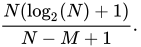
| Eq.3 |
For example, when 


Instead of Eq.1, we can also consider applying Eq.2 to a long sequence of length 

Comparatively, the number of complex multiplications required by the pseudocode algorithm is:

Hence the cost of the overlap-save method scales almost as 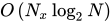

03Overlap-discard
Overlap-discard and Overlap-scrap are less commonly used labels for the same method described here. However, these labels are actually better (than overlap-save) to distinguish from overlap-add, because both methods "save", but only one discards. "Save" merely refers to the fact that M − 1 input (or output) samples from segment k are needed to process segment k + 1.
Extending overlap-save
The overlap-save algorithm can be extended to include other common operations of a system:
- additional IFFT channels can be processed more cheaply than the first by reusing the forward FFT
- sampling rates can be changed by using different sized forward and inverse FFTs
- frequency translation (mixing) can be accomplished by rearranging frequency bins
Sources and credits
This article is adapted from the Wikipedia article “Overlap-save method”, written by its contributors and licensed under CC BY-SA 4.0. Fathomly has changed the layout, removed citation markers, navigation and maintenance notices, and adjusted punctuation. This adapted version is shared under the same license. For references, see the original article.
Images, from Wikimedia Commons:
- Overlap-save algorithm.svg by Bob K, CC0
- FFT size vs filter length for Overlap-add convolution.svg by Bob K, CC0
Fathomly is not affiliated with or endorsed by the Wikimedia Foundation. Spotted a problem? Tell us.