Discrete spectrum (mathematics)
Set of isolated points in the spectrum of an operator with finite-rank Riesz projectors
In mathematics, specifically in spectral theory, a discrete spectrum of a closed linear operator is defined as the set of isolated points of its spectrum such that the rank of the corresponding Riesz projector is finite.
The discrete spectrum can also be defined as the set of normal eigenvalues.
01Definition
A point 


is an isolated point in
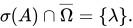
- The rank of the corresponding Riesz projector
is finite.
Here, 


02Normal eigenvalues
The set of points in the discrete spectrum is equal to the set of normal eigenvalues.

Root lineal
Let 


This set is a linear manifold but is not necessarily closed. If it is closed (for example, when it is finite-dimensional), it is called the generalized eigenspace of
Normal eigenvalue
An eigenvalue
- The algebraic multiplicity of
, where
- The space
, where
is an invariant subspace of
has a bounded inverse.
Equivalent characterizations
Equivalent characterizations (), Let
is a normal eigenvalue;
is finite;
is finite, and the range of
In all such cases, the root lineal
03Relation to other spectra
Isolated eigenvalues of finite algebraic multiplicity
In general, the rank of the Riesz projector can be larger than the dimension of the root lineal 



In particular, for a quasinilpotent operator

one has 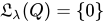


Point spectrum
The discrete spectrum 

However, they may be unequal. An eigenvalue may not be an isolated point of the spectrum, or it may be isolated, but with an infinite-rank Riesz projector. For example, for the left shift operator,


This is because 
Spectral decomposition
The spectrum of a closed operator

Sources and credits
This article is adapted from the Wikipedia article “Discrete spectrum (mathematics)”, written by its contributors and licensed under CC BY-SA 4.0. Fathomly has changed the layout, removed citation markers, navigation and maintenance notices, and adjusted punctuation. This adapted version is shared under the same license. For references, see the original article.
Fathomly is not affiliated with or endorsed by the Wikimedia Foundation. Spotted a problem? Tell us.