Nichols plot
Chart of a transfer function's phase response vs. magnitude

The Nichols plot is a plot used in signal processing and control design, named after American engineer Nathaniel B. Nichols. It plots the phase response versus the response magnitude of a transfer function for any given frequency, and as such is useful in characterizing a system's frequency response.
01Use in control design
Given a transfer function,
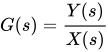
with the closed-loop transfer function defined as,
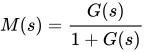
the Nichols plots displays 




In feedback control design, the plot is useful for assessing the stability and robustness of a linear system. This application of the Nichols plot is central to the quantitative feedback theory (QFT) of Horowitz and Sidi, which is a well known method for robust control system design.
In most cases,
Sources and credits
This article is adapted from the Wikipedia article “Nichols plot”, written by its contributors and licensed under CC BY-SA 4.0. Fathomly has changed the layout, removed citation markers, navigation and maintenance notices, and adjusted punctuation. This adapted version is shared under the same license. For references, see the original article.
Images, from Wikimedia Commons:
- Nichols plot.svg by Mdd, Public domain
Fathomly is not affiliated with or endorsed by the Wikimedia Foundation. Spotted a problem? Tell us.


