Closed-loop transfer function
Function describing the effects of feedback on a control system
In control theory, a closed-loop transfer function is a mathematical function describing the net result of the effects of a feedback control loop on the input signal to the plant under control.
01Overview
The closed-loop transfer function is measured at the output. The output signal can be calculated from the closed-loop transfer function and the input signal. Signals may be waveforms, images, or other types of data streams.
An example of a closed-loop block diagram, from which a transfer function may be computed, is shown below:
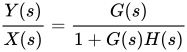
The summing node and the G(s) and H(s) blocks can all be combined into one block, which would have the following transfer function:


02Derivation
We define an intermediate signal Z (also known as error signal) shown as follows:
Using this figure we write:


Now, plug the second equation into the first to eliminate Z(s):
![Y(s)=G(s)[X(s)-H(s)Y(s)]](https://wikimedia.org/api/rest_v1/media/math/render/svg/28ca32117ca5a1061eb68777e15e264aae796d46)
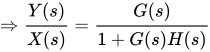
Move all the terms with Y(s) to the left hand side, and keep the term with X(s) on the right hand side:

Therefore,

Sources and credits
This article is adapted from the Wikipedia article “Closed-loop transfer function”, written by its contributors and licensed under CC BY-SA 4.0. Fathomly has changed the layout, removed citation markers, navigation and maintenance notices, and adjusted punctuation. This adapted version is shared under the same license. For references, see the original article.
Fathomly is not affiliated with or endorsed by the Wikimedia Foundation. Spotted a problem? Tell us.