Negative frequency
Indication of rate and sense of rotation

In mathematics, the concept of signed frequency (negative and positive frequency) can indicate both the rate and sense of rotation; it can be as simple as a wheel rotating clockwise or counterclockwise. The rate is expressed in units such as revolutions (a.k.a. cycles) per second (hertz) or radians/second (where 1 cycle corresponds to 2π radians).
Example: Mathematically, the vector 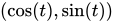

01Sinusoids
Let ω > 0 be an angular frequency with units of radians/second. Then the function f(t) = −ωt + θ has slope −ω, which is called a negative frequency. But when the function is used as the argument of a cosine operator, the result is indistinguishable from cos(ωt − θ). Similarly, sin(−ωt + θ) is indistinguishable from sin(ωt − θ + π). Thus any sinusoid can be represented in terms of a positive frequency. The sign of the underlying phase slope is ambiguous.
The ambiguity is resolved when the cosine and sine operators can be observed simultaneously, because cos(ωt + θ) leads sin(ωt + θ) by 1⁄4 cycle (i.e. π⁄2 radians) when ω > 0, and lags by 1⁄4 cycle when ω < 0. Similarly, a vector, (cos ωt, sin ωt), rotates counter-clockwise if ω > 0, and clockwise if ω < 0. Therefore, the sign of 
|
| Eq.1 |
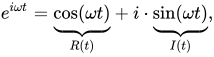
whose corollary is:
|
| Eq.2 |

In Eq.1 the second term is an addition to 


02Applications
Simplifying the Fourier transform
Perhaps the best-known application of negative frequency is the formula:
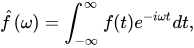
which is a measure of the energy in function 


For instance, consider the function:

And:
![{\begin{aligned}{\hat {f}}(\omega )&=\int _{-\infty }^{\infty }[A_{1}e^{i\omega _{1}t}+A_{2}e^{i\omega _{2}t}]e^{-i\omega t}dt\\&=\int _{-\infty }^{\infty }A_{1}e^{i\omega _{1}t}e^{-i\omega t}dt+\int _{-\infty }^{\infty }A_{2}e^{i\omega _{2}t}e^{-i\omega t}dt\\&=\int _{-\infty }^{\infty }A_{1}e^{i(\omega _{1}-\omega )t}dt+\int _{-\infty }^{\infty }A_{2}e^{i(\omega _{2}-\omega )t}dt\end{aligned}}](https://wikimedia.org/api/rest_v1/media/math/render/svg/0be3c33e876faf0c78dba0e8471b37af2406f1b3)
Note that although most functions do not comprise infinite duration sinusoids, that idealization is a common simplification to facilitate understanding.
Looking at the first term of this result, when 


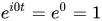

For realistic durations, the divergences and convergences are less extreme, and smaller non-zero convergences (spectral leakage) appear at many other frequencies, but the concept of negative frequency still applies. Fourier's original formulation (the sine transform and the cosine transform) requires an integral for the cosine and another for the sine. And the resultant trigonometric expressions are often less tractable than complex exponential expressions. (see Analytic signal, Euler's formula § Relationship to trigonometry, and Phasor)

Sources and credits
This article is adapted from the Wikipedia article “Negative frequency”, written by its contributors and licensed under CC BY-SA 4.0. Fathomly has changed the layout, removed citation markers, navigation and maintenance notices, and adjusted punctuation. This adapted version is shared under the same license. For references, see the original article.
Images, from Wikimedia Commons:
- Unit circle.svg by Gustavb, Public domain
- Negative frequency.svg by Mysid, Public domain
- Aliasing between a positive and a negative frequency.svg by Andrew Jarvis, Public domain
Fathomly is not affiliated with or endorsed by the Wikimedia Foundation. Spotted a problem? Tell us.
