Narrow escape problem
Singular perturbation problem dealing with confinement of Brownian particles
The narrow escape problem is a ubiquitous problem in biology, biophysics and cellular biology.
The mathematical formulation is the following: a Brownian particle (ion, molecule, or protein) is confined to a bounded domain (a compartment or a cell) by a reflecting boundary, except for a small window through which it can escape. The narrow escape problem is that of calculating the mean escape time. This time diverges as the window shrinks, thus rendering the calculation a singular perturbation problem.
When escape is even more stringent due to severe geometrical restrictions at the place of escape, the narrow escape problem becomes the dire strait problem.
The narrow escape problem was proposed in the context of biology and biophysics by D. Holcman and Z. Schuss, and later on with A.Singer and led to the narrow escape theory in applied mathematics and computational biology.
01Formulation
The motion of a particle is described by the Smoluchowski limit of the Langevin equation:



02Mean first passage time and the Fokker-Planck equation
A common question is to estimate the mean sojourn time of a particle diffusing in a bounded domain 


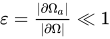
The probability density function (pdf) 


The pdf satisfies the Fokker-Planck equation:





The function




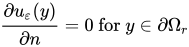
The solution depends on the dimension of the domain. For a particle diffusing on a two-dimensional disk
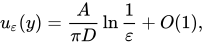


The first order term matters in dimension 2: for a circular disk of radius 

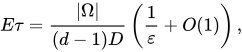
The escape time averaged with respect to a uniform initial distribution of the particle is given by

The geometry of the small opening can affect the escape time: if the absorbing window is located at a corner of angle 
![E\tau ={\frac {|\Omega |}{\alpha D}}\left[\log {\frac {1}{\varepsilon }}+O(1)\right].](https://wikimedia.org/api/rest_v1/media/math/render/svg/dc5ba8ef8136c0038e8aa166152e52cc8c5dfd1a)
More surprising, near a cusp in a two dimensional domain, the escape time 
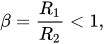
![E\tau ={\frac {(R_{2}^{2}-R_{1}^{2})}{D}}\left[\log {\frac {1}{\varepsilon }}+\log 2+2\beta ^{2}\right]+{\frac {1}{2}}{\frac {R_{2}^{2}}{1-\beta ^{2}}}\log {\frac {1}{\beta }}-{\frac {1}{4}}R_{2}^{2}+O(\varepsilon ,\beta ^{4})R_{2}^{2}.](https://wikimedia.org/api/rest_v1/media/math/render/svg/c851330c56948f30793610323116dfc22ad47bb1)
This equation contains two terms of the asymptotic expansion of 


03Analytical results
A theorem that relates the Brownian motion escape problem to a (deterministic) partial differential equation problem is the following.
Theorem, Let 


![T(x):=\mathbb {E} [\tau _{x}]](https://wikimedia.org/api/rest_v1/media/math/render/svg/077b013bba21a210ca43fde96b9fd6345c909046)
![v(x):=\mathbb {E} [(\tau _{x}-T(x))^{2}]](https://wikimedia.org/api/rest_v1/media/math/render/svg/bf17e470a83c5654d01820057640922f05dd6832)


Here 



The first part of the theorem is a classical result, while the average variance was proved in 2011 by Carey Caginalp and Xinfu Chen.
The escape time has been the subject of a number of studies using the small gate as an asymptotically small parameter. The following closed form result gives an exact solution that confirms these asymptotic formulae and extends them to gates that are not necessarily small.
Theorem (Carey Caginalp and Xinfu Chen Closed Formula), In 2-D, with points identified by complex numbers, let

Then the mean first passage time 


Another set of results concerns the probability density of the location of exit.
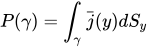
Theorem (Carey Caginalp and Xinfu Chen Probability Density), The probability density of the location of a particle at time of its exit is given by

That is, for any (Borel set) 



04Simulations of Brownian motion escape
In simulation there is a random error due to the statistical sampling process. This error can be limited by appealing to the central limit theorem and using a large number of samples. There is also a discretization error due to the finite size approximation of the step size in approximating the Brownian motion. One can then obtain empirical results as step size and gate size vary. Using the exact result quoted above for the particular case of the circle, it is possible to make a careful comparison of the exact solution with the numerical solution. This illuminates the distinction between finite steps and continuous diffusion. A distribution of exit locations was also obtained through simulations for this problem.
05Biological applications
Stochastic chemical reactions in microdomains
The forward rate of chemical reactions is the reciprocal of the narrow escape time, which generalizes the classical Smoluchowski formula for Brownian particles located in an infinite medium. A Markov description can be used to estimate the binding and unbinding to a small number of sites.
Sources and credits
This article is adapted from the Wikipedia article “Narrow escape problem”, written by its contributors and licensed under CC BY-SA 4.0. Fathomly has changed the layout, removed citation markers, navigation and maintenance notices, and adjusted punctuation. This adapted version is shared under the same license. For references, see the original article.
Fathomly is not affiliated with or endorsed by the Wikimedia Foundation. Spotted a problem? Tell us.