Discretization error
Quantization error in numerical analysis
In numerical analysis, computational physics, and simulation, discretization error is the error resulting from the fact that a function of a continuous variable is represented in the computer by a finite number of evaluations, for example, on a lattice. Discretization error can usually be reduced by using a more finely spaced lattice, with an increased computational cost.
01Examples
Discretization error is the principal source of error in methods of finite differences and the pseudo-spectral method of computational physics.
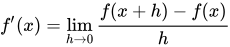
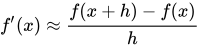
When we define the derivative of 

Sources and credits
This article is adapted from the Wikipedia article “Discretization error”, written by its contributors and licensed under CC BY-SA 4.0. Fathomly has changed the layout, removed citation markers, navigation and maintenance notices, and adjusted punctuation. This adapted version is shared under the same license. For references, see the original article.
Fathomly is not affiliated with or endorsed by the Wikimedia Foundation. Spotted a problem? Tell us.

