Moment problem
Trying to map moments to a measure that generates them

In mathematics, a moment problem arises as the result of trying to invert the mapping that takes a measure 

More generally, one may consider
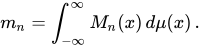
for an arbitrary sequence of functions 
01Introduction
In the classical setting, 

There are three named classical moment problems: the Hamburger moment problem in which the support of 
![[0,1]](https://wikimedia.org/api/rest_v1/media/math/render/svg/738f7d23bb2d9642bab520020873cccbef49768d)
The moment problem also extends to complex analysis as the trigonometric moment problem in which the Hankel matrices are replaced by Toeplitz matrices and the support of μ is the complex unit circle instead of the real line.
02Existence
A sequence of numbers 


should be positive semi-definite. This is because a positive-semidefinite Hankel matrix corresponds to a linear functional 


![\mathbb {R} [x]^{*}](https://wikimedia.org/api/rest_v1/media/math/render/svg/be8872fea62239a545a200e11def471f132e5c45)
![[a,b]](https://wikimedia.org/api/rest_v1/media/math/render/svg/9c4b788fc5c637e26ee98b45f89a5c08c85f7935)
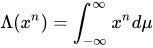
One way to prove these results is to consider the linear functional 
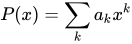
to

If 
 for any polynomial for any polynomial  that is non-negative on . that is non-negative on . | 1 |
Vice versa, if (1) holds, one can apply the M. Riesz extension theorem and extend ![C_{c}([a,b])](https://wikimedia.org/api/rest_v1/media/math/render/svg/57d7a089c9786fcfada09a724014ce3fe53a67e6)
 for any for any ![f\in C_{c}([a,b]),\;f\geq 0.](https://wikimedia.org/api/rest_v1/media/math/render/svg/da317fe617df59bcc44b4079d8f51fc61420a257) | 2 |
By the Riesz representation theorem, (2) holds iff there exists a measure
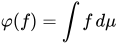
for every ![f\in C_{c}([a,b])](https://wikimedia.org/api/rest_v1/media/math/render/svg/6fd337a27693f0ea8c35a0314dbc2b36a9f9bec5)
Thus the existence of the measure
03Uniqueness (or determinacy)
The uniqueness of
04Formal solution
When the solution exists, it can be formally written using derivatives of the Dirac delta function as
.
The expression can be derived by taking the inverse Fourier transform of its characteristic function.
05Variations
An important variation is the truncated moment problem, which studies the properties of measures with fixed first k moments (for a finite k). Results on the truncated moment problem have numerous applications to extremal problems, optimisation and limit theorems in probability theory.
06Probability
The moment problem has applications to probability theory. The following is commonly used:
Theorem (Fréchet-Shohat), If 

![\forall k\geq 0\quad \lim _{n\rightarrow \infty }m_{k}\left[\mu _{n}\right]=m_{k}[\mu ],](https://wikimedia.org/api/rest_v1/media/math/render/svg/b29560a21ea5b15919f56be79e485a8d11bd47c7)

By checking Carleman's condition, we know that the standard normal distribution is a determinate measure, thus we have the following form of the central limit theorem:
Corollary, If a sequence of probability distributions 
![m_{2k}[\nu _{n}]\to {\frac {(2k)!}{2^{k}k!}};\quad m_{2k+1}[\nu _{n}]\to 0](https://wikimedia.org/api/rest_v1/media/math/render/svg/530850ee1f27198b91937812fe97e19b9db2fd4d)

Sources and credits
This article is adapted from the Wikipedia article “Moment problem”, written by its contributors and licensed under CC BY-SA 4.0. Fathomly has changed the layout, removed citation markers, navigation and maintenance notices, and adjusted punctuation. This adapted version is shared under the same license. For references, see the original article.
Images, from Wikimedia Commons:
- Standard deviation diagram.svg by M. W. Toews, CC BY 2.5
Fathomly is not affiliated with or endorsed by the Wikimedia Foundation. Spotted a problem? Tell us.